India has quartz deposits, but turning them into semiconductor- and solar-grade material needs careful testing, beneficiation and quality control, says Mohammed Saif Zaveri.
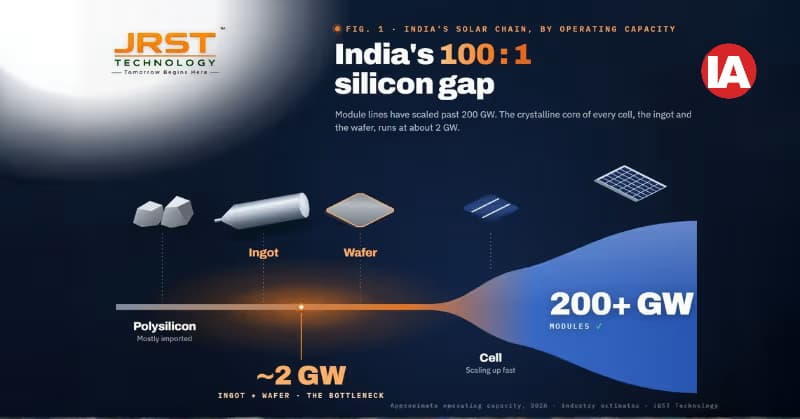
India has built one of the fastest-growing solar manufacturing bases in the world. Module capacity has grown to more than 200 GW in only a few years, and cell capacity is rising quickly behind it. But one stage of the chain has barely moved. India's operating capacity for silicon ingots and wafers, the crystalline heart of every solar cell, is only about 2 GW.
That gap of roughly a hundred to one used to be a question of cost. It is now a question of supply security.
Why the wafer matters
A solar module is mostly glass, aluminium, polymer and wiring. The value, and the hardest engineering, sits upstream. High-purity polysilicon is melted and grown into single-crystal ingots in Czochralski (CZ) pullers, at temperatures above 1,400 °C, under tightly controlled atmosphere and rotation. The ingots are then squared, cropped and sliced with diamond wire into wafers thinner than 150 microns. Every cell plant in India depends on that wafer.
Today nearly all of those wafers are imported. When an Indian cell line runs, its most critical input comes from a supply chain that India does not control.
Three developments that change the calculation
1. Draft export controls on ingot and wafer technology. On 16 October, draft rules were published abroad that would restrict the export of advanced ingot and wafer manufacturing technology and equipment. If they are adopted, buying a complete, ready-made production line becomes harder, and know-how, process recipes and spares become strategic assets.
2. ALMM List-III. India's Approved List of Models and Manufacturers is expanding upstream. List-III, covering ingots and wafers, takes effect from 1 June 2028. Projects that need domestic-content compliance will need domestic wafers, and manufacturers will need matching ingot capacity to qualify.
3. Domestic content in cells. Domestic-content cells need wafers that have not already been processed abroad. That ties the cell boom directly to the wafer stage.
Together, these turn wafer manufacturing from an optional upgrade into a deadline.

the loop on pull speed and heater power.
What it actually takes to build an ingot-wafer plant
Announcements are easy. Running plants are hard. From our work inside large ingot and wafer facilities, and in commissioning a CZ ingot pilot line in Maharashtra, I see five things that decide whether a project succeeds.
Process know-how, not just machines. A CZ puller is only as good as the recipe running it: seeding, necking, shoulder growth, body growth, tail-off, and control of oxygen, resistivity and dislocations. These are learned on the shop floor. A plant that buys equipment without this depth spends its first two years learning expensively.
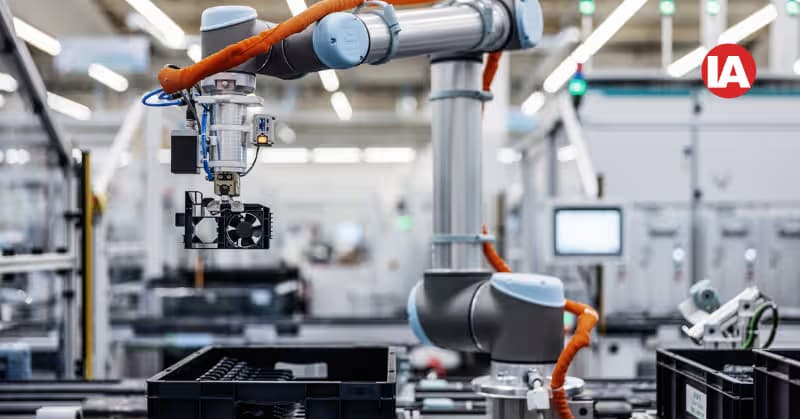
Automation and control. Modern ingot growth is closed-loop: diameter control from camera systems, heater-power and pull-speed loops, argon flow and pressure control, and real-time data logging for every ingot. Wafering adds automated squaring, grinding, wire-saw tension control and inline inspection. For a readership in industrial automation, this is where Indian engineering talent can contribute most: controls, sensors, MES integration and predictive maintenance.
Consumables and hot-zone parts. Quartz crucibles, graphite and carbon-composite hot-zone parts, diamond wire and slurry-free cutting fluids are recurring costs that decide plant economics. Many are still imported. Localising them is a manufacturing opportunity in itself, and it starts with high-purity quartz, the raw material for crucibles.
Power and utilities. Ingot growth is energy-intensive, and utilities such as argon recovery, chilled water and clean-room systems must be designed in from day one. Site selection and power tariffs can decide whether a plant competes.
People. India has excellent engineers but few with years inside ingot and wafer plants. Training operators, process engineers and maintenance teams has to start before the equipment arrives, not after.
A realistic, phased path
The fastest route is not always a giant integrated plant from day one. A phased approach reduces risk:
Phase 1: blueprint. Capacity, product mix (n-type or p-type, M10 or G12), site, utilities, equipment, CAPEX and OPEX, and the compliance roadmap.
Phase 2: wafering first. A cutting line can start by slicing ingots while ingot capacity is built, so teams, customers and quality systems are in place early.
Phase 3: ingot growth. Adding CZ pullers in modules, scaling as yields stabilise.
Phase 4: localising consumables and spares. Crucibles, hot-zone parts and maintenance capability, to cut both cost and dependence.
Each phase creates value on its own and lowers the risk of the next.
Why upstream starts with quartz
Every crystalline silicon wafer begins as quartz. High-purity quartz becomes the crucibles that hold molten silicon, and quartz feedstock is the start of the polysilicon chain. India has quartz deposits, but turning them into semiconductor- and solar-grade material needs careful testing, beneficiation and quality control. A serious upstream strategy has to think from quartz to wafer, not just from wafer to module.
The opportunity
The numbers are stark: more than 200 GW of modules, about 2 GW of ingots and wafers, and a compliance deadline in 2028. That gap is also India's biggest manufacturing opportunity in solar. Closing even part of it would create high-skill jobs in process engineering, automation, metrology and maintenance, and would make India's solar build-out far more resilient.
The technology is demanding, but it is not out of reach. Indian teams have already grown silicon ingots on Indian soil. The next step is to do it at scale, with the process discipline, automation and supply chains that make it bankable.
The module boom showed what Indian manufacturing can do in five years. The wafer is the next test, and the clock is running.
About the author
Mohammed Saif Zaveri is Co-Founder & Director of JRST Technology, an Indian deep-tech silicon company working across the chain from quartz to ingot, wafer and cell. JRST provides plant blueprints, turnkey ingot and wafer projects, equipment sourcing, and spares and consumables. Its group company, Silicon Ingot Technology (SIT), has commissioned Maharashtra's first silicon-ingot pilot line. www.jrsttechnology.com
Author