Low-code provides a pathway to move progressively from paper and spreadsheets toward connected operations, says Vijay Mathew.
For many small and mid-sized manufacturers, the challenge with Industry 4.0 has never been a lack of potential use cases. The difficulty has been turning those ideas into working applications quickly and economically.
A production manager may want a simple application to monitor downtime. A quality engineer may need digital inspection forms linked to traceability data. A maintenance team may want mobile alerts when equipment parameters move outside acceptable limits. Traditionally, each requirement could involve software developers, system integrators, lengthy specifications and integration work. For a large manufacturer, that may be manageable. For an SME, it can make relatively straightforward digitalisation projects difficult to justify.
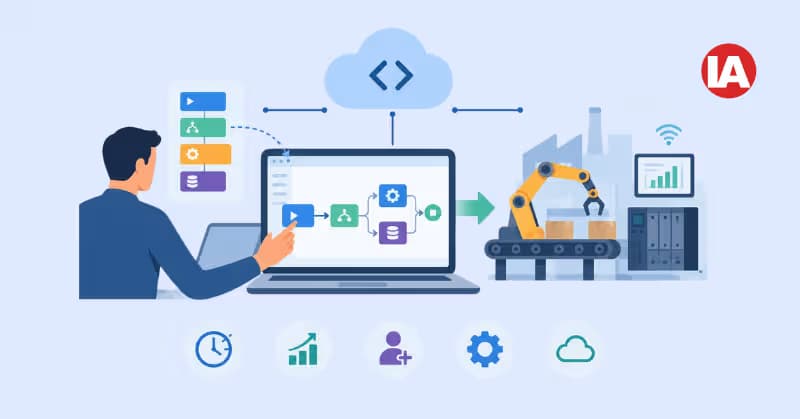
Low-code and no-code platforms are beginning to change this equation. Visual development environments, reusable components, pre-built connectors and increasingly AI-assisted development allow engineers and process specialists to create applications with substantially less conventional programming. The result is not the elimination of IT. It is a redistribution of who can participate in industrial digitalisation.
This shift has important implications for Industry 4.0. Rather than digital transformation being defined primarily by large MES, ERP or automation projects, manufacturers can increasingly solve individual operational problems quickly and expand what works. For SMEs, startups and mid-sized factories in particular, low-code could become one of the most practical routes into industrial digitalisation.
The market is expanding beyond enterprise application development
Low-code is already a substantial software market. Frost & Sullivan analysis places the broader global market for low-code and no-code development and automation platforms at approximately USD 35 billion to USD 40 billion in 2025, with the potential to reach approximately USD 70 billion to USD 85 billion by 2030.
Manufacturing represents a smaller but increasingly important part of this opportunity. Frost & Sullivan analysis estimates that manufacturing-focused low-code platforms, frontline operations applications and associated services represented approximately USD 4 billion to USD 6 billion in 2025. This could increase to approximately USD 9 billion to USD 13 billion by 2030 as manufacturers digitise production, quality, maintenance, warehousing and other operational workflows.

Low-code fills the gap between spreadsheets and enterprise systems
Industrial low-code should not be understood simply as an easier way of writing software. Its real value lies in addressing what could be described as the long tail of factory digitalisation.
Most manufacturers already have core systems. ERP manages transactions and planning. PLCs and control systems run equipment. Larger facilities may have MES, historians, warehouse systems and maintenance platforms. Yet dozens of processes between these systems are often still managed through spreadsheets, emails, paper forms, messaging applications or manually consolidated reports.
This is where low-code platforms can create value.
A factory can build a digital quality inspection application without developing an entire QMS. Maintenance teams can create a machine-checking workflow that automatically raises an escalation when an abnormal condition is recorded. Production supervisors can capture downtime reasons on tablets and immediately display them in an operational dashboard. Manufacturers can create material-request, work-instruction, deviation-management or approval applications around their existing ERP and MES rather than attempting to replace them.
The platform therefore becomes an adaptable application layer sitting between people, machines and existing enterprise systems.
Low-code is not a replacement for the deterministic control logic required to operate a machine safely. PLC, DCS and safety-control engineering will continue to require specialist expertise. The opportunity lies in making the information and workflows around those systems considerably easier to create, modify and scale.
AI is moving low-code from drag-and-drop to intent-driven development

The next phase of low-code is being shaped by generative and agentic AI. Visual development already reduces the amount of code users need to write. AI can reduce the amount of application building they need to perform manually.
Siemens-owned Mendix provides one indication of this direction. Mendix 11 has progressively expanded its AI-assisted development capabilities, including Agents Kit for building agentic applications. Mendix has further expanded Maia, its AI development assistant, alongside additional workflow automation functionality. The direction is increasingly toward users describing what they need and AI helping generate the application structure, logic and workflow rather than requiring every element to be configured manually.
Tulip is pushing the concept directly onto the factory floor. Its AI Composer, introduced in 2025, allows manufacturers to take documents such as standard operating procedures and work instructions and convert them into configurable no-code applications. In October 2026, Tulip expanded this approach with AI Authoring. Its Authoring Agent can use existing operational context, documents and applications to propose and draft manufacturing applications while keeping the engineer responsible for approval and deployment.
SMEs can digitise without waiting for a large transformation program
The economics are particularly compelling for smaller manufacturers. A large enterprise can justify a multi-year MES program involving internal IT teams, automation engineers and major system integrators. A 100-person component manufacturer may have the same need for production visibility, quality control or inventory tracking, but not the same budget or internal resources.
Low-code allows the starting point to be much smaller. An SME could initially digitise incoming inspection. It could subsequently add production tracking, tool-management and maintenance applications. If the platform has suitable integration capabilities, these applications can eventually connect with ERP, machine data and other systems.
Examples are already visible in India. Drip-irrigation manufacturer KSNM Drip built applications on Zoho Creator covering production, inventory and internal operations, including an application supporting its continuous extrusion operations. Bangalore-based manufacturing startup MachineMaze similarly built its manufacturing-management platform around multiple Zoho Creator applications, linking customers, vendors and internal project-management processes.
Other Indian manufacturers illustrate how the approach can extend deeper into operations. Hyderabad-based oil and gas equipment manufacturer Technostrength has used Zoho Creator across inventory and production workflows, while Carrier Wheels has used the platform to digitise departmental manufacturing processes alongside its core SAP environment rather than attempting to replace the enterprise system.
For mid-sized manufacturers, low-code does not necessarily compete with ERP or MES. It can make those systems more useful by digitising the processes that are too specific, too small or too frequently changing to justify conventional custom development.
The industrial automation vendors are moving in the same direction
The trend is also beginning to influence established industrial automation platforms.
Rockwell Automation's FactoryTalk Optix, for example, combines HMI, IIoT, edge and data-management capabilities with drag-and-drop development and extensibility. Rockwell has also added support for containerised and low-code applications through its Embedded Edge Compute Module, enabling applications to be deployed closer to industrial equipment.
Schneider Electric continues to develop EcoStruxure Automation Expert around software-defined automation. While software-defined automation is not identical to low-code development, it reflects the same broader industry direction: moving industrial engineering away from tightly coupled, hardware-specific applications toward reusable, software-centric architectures.
The boundaries between traditional industrial automation, low-code development and operational software are therefore becoming less distinct. This is likely to create new competition between enterprise software companies, industrial automation suppliers and manufacturing-focused platforms such as Tulip.
What makes low-code deliver RoI
The strongest deployments start with a specific operational problem rather than an ambition to create a large citizen-development program.
Factories should identify processes where manual data entry, spreadsheets, paper or disconnected systems are creating measurable inefficiency. Quality inspection, downtime reporting, maintenance checks, material tracking, operator instructions and approval workflows are often practical starting points because the existing pain is clear and results can be measured quickly.
Integration should be considered early. A standalone digital form may remove paper, but its value increases significantly when it can automatically access production orders from ERP, equipment information from industrial systems and quality data from existing databases.
Manufacturers also need to distinguish between applications that can safely be developed by trained business users and those requiring professional engineering. The objective should not be to eliminate developers or automation specialists. It should be to ensure scarce technical expertise is not consumed building every dashboard, approval workflow or production form that a knowledgeable operational team could create themselves.
For SMEs, this combination of incremental deployment, reusable components and reduced reliance on bespoke development can fundamentally change the economics of Industry 4.0.
Conclusion
Over the next several years, routine application development will increasingly become AI-assisted. Pre-built manufacturing templates will reduce the need to start projects from scratch. Edge connectivity will allow low-code applications to interact more easily with machines and industrial data. AI agents will begin to automate portions of application development, analysis and workflow execution.
This could create an important new layer in the industrial technology market. Between the large enterprise platforms at one end and machine-level automation at the other will sit thousands of smaller applications built around the specific way an individual factory operates.
For India, the opportunity is particularly significant. The country's manufacturing base contains a large number of companies that need greater digitalisation but cannot justify enterprise-scale transformation programs. Low-code provides a pathway to move progressively from paper and spreadsheets toward connected operations without requiring factories to rebuild their technology architecture in one step.
That is where the real promise of low-code lies. Industry 4.0 becomes less dependent on how many software developers a manufacturer can hire, and more dependent on how effectively it can turn the knowledge already sitting inside its factory into working digital solutions.
Vijay Mathew is Director, Industrial Growth Advisory, at Frost & Sullivan. With over 18 years of experience, Vijay is a seasoned advisor known for providing strategic, unbiased, and objective advisory services across a variety of industries. His areas of expertise include automation, process control, industrial sensors and instrumentation, and electronic test and measurement. Always on the forefront of technological evolution, Vijay is committed to tracking and understanding the latest trends in Industry 4.0, data analytics, predictive maintenance, smart factories, and blockchain technologies.
Author