Edge Computing & Real-Time Industrial Analytics
Edge computing enables real-time analytics, helping industries improve uptime, efficiency, and decision-making.
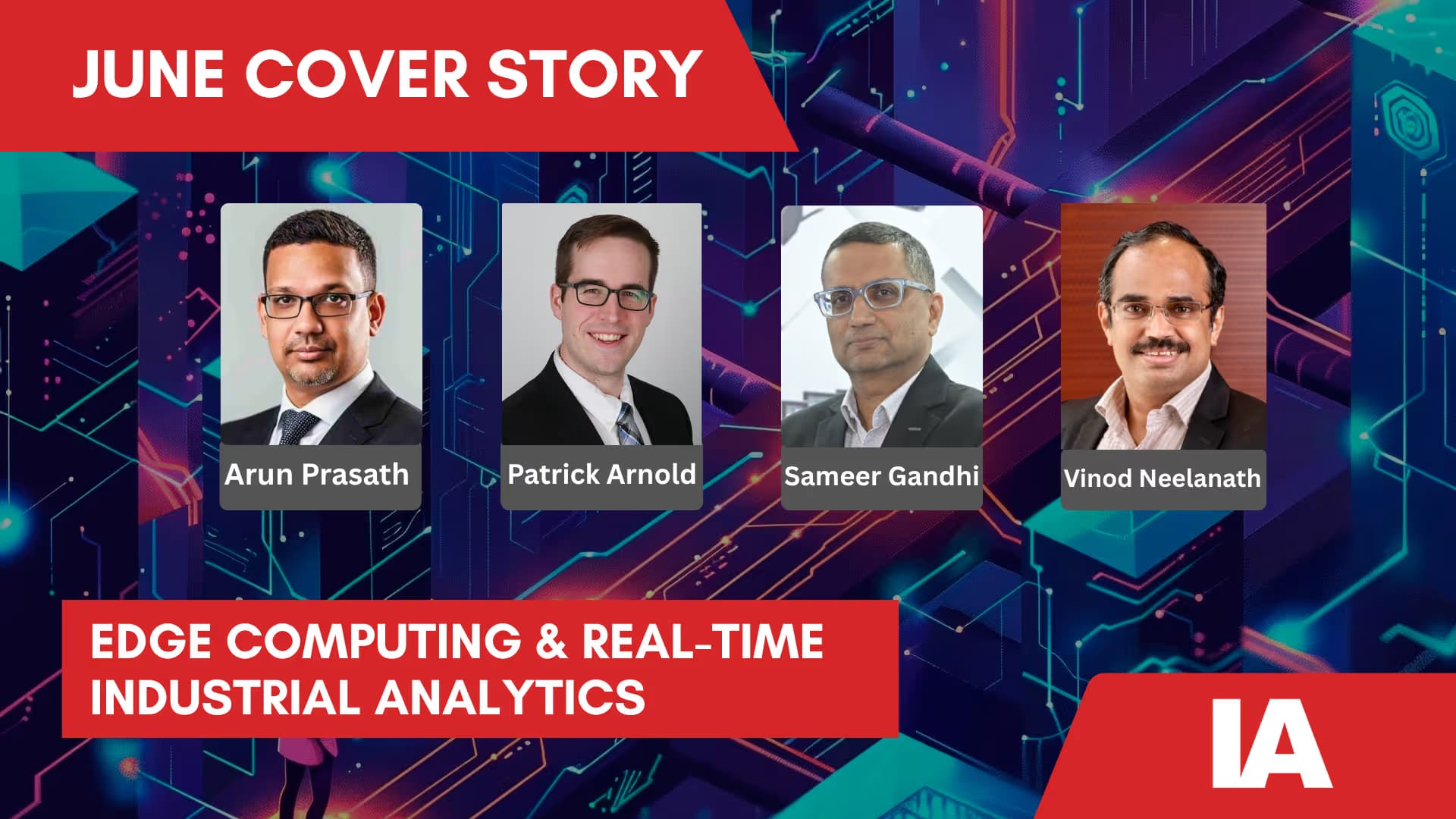
Enabling real-time analytics for instant anomaly detection, predictive maintenance, and autonomous operations.
Edge computing enables real-time industrial analytics by processing data closer to its source, minimising latency and allowing for immediate insights and actions. This is crucial for applications like predictive maintenance, anomaly detection, and optimising industrial processes. Edge devices (like sensors, controllers, and edge gateways) collect and process data at or near the point of generation, rather than sending it all to a central cloud. Processing data locally eliminates the need for long-distance data transmission, significantly reducing latency. This allows for immediate analysis of data, enabling faster decision-making and quicker responses to changing conditions. So how exactly is edge computing reshaping real-time decision-making on the shop floor in discrete manufacturing versus continuous monitoring and control in process industries?

“Edge computing is boosting real-time decisions in both discrete and process industries, but in slightly different ways. On the discrete manufacturing shop floor, edge devices enable ultra-fast, event-driven responses. Production operations like automotive assembly and packaging rely on quick edge processing to coordinate robots and machines, do quality checks, and quickly adjust workflows without needing to wait on a remote server. In these industries, speed, throughput, and uptime are the name of the game,” says Patrick Arnold, Research Analyst, ARC Advisory Group, USA. “In continuous process industries, edge computing takes on a more supervisory and optimisation role. Local edge analytics continuously monitor process variables for anomalies or optimise conditions alongside existing DCS/SCADA control systems. Continuous control loops prioritise stable operations and safety, so edge analytics typically feed insights or fine-tune setpoints without disrupting control processes,” he explains.

Sameer Gandhi, Managing Director, OMRON Automation India, shares the view that the impact of edge computing differs across manufacturing sectors, but its core value remains the same, enabling faster and smarter decisions closer to operations. “In discrete manufacturing industries such as automotive, electronics, semiconductors, and packaging, production environments are highly dynamic and require precise coordination between robotics, motion systems, machine vision, sensors, and operators. In such environments, even a fraction of a second can influence cycle time, throughput, and product quality,” he says. “In process industries such as pharmaceuticals, chemicals, food & beverage, water treatment, and energy, operational priorities focus more on continuous monitoring, process stability, and asset reliability. Here, edge computing allows real-time monitoring and control of parameters such as pressure, flow, temperature, vibration, and energy consumption. By processing this data locally, operators can respond immediately to process fluctuations, reducing operational risks and ensuring process continuity,” he adds. In both cases, edge computing improves operational responsiveness while reducing dependency on network latency and cloud availability.
While edge computing addresses many contemporary issues by bringing computing power closer to the source of data generation, which specific applications – such as predictive maintenance, anomaly detection, or closed-loop control – derive the greatest value from low-latency edge analytics, and how do these differ across industry segments?

“It’s not a one-size-fits-all. Manufacturing companies and process industries use edge computing differently because what matters to them isn’t always the same. Factories use Edge for speed and agility while process plants use it for stability and reliability,” says Vinod Neelanath, General Manager, Chief Product & Technology Officer – Intelligent Automation, UST, and lists some industrial applications that stand out with low-latency edge analytics:
Predictive maintenance: Edge systems analyse vibration, temperature, and other signals in real time to predict failures before they happen. That means fewer breakdowns and better equipment usage.
Anomaly detection: Edge AI spots odd patterns quickly, like a slight tweak in vibration or power use that hints a machine is going south – catching these early can stop major disasters.
Closed-loop control: Robotics and precision systems can’t afford delays. Edge computing lets them analyse and react instantly, keeping production sharp and reliable
AI-powered quality inspection: Cameras and AI models catch defects instantly, cut waste, boost yields, and reduce the need for hands-on checks, all without slowing the line.

Arun Prasath, Principal Consultant, Industrial Growth Advisory, Frost & Sullivan, believes that applications such as predictive maintenance, Anomaly detection, energy optimisation, and autonomous operations are accelerating the shift from centralised computing toward localised operational intelligence. “Edge computing processes industrial data closer to where it is generated through sensors, controllers, machines, and gateways rather than sending all data to centralised cloud systems. This localised processing reduces latency, improves responsiveness, lowers bandwidth usage, and enables faster operational decisions. The market is being driven by the increasing adoption of Industrial IoT (IIoT), AI-enabled analytics, autonomous systems, and connected industrial infrastructure,” he says, and cites the example of the oil & gas industry, where companies such as Oil and Natural Gas Corporation, Reliance Industries, and Indian Oil Corporation are increasingly investing in digital oilfield initiatives, smart refineries, and AI-driven industrial monitoring systems. “Edge computing allows oil & gas operators to process sensor data locally for applications such as predictive maintenance, leak detection, drilling optimisation, and pipeline monitoring. Real-time anomaly detection helps prevent equipment failures and operational disruptions before they escalate. Remote operations centres powered by edge analytics are further improving operational visibility and efficiency,” emphasises Arun.
As usual, with any digital era technologies, there are issues in implementation with legacy equipment. What exactly are the practical challenges of integrating edge devices with existing PLCs, SCADA, and DCS infrastructures, particularly in brownfield industrial environments?
According to Patrick Arnold, integrating new edge devices with legacy PLC/SCADA/DCS systems poses significant challenges in brownfield plants, especially concerning interoperability with legacy processes and data integration. Many existing facilities run on proprietary protocols and older networks which cannot always be easily replaced. “This makes data access and communication a hurdle, requiring protocol converters or OPC UA servers to bridge legacy PLCs and SCADA with new edge gateways. Ensuring consistent data models and context is also difficult. Older systems often use proprietary tags and formats, complicating their integration into a unified data fabric,” he says and notes how ARC emphasizes the importance of open standards in tackling these issues. Adopting common protocols and information models allows edge platforms to securely gather and model data from multiple legacy devices in a uniform way. Don’t create more data silos in an attempt to fix the old ones. “Equally crucial is managing edge devices over their lifetimes with secure device identity, certificate updates, and software patching in alignment with industrial cybersecurity practices like IEC 62443. Successful integration often requires gradual, modular modernisation: proving the concept on a few assets, then scaling to more equipment once the new process is validated,” he elaborates.
“A large percentage of manufacturing facilities globally continue to operate using legacy automation infrastructure consisting of PLCs, SCADA systems and proprietary industrial protocols developed over several decades. Integrating modern edge technologies into such brownfield environments requires careful planning to ensure compatibility, interoperability, and operational continuity,” says Sameer Gandhi. To him, one of the biggest challenges is achieving seamless communication between legacy systems and modern edge platforms. Different communication standards, fragmented data architectures, and limited connectivity capabilities can create integration complexities. “At OMRON, we strongly believe that digital transformation should not require complete replacement of existing infrastructure. Instead, manufacturers need scalable and phased modernisation strategies that preserve prior investments while enabling future readiness. Open industrial communication protocols, interoperable architectures, and modular automation platforms are therefore essential for successful edge adoption,” he adds.
For organisations, the choice between edge and cloud computing depends on their specific application needs. In general, edge computing is used where the need is for real-time, sub-10-millisecond response times, offline reliability, and strict privacy. Cloud computing, on the other hand, is for massive scalability, heavy batch processing, global accessibility, and lower upfront hardware costs. So how should organisations balance workloads between edge and cloud to optimise performance, scalability, and cost, while ensuring data consistency and governance?
Vinod Neelanath is of the view that edge computing won’t replace the cloud. “Enterprises will need both. Edge’s great for workloads where speed matters, like, AI inference, anomaly spotting, machine control, and local analytics. The cloud’s still key for long-term storage, big-picture analytics, AI model training, digital twins, and optimising across sites,” he says, and adds that usually, it works like what’s stated below:
- Real-time decisions at the edge
- Historical analysis and reports in the cloud
- AI models trained centrally, and
- AI inference at the edge.
This hybrid model gives both scalability and resilience.
“One big plus is, when your cloud link drops, local systems keep running. No outages, just business as usual. We have used this hub and spoke model for the Cruise liners operations effectively when they are at sea. Still, running a distributed setup means more governance headaches. Companies need clear rules for data, lifecycle management, observability, and compliance, especially when scaling across sites,” says Vinod.
“Industrial enterprises are rapidly shifting toward real-time, data-driven operations where speed, responsiveness, and operational intelligence are becoming critical competitive differentiators. While cloud computing remains important for centralised analytics and storage, it often struggles to meet the low latency demands of modern industrial environments. As industries increasingly rely on instant insights for safety, productivity, and operational continuity, edge computing is emerging as a key enabler of real-time industrial intelligence,” says Arun Prasath. According to him, industrial analytics has evolved from isolated automation systems to highly connected digital operations. Early industrial environments relied on centralised control architectures with limited real-time visibility, while the rise of cloud computing later enabled large-scale data aggregation and remote analytics. However, the rapid growth of IIoT deployments significantly increased the volume and speed of industrial data generation, making continuous transmission to centralised cloud systems increasingly costly and inefficient. “Edge computing emerged to solve these challenges by bringing analytics and AI closer to industrial assets. Combined with AI and IIoT, edge computing is enabling decentralised analytics, allowing operational decisions to be made autonomously at the machine or asset level. This transition is helping industries move from reactive operations to predictive and adaptive industrial ecosystems that respond dynamically to operational conditions,” he elaborates.
With all the advantages edge computing brings with decentralised processing power by moving it closer to the data source, it also expands the digital and physical attack surface. Its primary cybersecurity risks include vulnerable, physically accessible edge nodes, distributed data privacy threats, and complex compliance challenges across multiple regulatory jurisdictions. So how are companies addressing cybersecurity risks and ensuring resilience of mission-critical operations?
“Distributed edge intelligence brings great benefits, but also demands robust cybersecurity and resilience measures. With more connected edge devices in mission-critical roles and a greater number and variety of software providers being involved in assembling the more complex solutions, the attack surface expands,” says Patrick Arnold. Leading organisations are adopting ‘zero trust’ security frameworks at the industrial edge by treating every device, user, and network segment as potentially untrusted until verified. This means strong device identity management, mutual authentication for communications, and strict access controls so devices only interact as authorised. Network segmentation is another strategy. Isolate edge systems and use firewalls or software-defined networks to contain breaches. Companies also emphasize fail-safe design and redundancy. Edge controllers are often configured to maintain local control in case of cloud or network outages. This involves measures like local data buffering, stateful failover, or fallback to a safe mode if an edge node goes down. “Modern industrial network infrastructure is converging IT/OT management and security, enabling unified policies across edge nodes. The end goal is cyber-resilient, mission-critical operations where each edge node is hardened against attacks, continuously monitored for anomalies, and capable of autonomous, secure operation even under unfavourable conditions,” asserts Patrick.
Sameer Gandhi draws attention to the fact that as industrial systems become increasingly connected and decentralised, cybersecurity has become a critical business priority. Distributed intelligence at the edge expands the attack surface across manufacturing networks, making industrial cybersecurity more complex than ever before. “Manufacturers must therefore adopt comprehensive cybersecurity strategies that include secure network architectures, authentication protocols, access control mechanisms, encryption, continuous monitoring, and incident response capabilities. At the same time, resilience is becoming equally important. Manufacturing operations today cannot afford disruptions caused by cyber incidents, network failures, or infrastructure downtime,” says Sameer. With increasing connectivity at the edge, certified cybersecurity in PLCs is essential to protect critical manufacturing operations. OMRON PLCs incorporate robust, standards-aligned security features to enable safe and resilient industrial automation.
Having seen the merits of edge computing and its applications, what measurable business outcomes – such as reduced downtime, improved yield, or energy efficiency – have been realised through edge deployment, and what factors determine successful scaling across multiple sites?
“Industrial players using edge computing are already reaping benefits, less downtime, improved utilisation, better yields, faster anomaly detection, less waste, lower energy use, improved safety, quicker response times and overall reduction in operational costs. Predictive maintenance cuts downtime and improves planning and equipment lifespan. AI-driven quality inspections found more defects, did it faster, and reduced manual labour. Energy-hungry industries use edge analytics to optimise power, slashing costs and their footprint,” says Vinod Neelanath. But rolling out Edge across facilities takes more than one-off pilots. You need standardised deployment, solid governance, repeatable frameworks, and tight integration between IT and OT teams.
Arun Prasath notes that edge computing is becoming a foundational technology for next-generation industrial operations. As industries demand faster insights, operational resilience, and autonomous decision-making, edge-enabled intelligence will continue to gain importance. The convergence of AI, IIoT, private 5G, and edge analytics is transforming industrial environments into intelligent, adaptive ecosystems that respond to operational changes in real time. Industries such as oil & gas, smart manufacturing, and mining are already demonstrating how edge-enabled analytics can improve productivity, safety, sustainability, and agility. “Organisations investing in industrial edge computing today are building the foundation for more autonomous, connected, and intelligent industrial enterprises of the future,” he concludes.
Note: The responses of various experts featured in this story are their personal views and not necessarily of the companies or organisations they represent. The full interviews are hosted online at https://www.iedcommunications.com/interviews)