Robotics Redefined: Cobots & Human-Machine Collaboration
Cobots are redefining human-robot collaboration in smart factories, blending AI, safety sensing and precision automation for flexible production.
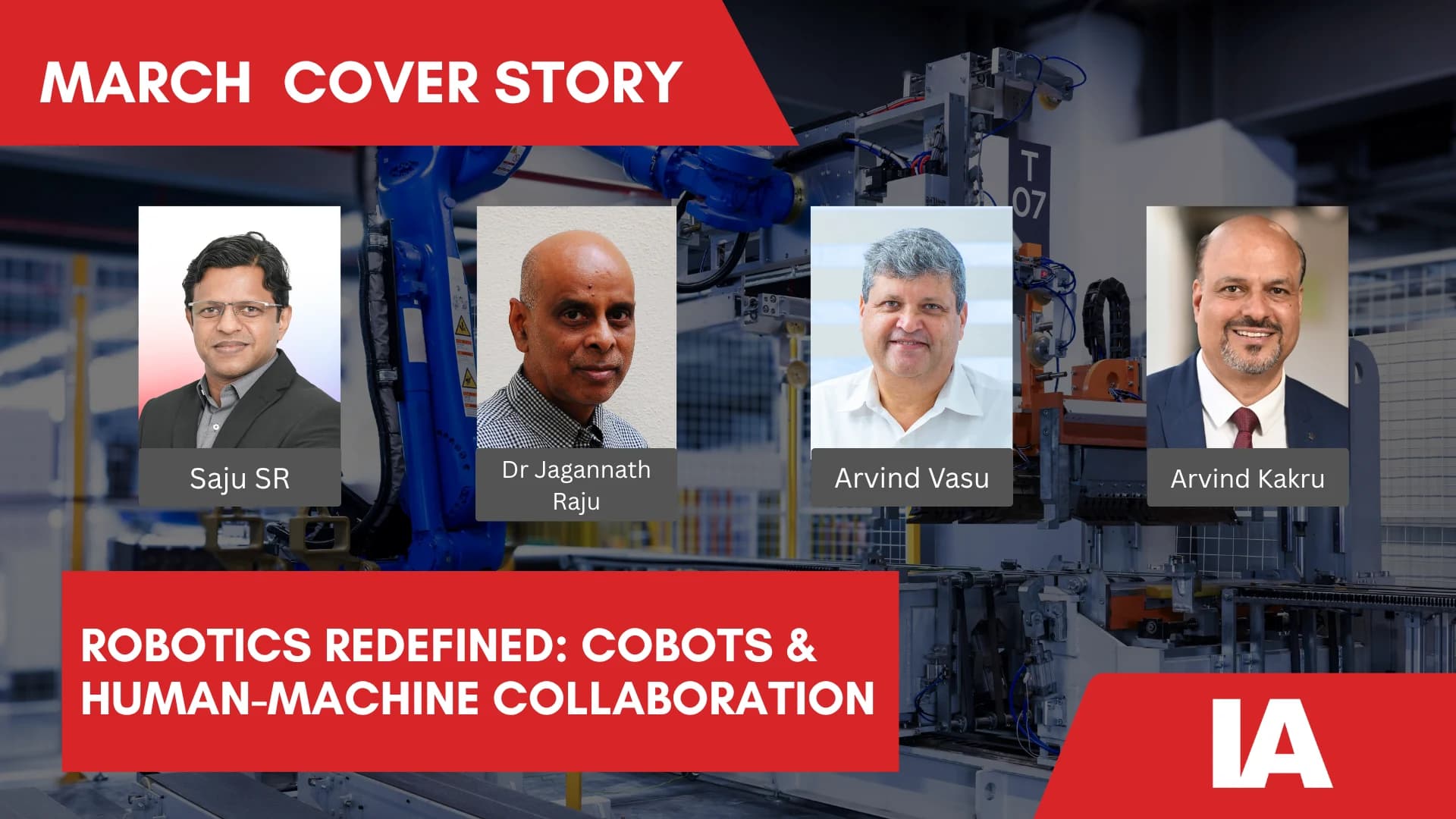
The shift towards human-robot synergy is transforming various industries, from manufacturing and assembly to healthcare and logistics.
Cobots, or collaborative robots, are revolutionising human-machine collaboration by enabling safe and efficient interaction in shared workspaces. They are designed to augment human capabilities, not replace them, by handling repetitive or physically demanding tasks, while humans focus on more complex and creative work. This shift towards human-robot synergy is transforming various industries, from manufacturing and assembly to healthcare and logistics. Cobots are equipped with advanced safety features like force and torque sensors, and AI-driven motion control, allowing them to work safely alongside humans without the need for physical barriers. So how are cobots redefining human-machine collaboration on the shop floor, and what tasks are best suited for true ‘co-working’ between people and robots?

“Cobots are redefining human-machine collaboration by moving automation out of isolated, fenced environments and into shared workspaces where humans and robots operate side by side. Unlike traditional industrial robots designed for rigid, pre-programmed tasks, cobots are built to adapt to human presence and variability on the shop floor. This enables a more natural form of collaboration, where machines handle tasks that demand consistency, endurance, and precision, while humans contribute judgment, dexterity, and contextual decision-making, says Saju SR, Senior Vice President, Smart Power Division, ABB India. “The most effective co-working applications are those that are repetitive or physically demanding but still require human oversight,” he adds.
Arvind Kakru, Vice President, Industrial Automation – Greater India, Schneider Electric, believes cobots are a key enabler of human centric automation and are designed to collaborate safely and efficiently with operators on the shopfloor. “Traditional industrial robots typically work inside dedicated cells, but cobots such as our LexiumCobot range operate in shared spaces with advanced torque and speed monitoring that ensures safe interaction. They take on repetitive, ergonomically demanding, and precision-intensive tasks so that operators can focus on activities that require problem solving, quality judgment, and continuous improvement. Light assembly, component handling, pick and place, inspection support, machine tending, packaging, and material transfer are among the applications best suited for true co-working,” he explains.

One major advantage of cobots is their enhanced safety and ability to work alongside human operators without requiring protective fencing; and because they don't need safety cages, they can be easily moved between different workstations. What design and sensing innovations make cobots inherently safer, and how do these change the way factories think about workplace safety?
“The shift from ‘Safety through Exclusion’ to ‘Safety through Intelligence’ is driven by a sophisticated stack of sensing technologies. At the heart of a cobot are integrated force and torque sensors at every joint. These act as a digital ‘nervous system’, allowing the robot to detect a resistance as light as a human touch and halt motion in milliseconds,” says Arvind Vasu, Managing Director, Scandinavian Robot Systems India Pvt Ltd. Furthermore, innovations in Power and Force Limiting (PFL) and Speed and Separation Monitoring (SSM) have changed the geometry of the factory. “Using 3D LiDAR and vision systems, a cobot can dynamically adjust its speed based on a human’s proximity, slowing down as someone approaches and resuming full speed once the path is clear. This eliminates the need for physical barriers, reclaiming valuable floor space, and allowing for a more ergonomic, open-plan factory layout where humans and robots flow together safely,” he elaborates.

According to Dr Jagannath Raju, Founder and Chief Technical Officer, Systemantics India Pvt Ltd, Power and Force Limiting Technology in cobots makes it inherently safe – the core innovation lies in joint-level motion resistance sensing, which aligns with ISO/TS 15066 standards. These still provide passive safety – ensuring the cobot stops within milliseconds when it comes in contact with a subject in the environment. “With advancement in sensor technology and Lidar becoming more affordable, cobots can move to active avoidance and speed and separation monitoring, allowing factories to replace rigid fencing with virtual safety zones, making machines contextually aware of their human coworker and in turn lowering the Total Cost of Ownership,” he states.
Adding another perspective, Saju SR, emphasises that beyond mechanical safety, AI-driven sensing is reshaping how factories manage workplace safety. “Vision systems, proximity sensors, and edge AI enable machines to interpret their surroundings and enforce safety protocols in real time. For instance, AI-powered cameras can verify whether workers are wearing appropriate personal protective equipment before allowing access to restricted areas. While such systems require extensive training and fine-tuning – early challenges can include misidentifying safety gear – the learning curve highlights how safety is becoming adaptive rather than rule-based,” he explains.
Robots performing repetitive tasks are essential for driving industrial productivity, ensuring high-quality, consistent output, and improving workplace safety by removing humans from dull, dirty, or dangerous jobs. By automating, companies achieve faster production speeds, reduced errors, lower costs, and better resource allocation, allowing human workers to focus on creative or strategic tasks. Which repetitive yet skill-intensive operations are seeing the fastest adoption of cobots, and why are they better handled through human–robot collaboration than full automation?

“In the Indian market, we see rapid adoption in precision welding, technical assembly, and high-mix palletizing. While full automation is excellent for million-unit runs of a single part, it is often too rigid and expensive for the ‘High-Mix, Low-Volume’ (HMLV) production cycles common in Tier-2 automotive and electronics sectors,” says Arvind Vasu. According to him, collaborative systems are superior here because they leverage human process knowledge. A skilled welder can ‘teach’ a cobot a complex path simply by moving the arm (lead-through programming). “The cobot then executes that path with mathematical consistency, while the welder supervises the quality and handles the setup,” he emphasises.
Dr Jagannath Raju cites the latest IFR report, which indicates that cobot adoption is expected to grow by 20-25% in 2026, primarily driven by the need for flexible automation. Skill-intensive operations like welding have started to move to collaborative welding. “We are also seeing adoption in electronics, for instance, PCB assembly, inspection, precision dispensing; and automotive Tier-1 component manufacturing processes of machine tending and quality checks through inspections. The IFR report 2024 highlights that cobots account for 10% of all industrial robot installations globally, with SMEs showing the most interest. “Production can be increased by allowing humans to contribute to areas of complex decision making and cobots handling the fatigue work. In the case of welding for a high-mix, low-volume manufacturing setup, humans can focus on the weld parameters and quality control rather than ensuring torch angle, distance, speed, etc., says Dr Raju.
“Cobots are being adopted fastest in operations that combine repetition with high quality sensitivity. These include precision assembly, fastening, inspection, packaging, and surface finishing – areas where variability is common and outcomes are critical. Fully automated systems often struggle with such variability, while manual processes can introduce inconsistency due to fatigue or differences in skill levels. Human-robot collaboration bridges this gap by combining machine precision with human adaptability,” says Saju SR. Yet, for him, not every process requires advanced AI or cobots. For simple, fixed tasks with little variation, conventional automation can be sufficient. However, when a process directly impacts product quality or customer value, intelligent automation makes a measurable difference. Cobots equipped with sensors and AI can adjust parameters in real time, while humans oversee outcomes and handle exceptions. “Real-world examples reinforce this approach. In heavy manufacturing environments, AI-enabled systems are already assessing conditions such as corrosion or equipment wear and making operational decisions that were previously dependent on human judgment alone. Cobots fit naturally into these settings by reducing subjectivity while retaining human control over critical decisions. The result is greater consistency, improved quality, and predictable output – without sacrificing flexibility,” he elaborates at length.
Increasingly, at least in certain sections, there is some apprehension, and hence the need to balance the deployment of cobots and also protecting human jobs. So how do cobots balance productivity gains with responsible deployment – ensuring they augment human capability rather than replace it?
“Cobots continue to transition from niche enhancers to mainstream productivity partners in manufacturing and logistics. Global sales of collaborative robots has evolved at a rapid pace, a trend reflecting how industries lean on cobots to handle repetitive, precision tasks while preserving human oversight. Productivity benefits are tangible,” says Arvind Kakru. Manufacturers today are balancing productivity gains with responsible deployment by designing workflows where cobots take on predictable, high-volume, or ergonomically challenging tasks, and people handle decision-intensive activities like quality assurance, exception handling and system optimisation. “Nearly 65% of workers surveyed in manufacturing believe cobots make their jobs safer by taking on hazardous tasks, pointing to increased worker confidence in collaborative models. This combination of rapid adoption, measurable efficiency improvements, and positive workforce sentiment helps ensure cobots augment capability; enabling organisations to scale productivity responsibly while maintaining human value at the core of operations,” he elaborates.
Arvind Vasu is of the view that responsible deployment is measured by ergonomic gain. A cobot’s primary value proposition is taking over the ‘Three Ds’ – tasks that are Dull, Dirty, or Dangerous. When a robot handles a repetitive 10kg lift 500 times a day, it isn't ‘taking a job’; it is preventing a lifelong musculoskeletal injury for a worker. “By automating the physical burden, we elevate the worker to a Process Specialist. This shifts the RoI calculation from ‘headcount reduction’ to ‘output optimisation’. Productivity increases because humans are no longer fatigued, and robots never slow down. In this model, the human remains the decision-maker, using the robot as a sophisticated power tool to achieve results that neither could reach alone,” he asserts.
While the arrival of cobots on the shop floor have shifted the human worker's role from manual labour to process management, there is a need for human operators to have a blend of technical fluency, adaptability, and high-level cognitive skills. Because cobots handle repetitive, tedious, or dangerous tasks, humans are freed to focus on tasks requiring creativity, judgment, and interaction. In this scenario, what new skills must operators and engineers develop to work effectively alongside cobots in a modern manufacturing environment?
“Engineers must evolve beyond traditional, ladder-logic PLC programming to embrace ROS2 (Robot Operating System), AI-driven vision integration, and Digital Twin synchronisation – this will enable designing solutions that help in easy re-deployment of cobots across applications, helping create better RoI on the asset,” says Dr Jagannath Raju. “The no-code intuitive user interface of the cobot reduces the entry barrier for operators to familiarise with the technology, and with training in application-level risk assessment and predictive maintenance logic, they can add value to the work,” he stresses.
“As collaborative robots become more intelligent and adaptive, their role in production systems is shifting from performing simple repetitive actions to supporting smart, context-aware, and flexible operations. With advancements in sensing, AI-driven control, and real-time feedback, cobots are increasingly able to adjust their behaviour based on changing conditions on the shopfloor; such as object position, human movement patterns, and task variations. This adaptability helps them maintain consistent performance even in dynamic, high-mix production scenarios,” says Arvind Kakru. Further, intelligent cobots equipped with vision systems, digital twin integration, and IoT connectivity can participate in tasks like adaptive inspection, precision assembly, and machine tending with high throughput. Their ability to recognise objects, predict trajectories, and support dynamic task flows enables faster cycle times and consistent output while still prioritising safe interaction with human operators.
Finally, as cobots become more intelligent and adaptive, how will their role evolve in creating high-throughput, high-safety production systems?
According to Arvind Vasu, we are moving toward High-Throughput, High-Safety (HTHS) systems where the robot is predictive rather than just reactive. Future cobots will use AI to recognise human intent, anticipating which tool a worker needs next and handing it to them. “The robot will move from being a ‘tool’ to being an ‘intelligent teammate’, capable of self-correcting minor variations in part placement, thereby reducing downtime and maximising the efficiency of the human-robot cell,” he opines.
“With advanced vision capabilities and edge AI computing modules being integrated into cobots, the required throughput need not necessarily come from high-speed motion but rather with zero downtime or stoppage,” says Dr Jagannath Raju. Referring to Systemantics’ ASYSTR cobots, he informs these are already integrated with AMRs as a part of ‘Autonomous Collaborative Manipulation’ – these systems can synchronise to create a resilient ‘dark factory’ capability that maintains the flexibility of human-centric shopfloors. “Multitude of functions and applications would become edge processing based shortly. This would enable Cobots with greater versatility. 5G-enabled networks will facilitate ultra-low latency tele-operation, allowing humans to perform high-dexterity tasks in hazardous environments from a safe distance,” he adds.
For Saju SR, the evolution of cobots is closely tied to their growing intelligence and adaptability, which are enabling manufacturers to design production systems that deliver both high throughput and high safety. Advances in sensing technologies, real-time motion control, and vision systems now allow cobots to continuously monitor their surroundings, adjust movements dynamically, and respond safely to human presence without interrupting production flow. This capability is particularly important in environments where speed, flexibility, and worker proximity coexist. “Intelligent cobots are increasingly integrated with data platforms and analytics, allowing them to optimise cycle times, identify process deviations, and support in-line quality checks. By reducing variability and rework, these systems help maintain consistent output even in high-mix or frequently changing production scenarios. Recent industry studies indicate that adaptive robotics can significantly improve operational efficiency in such settings while maintaining stringent safety standards,” he says.
In conclusion, as Saju has stated, from a safety perspective, the shift toward context-aware automation reduces dependence on physical barriers and static safety zones. Instead, safety is embedded into the system through continuous monitoring and responsive control. This enables closer human-robot collaboration while meeting productivity goals, supporting production models that are faster, safer, and more resilient to change.
Note: The responses of various experts featured in this story are their personal views and not necessarily of the companies or organisations they represent. The full interviews are hosted online at https://www.iedcommunications.com/interviews)
FAQ
What are "Cobots" and how do they differ from industrial robots?
Cobots, or collaborative robots, are designed to work safely alongside humans in shared workspaces without physical barriers. Unlike traditional industrial robots that operate in isolated, fenced cages, cobots use advanced sensors and AI-driven motion control to detect human presence and react instantly to touch or proximity.
What are the "Three Ds" of cobot deployment?
Cobots are primarily used to take over tasks that are Dull, Dirty, or Dangerous. By automating repetitive 10kg lifts or high-heat welding, cobots prevent musculoskeletal injuries and reduce worker exposure to hazardous environments, shifting the human role from manual labor to "Process Specialist."
How do "Safety through Intelligence" innovations work?
Modern cobots use a "digital nervous system" of integrated force and torque sensors. Combined with 3D LiDAR and vision systems, these technologies enable Speed and Separation Monitoring (SSM). This allows a robot to dynamically slow down as a human approaches and resume full speed once the path is clear, optimising both safety and throughput.
Why is "High-Mix, Low-Volume" (HMLV) production ideal for cobots?
Traditional automation is often too rigid for small, varied production runs. Cobots offer flexibility through lead-through programming, where a skilled worker can "teach" a robot a complex path simply by moving its arm. This combines human qualitative judgment with machine-level mathematical consistency.
What is "Autonomous Collaborative Manipulation"?
This refers to the integration of cobots with AMRs (Autonomous Mobile Robots). These mobile systems can navigate the shop floor independently, synchronising with other machines to create resilient "dark factory" capabilities while maintaining the flexibility required for human-centric environments.
What skills do operators need to work with cobots in 2026?
The shift toward intelligent automation requires a blend of technical fluency and cognitive skills. Operators and engineers are moving away from traditional ladder-logic programming toward ROS2 (Robot Operating System), AI-driven vision integration, and Digital Twin synchronisation for real-time process optimisation.