Delhi Metro Makes History in Urban Automation by Going Fully Driverless on the Magenta Line
The Delhi Metro has made history by transitioning its Magenta Line to fully driverless operations, marking a transformative milestone in India’s urban mobility. Achieving Unattended Train Operations (UTO) in May 2025 after a phased rollout since 2020, the line now operates without any onboard drivers, relying on advanced automation systems including Automatic Train Control (ATC), Automatic Train Operation (ATO), and real-time predictive analytics.
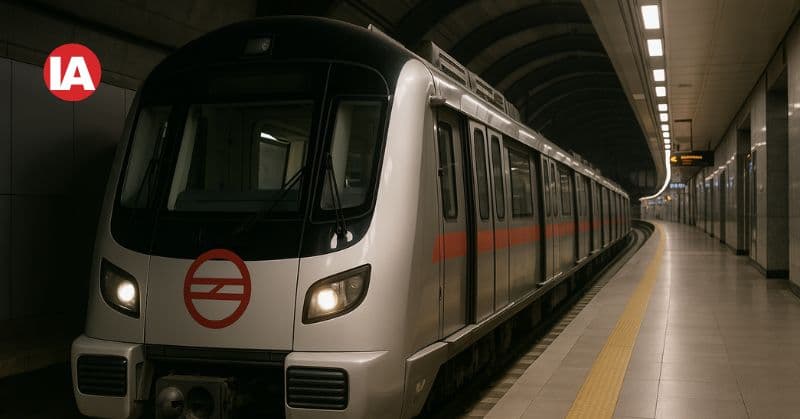
Delhi Metro’s Fully Driverless Magenta Line Sets Global Benchmark for Smart Urban Transit, Showcasing India’s Leap into AI-Enabled Mobility Automation
The Delhi Metro's Magenta Line went entirely driverless, marking a significant advancement for India's urban mobility scene and putting the country in the elite group of cities driven by intelligent transportation automation. Millions of people today commute safely and smoothly across the capital thanks to artificial intelligence, sophisticated control systems, and precision automation, which was once only a vision of the future.
By combining automation, data analytics, and real-time monitoring into a unified, self-regulating ecosystem, the move represents a technological victory for the Delhi Metro Rail Corporation (DMRC). A complex network of automated train control (ATC), automatic train operation (ATO), and automatic train supervision (ATS) devices currently controls every train on the Magenta Line, eliminating the need for human involvement. Together, these technologies can precisely coordinate train movements with millisecond precision, guaranteeing optimal energy efficiency, flawless station door synchronization, and almost zero error margin. An intelligent data infrastructure is always humming beneath the surface of the city. A centralized command center driven by predictive analytics receives operational data from sensors placed across tracks, carriages, and substations. This effectively turns India's busiest metro into a living, learning network by enabling the system to predict mechanical wear, dynamically reroute trains, and even control speed to alleviate congestion.
In addition to being an engineering wonder, the driverless metro signifies a significant philosophical change as human oversight is replaced by automation. The system's machine-learning-driven diagnostics, redundancy measures, and multi-layered safety rules make sure that automation improves human control rather than simply replacing it.
With the Pink Line expected to follow shortly, the Magenta Line's success will serve as a model for future automation throughout India's urban transportation systems. It emphasizes how data-driven precision, intelligent control, and AI integration are changing not just industry and production but also the way cities move and breathe.
In addition to being a transportation milestone, the driverless Delhi Metro is a celebration of automation's potential to improve urban living by making it safer, smarter, and more sustainable. The Magenta Line, which moves without a driver, represents India's transition from manual to machine intelligence, where automation has become the fulcrum of progress.