Haryana Eyes Big Leap in Electronics Sector Under Govt Push — Automation Set to Power India’s Next Manufacturing Wave
Haryana is positioning itself as India’s emerging hub for electronics manufacturing under the Government of India’s Electronics Component Manufacturing Scheme (ECMS) and the state’s ESDM 2024 policy. With upcoming automation-led manufacturing clusters across Gurugram, Faridabad, and Manesar, the state aims to integrate robotics, AI-driven quality assurance, and smart assembly systems into production lines.
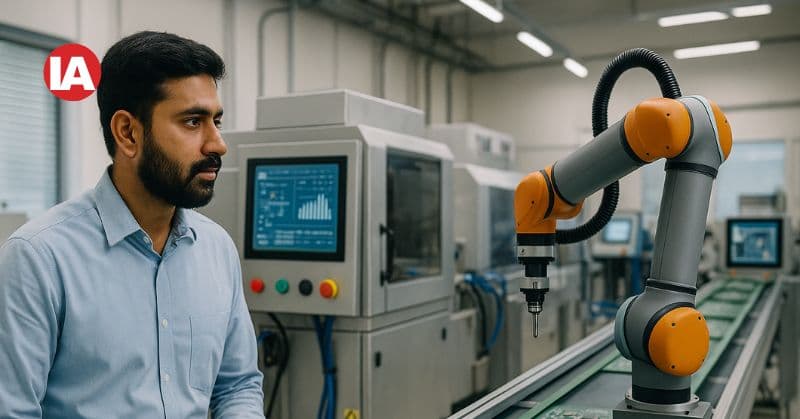
Haryana’s Electronics Push Positions the State as India’s Automation Nucleus, Blending Policy, Robotics, and Industry 4.0 to Drive the Next Manufacturing Revolution
Haryana has unveiled a significant plan to boost growth in the electronics and semiconductor ecosystem, driven by automation, smart manufacturing, and digital integration, in a calculated move that could reshape the state's industrial identity. This action is under the Electronics Component Manufacturing Scheme (ECMS), a government-sponsored initiative aimed at establishing Haryana as a high-tech center for advanced manufacturing and electronics production. The project represents a dramatic change from traditional production to plants that are completely automated and equipped with digital technology. Haryana wants to create an environment for electronics manufacturing that is sustainable and competitive on a global scale by using Industry 4.0 technology, such as robotics, AI-driven quality control, and precision assembly lines. In order to accommodate automation-enabled facilities capable of producing parts for smartphones, semiconductors, electric vehicles, and defense electronics, the state's industrial clusters in Gurugram, Faridabad, and Manesar are undergoing restructuring.
A key component of this change will be automation. Haryana's manufacturing facilities are being engineered to run with almost zero flaws and maximum energy efficiency, from automated PCB assembly units and machine-vision inspection systems to predictive maintenance using IoT-based analytics. In order to guarantee that human capital develops in tandem with technology, the government's strategy also calls for the establishment of specialized training facilities for robotics, mechatronics, and AI applications.
Experts in the field predict that this endeavor will create doors for Indian automation solution providers in addition to drawing in multinational electronics behemoths. The explosion in automated infrastructure development is anticipated to have a major positive impact on businesses that specialize in motion control, SCADA systems, robotics integration, and industrial IoT. The strategy, which moves the emphasis from assembly to innovation-driven production, is a natural fit with India's larger Make in India and Digital India goals.
Haryana's aggressive push for electronics production is the model for India's automated future, not just a sign of economic success. The state is manufacturing competitiveness, not simply components, by integrating automation into its plan. Haryana is positioned to become India's Silicon Valley of automation, where precision, technology, and policy come together to define the next industrial revolution, as digital factories emerge and smart robots take over.