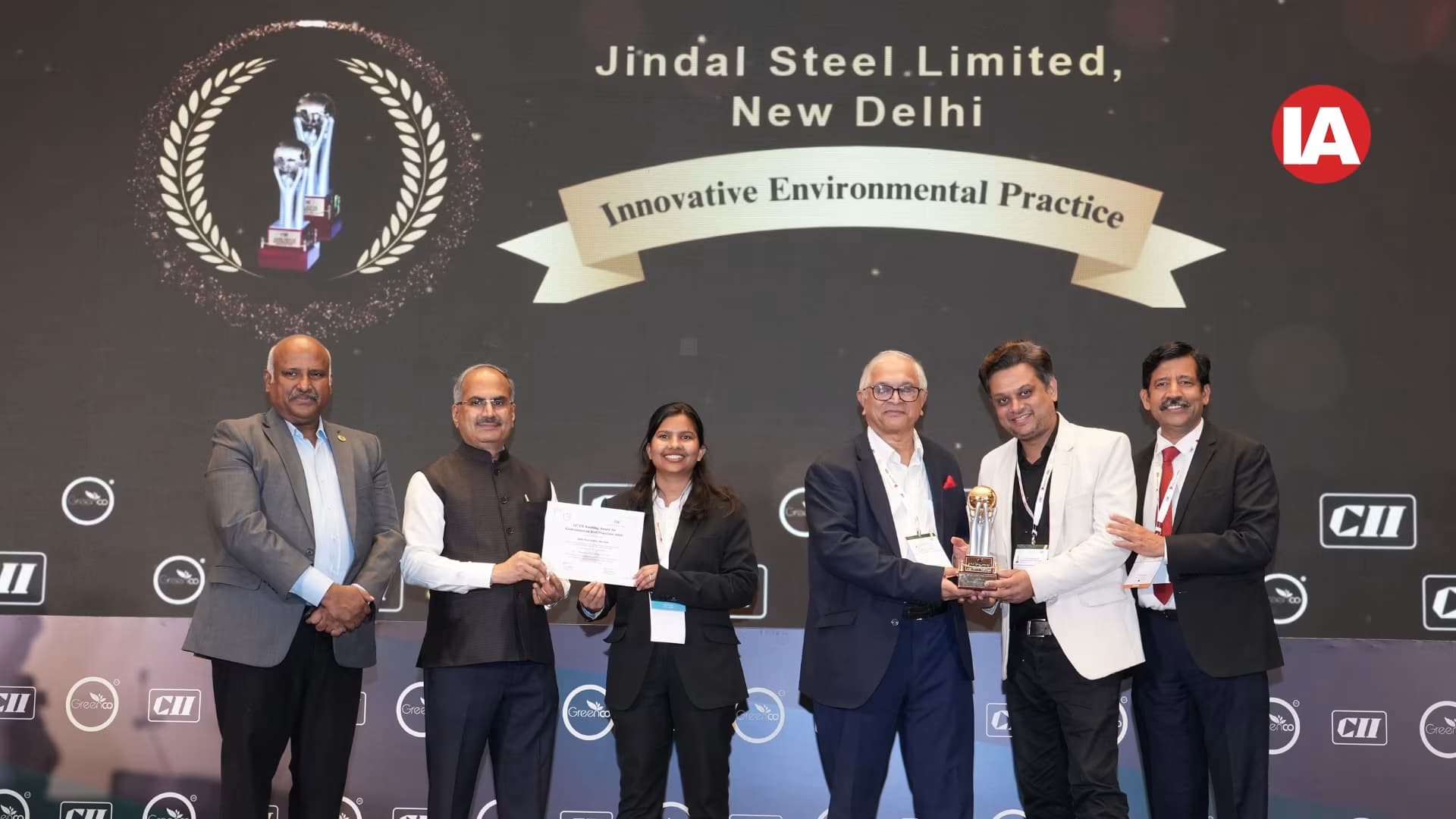
Jindal Steel wins CII National Award for environmental best practices 2026 for low-carbon hydrogen integration in steelmaking
Jindal Steel wins the CII National Award 2026 for integrating low-carbon green hydrogen into DRI steelmaking, driving significant decarbonisation at Angul.
Phase II is projected to cut approximately 55 kg of CO₂ per tonne of DRI, with potential savings of about 264 tonnes of CO₂ per day.
New Delhi, October 15, 2026: Jindal Steel Limited has won the CII National Award for Environmental Best Practices 2026 under the Technological Advancement category for its pioneering initiative to integrate low-carbon hydrogen into direct reduced iron (DRI) operations at its integrated steel complex in Angul, Odisha. The project integrates green hydrogen into the Midrex MxCol DRI process, partially substituting coal-based syngas while maintaining furnace stability and operational continuity.
The initiative is being implemented in phases. Phase I, operational since May 2026, uses a 5 MW alkaline electrolyser to supply green hydrogen at 1,000 Nm³ per hour to the DRI shaft furnace. Phase II, planned for July 2027, envisages a 30 MW electrolyser with injection capacity of 6,000 Nm³ per hour.
According to the project assessment submitted for the award, Phase I is expected to reduce emissions by approximately 9 kg of CO₂ per tonne of DRI, while Phase II is projected to achieve approximately 55 kg of CO₂ per tonne of DRI, or about 264 tonnes of CO₂ per day, based on stated operating assumptions.
A distinguishing feature is its application to a coal-gasification-based DRI route rather than a natural-gas-based configuration. Hydrogen is blended into processed syngas and recycled furnace top gas without fundamentally changing the core reactor, offering a potential pathway for steel plants in coal-rich regions. The project incorporates targeted oxygen injection, hydrogen-compatible pipeline materials, automated controls and emergency isolation systems, with design work by Fichtner and detailed project report validation by IIT Kharagpur.
The hydrogen-blending model could be evaluated for replication across suitable DRI installations, including plants where natural gas availability is constrained, while its phased implementation helps build operational experience and the controls required for higher hydrogen injection rates.