Mumbai on Alert: The City's Protection Against Monsoon Fury Is Automation
Mumbai is leveraging automation to transform its monsoon flood response from reactive chaos to predictive resilience. IoT sensors, AI-driven water management, automated supply chains, and robotic disaster response are reshaping the city’s ability to predict, manage, and mitigate flood impacts, safeguarding industries and residents amid increasingly severe monsoon rains.
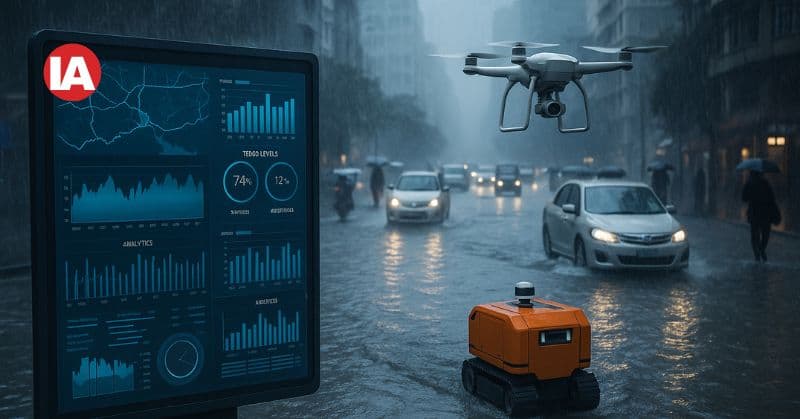
Automation Emerges as Mumbai’s First Line of Defense Against Climate-Driven Flooding and Industrial Disruption
Although Mumbai is accustomed to the monsoon's fury, the city's precarious flood preparedness has once again been highlighted by this year's most intense rainfall. The storyline sounds familiar: transportation is paralyzed, industry sluggish, and streets are submerged. Beneath this catastrophe, however, there is a significant change: automation is taking over as the city's problem-solver, providing a route from reactive helplessness to predictive resilience.
IoT-enabled flood management technologies are at the center of this change. Civic officials can now monitor rising water levels second by second thanks to smart sensors placed throughout stormwater drains, rivers, and crucial intersections that transmit real-time data onto dashboards driven by artificial intelligence. Today's prediction models can detect high-risk areas, mimic rainfall patterns, and automatically activate pump stations to channel surplus water—all in contrast to the guesswork of previous decades. Such automated intelligence can save entire neighborhoods from drowning, in addition to buying valuable time. Automation is also being used by industries as a buffer against disruption. Predictive maintenance algorithms are being used by manufacturing facilities in Thane, Navi Mumbai, and Andheri to keep equipment operating efficiently in spite of water seepage and power outages. When conventional roads fail underwater, automated supply chain platforms immediately reroute deliveries to prevent industries from stopping due to a shortage of raw materials. Automated guided vehicles (AGVs) and robotics are being used by warehouses to maintain internal logistics while external transportation comes to a complete stop.
Drones and autonomous robots are revolutionizing disaster response. While robotic units traverse submerged streets to deliver medical kits and necessities, high-resolution aerial surveys of flooded districts enable the quick deployment of relief resources. Authorities may now coordinate relief efforts with a level of accuracy and speed that was unthinkable ten years ago when paired with cloud-based command centers. The message is clear: automation is now the foundation of urban resilience rather than a supplementary facilitator. Cities like Mumbai must incorporate automation as a fundamental component of their industrial and civic infrastructure, not as an afterthought, as climatic unpredictability increases. While the monsoon is unavoidable, paralysis is not. Mumbai has the resources to turn floods from a calamity into a manageable—and eventually conquerable—challenge with automation on its side.