3/3/2026
It takes several years to establish and maintain technical credibility in the industrial domain
Anjani Rajagopal on power quality, vibration analytics, and building global-standard industrial electronics from India.
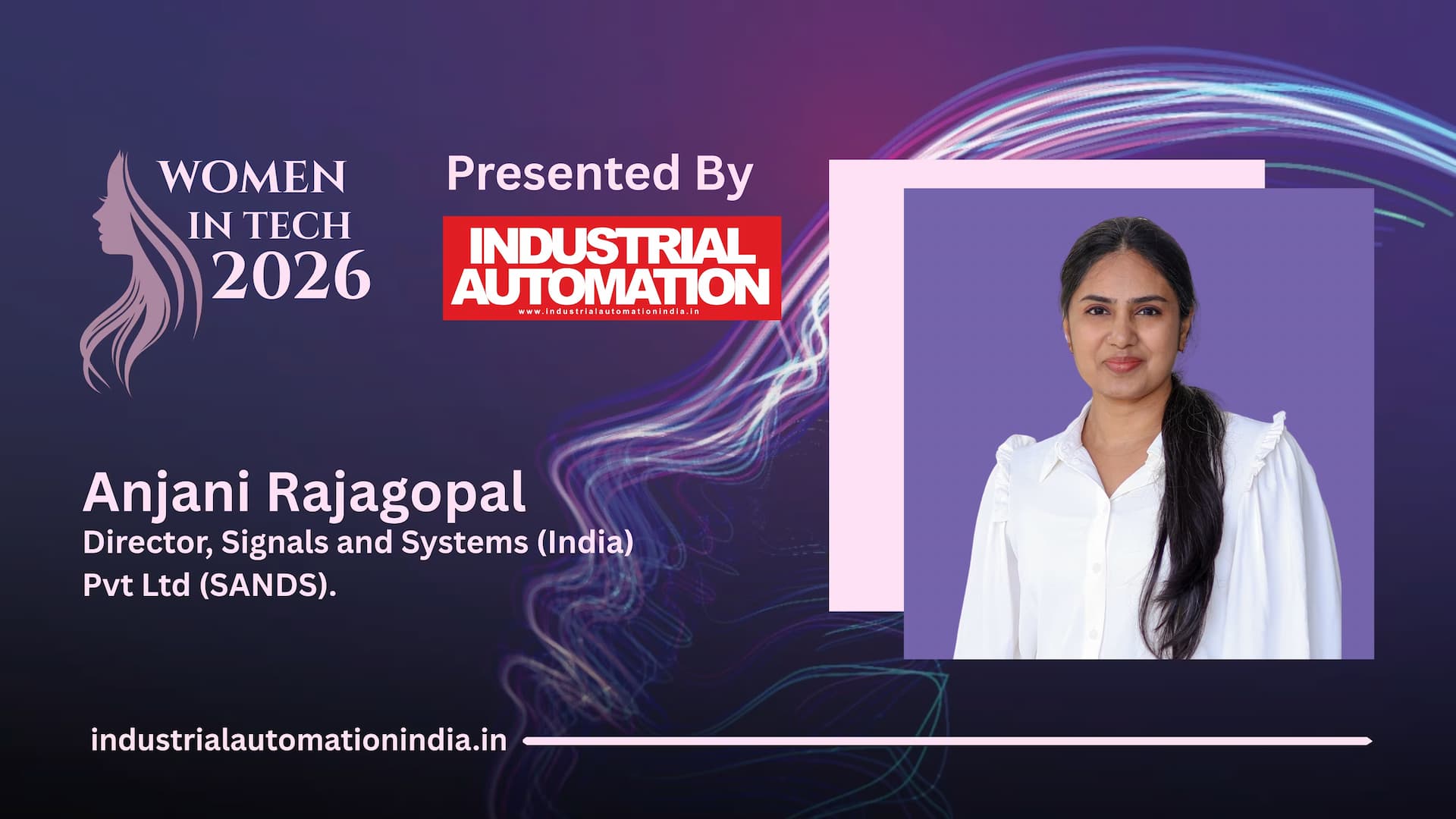
Anjani Rajagopal, Director, Signals and Systems (India) Pvt Ltd (SANDS).
How would you describe your professional identity beyond your title?
I have 20 years of experience in designing electronic equipment for utilities and industries. I focus on high-precision measurement instruments, which include hardware, signal processing, sensing, wireless networking, IIoT, and cloud-integrated systems.
My core specialisation is in the area of electrical signal processing in the domain of Energy and Power Quality.
A defining aspect of my professional identity is developing reliable and rugged global-standard niche-technology products in India for domestic and international markets. When critical technologies are available globally but not manufactured in India, we at SANDS take it as an engineering challenge to design and deliver them not just in India, but globally as well. This is reflected in our development of vibration analyzers, Class S power quality analyzers, 0.05 Class energy reference standards and stator protection systems for nuclear power plants, where we became the first Indian designer and manufacturer.
It is also my priority to keep in mind the field personnel. Towards this, I have led the introduction of innovations such as wireless IoT connectivity and tablet-based interfaces to the products for ensuring ease-of-use.
One Defining Project That Proves Your Technical Strength
One specific project that challenged me not just technically, but also as a manager was a case where we had deployed our 24x7 online vibration sensors for a critical application at a leading automotive manufacturer’s plant.
The application was for a high-speed spindle operating at 95,000 RPM inside a CNC machine. The customer was facing repeated spindle failures, causing unplanned downtime. Conventional vibration monitoring solutions were not serving their needs due to traditional thresholds being unsuitable for such high RPMs. Also, the sensor had to be deployed under harsh conditions with coolant flowing over it.
The key technical challenge was that standard ISO vibration limits were simply not applicable at such high speeds. We had to move beyond standard approaches and deeply study the spindle behaviour under real operating conditions. It demanded extensive cross-functional coordination and going the extra mile to deep-dive into this specific customer’s needs.
By customising the solution, applying machine learning to automatically identify the various stages of the machine's operation, and to detect anomalies, refining frequency analysis, and validating our approach iteratively on-site, we were able to detect early-stage deviations before failure, in a manner that met the customer's needs.
The result was an approximately 80% reduction in unplanned downtime related to spindle failures. More importantly, solving this complex problem has now got us excited to address other challenging high-speed applications in this domain.
People often assume growth comes from privilege rather than performance. What would you like to say to those who don't know the effort behind building technical credibility?
Over the years, I have worked to earn credibility for SANDS by delivering robust and reliable products that stand the test of time. Alongside the other leaders at SANDS, I have developed a company culture of delivering what is said. To do this, all stakeholders within the company need to be clear about the product's technical capabilities and be transparent to the customer about them. In today’s world, where people often overcommit and underdeliver, I have learned that it takes courage to say that a certain technical specification cannot be met. Such honest and upfront interactions with customers win their trust over time. This approach has become a part of our culture, and it applies to both internal and external stakeholders.
It takes several years to establish and maintain technical credibility in the industrial domain. Unlike consumer electronics, which have shorter life cycles, industrial products are expected to last for a minimum of ten years. Year-on-year product certifications from accredited labs are essential. Products must be tested with the intention of building reliable solutions, not just to meet a certain compliance requirement. The quality and longevity of the products will speak for themselves.
We take pride in stating that our flagship product – CMRI, which is a held equipment that was sold 20 years ago, is still being used by utility field personnel. Might be hard to believe, but these are devices that run on MS-DOS
Strong engineers are defined by how they think under pressure. What is your method when systems fail or performance drops?
The key is to strike a balance between quick decisions and actions, and creating mechanisms and processes, which bring more long-term stability but can slow things down in the short term. I usually think of a quick way to start a mechanism; often, Google Sheets is good enough for starting a process. After the system proves to be effective and sustains over time, I work on making it a more formal process that gets embedded into the organisation.
One example of this in action is that, having been at SANDS for nearly two decades and understanding how everything works, a few years ago, I drove the initiative to build an in-house digital platform to manage our entire operations. However, this wasn’t an easy decision, as I had to choose between whether resources should be spent on developing this platform or on our core products for customers. This decision came after years of experimenting with various off-the-shelf software and platforms and finding that they did not fit our company’s unique needs. Today, this digital platform has improved coordination between engineering, production, service teams, and vendors, as everyone works with the same information and clear ownership. It has also given us the flexibility in the long term to constantly evolve according to the changing needs of the organisation and business.
You also have to constantly think about what to prioritise and how to strike a balance between what needs to be done immediately versus what is not critical but is of high value in the long run. During COVID, when business had slowed down with organisations running only critical functions, I prioritised setting up an independent NABL Lab at our own facility, which broadened our horizons in traceability and global standards.
Many students and young professionals still assume industrial careers are ‘slow’ or ‘not exciting’. What would you tell the next generation to change this mindset?
Hands-on experience is critical for growing into leadership roles in industrial careers. Starting on the shop floor instead of in an office cabin might not seem appealing, but it will pay off in the long run.
When I interview Gen Z candidates, I find that they are often spoilt for choice and struggle to persist in the path they choose. The moment there is discomfort, the immediate thought is to move to another organisation or domain. Having been in different roles in engineering, marketing, sales, operations and leadership over the years, one learning I want to share is that every role comes with its challenges, and there will be phases when it is not exciting, and in your list of to-dos, there will always be certain tasks that you don't look forward to. It is important to persist through these.
My advice to new graduates is – do not chase trends. Many top jobs that are now fading were once trending. Technologies, tools, and trends will keep changing, but the technical depth you build in a domain over time will always have a high value.
Another observation while interviewing women is that imposter syndrome is quite evident when it comes to technical roles. For the women reading this, ‘You do not have to be perfect, you do not have to know it all. Trust your credentials that you've established over the years and put your best foot forward!’
Anjani Rajagopal is a Director at Signals and Systems (India) Pvt Ltd (SANDS), with a strong technical foundation in Electronics and Communication Engineering and an MBA in Finance from Great Lakes Institute of Management. She has been associated with SANDS since 2007, beginning her career as an R&D Engineer and gaining extensive hands-on experience in the design and development of industrial electronic and automation systems.
Over the course of her career, she has worked across multiple functions, including Research & Development, Marketing & Sales, and Operations, enabling her to develop a comprehensive understanding of both the technical and commercial aspects of industrial solutions. Her expertise includes requirements analysis, system development, and supporting the deployment of scalable solutions for energy monitoring, condition monitoring, and industrial automation applications.
Her multidisciplinary experience, combined with strong business acumen, enables her to effectively bridge engineering innovation and strategic business objectives. As Director, she plays a key role in driving technology-led growth, operational excellence, and the advancement of intelligent, interoperable solutions aligned with Industry 4.0 and digital transformation initiatives.