By Rajat Kulshreshtha, CBO at BMW Industries Limited.
For the better part of two years, India's infrastructure push has been defined by an impressive expansion across roads, railways, power and other critical infrastructure, creating strong and sustained demand for steel. As this momentum continues, the opportunity is now evolving from simply enhancing steel capacities to building steel capabilities, enabling infrastructure projects with more specialised, application-ready and value-added steel solutions.
With EPC order books expanding and infrastructure projects becoming increasingly sophisticated, the steel industry is well placed to support this next phase of growth by delivering products that align more closely with the technical, quality and performance requirements of modern infrastructure. This evolution can further strengthen India's manufacturing capabilities while enabling faster, more efficient and higher-quality project execution.
That distinction is becoming the real story of this cycle.
The demand curve is strong and accelerating
Start with what the data tells us. Government figures for the first quarter of this fiscal year show finished steel production rising close to 5% year-on-year, while consumption climbed even faster, at over 8%. That gap between how much steel India makes and how much it uses is a clear signal of how fast demand is scaling, even as the country's crude steel capacity pushes toward 222 million tonnes a year, on its way to a stated ambition of 300 million tonnes by the end of the decade.
Independent forecasts point the same way. Steel demand is expected to grow in the high single digits through this fiscal year, with government capital expenditure in roads, railways and broader infrastructure cited as the primary driver. And the most recent monthly data, covering April through July, shows the momentum holding strong, with finished steel consumption up nearly 8%. This is not a one-quarter spike; it's a sustained curve, and one that every steel-linked business in the country is now building its plans around.
EPC companies aren't just buying steel, they're investing in solutions
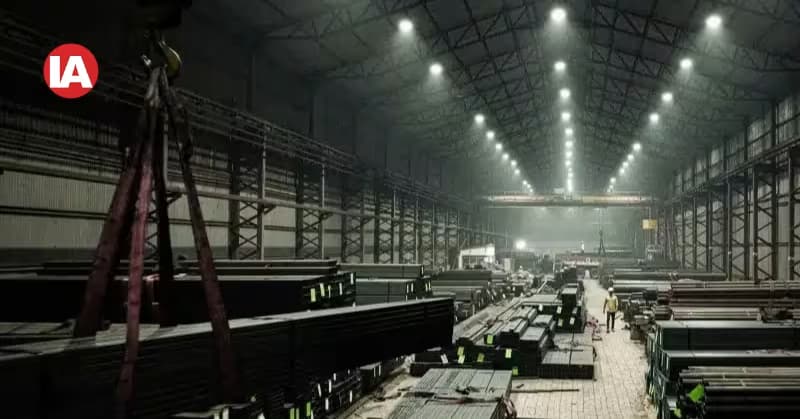
As infrastructure projects grow more sophisticated, the opportunity lies in recognising that rising steel consumption isn't a single, uniform number. Each tonne serves a distinct purpose as it moves from mill to site, shaped by the specific needs of the project it supports. The infrastructure economy calls for transmission towers, tubular poles, structural sections, MS and GI pipes, and precisely fabricated components engineered for a specific project, a specific tolerance, and a specific delivery window.
An EPC contractor building a transmission line or a highway overpass is looking for a component that arrives cut, shaped, coated and certified — ready to be bolted, welded or erected the moment it reaches the site. That is where a vibrant downstream ecosystem plays its part: processing, fabrication, customisation, quality control and logistics, all working together to convert raw material into build-ready infrastructure.
This downstream layer is increasingly recognised as central to how effectively India's infrastructure ambitions translate into reality. As the country's infrastructure pipeline grows more complex, spanning renewable energy, power transmission, urban transit and industrial capacity, this is precisely the layer that helps ambitious project timelines get met.
Speed and reliability are becoming defining strengths
For EPC players, materials typically account for well over half of total project cost, and power-sector projects in particular now form a substantial share of order books industry-wide. That weighting means every gain in how quickly and consistently steel moves from mill to site translates directly into project timelines, working capital and commissioning schedules staying on track.
Put simply: reliability is becoming as valuable as price. A contractor who can lock in on-time, ready-to-install material has effectively found a better deal, even at a comparable price point. This is an exciting shift taking shape across India's infrastructure supply chain, and one that downstream steel processors are well placed to lead.
From commodity supply to engineered solutions
There's a broader evolution underway, and it's worth naming directly: India's steel ecosystem is moving from a commodity-led supply model toward a more integrated, application-oriented one. The businesses that will lead this next phase are not necessarily the ones with the largest furnace capacity, but the ones that can consistently convert raw steel into infrastructure-ready components at scale, on schedule, and to specification.
That calls for investment across several fronts at once: processing capacity that can handle volume without compromising precision; faster turnaround times built for the pace of EPC execution; consistent quality control that gives contractors confidence in their planning; smarter inventory and supply-chain integration that anticipates project needs; and, increasingly, the engineering capability to customise products pipes, tubes, transmission structures for the specific demands of renewable energy, power transmission and industrial infrastructure projects.
This is a significant and growing capability. As infrastructure and construction continue to account for well over half of the country's total steel consumption, the businesses that master this conversion from base material to deployable component are set to shape how quickly and how well India builds.
Where the next opportunity lies
India's steelmaking capacity is expanding fast, and on current trajectory, the country is well on track to have enough steel in absolute terms to support its infrastructure ambitions. The bigger opportunity now lies in how quickly, and how precisely, that steel can be processed, customised and delivered to match the pace of the projects that depend on it.
The next chapter of India's infrastructure story will be written not just by steelmaking capacity, but by the depth and readiness of the ecosystem that turns raw steel into infrastructure that's actually built.
Author