As technology advances and sustainability becomes non-negotiable, T&M companies are well positioned to lead the way, says Srividhya Murali.
The Test and Measurement (T&M) industry – once a supporting function to verify performance and compliance – is now emerging as a central enabler of innovation and sustainability in modern manufacturing and product development. The T&M industry is undergoing a transformation driven by rising product quality expectations, regulatory pressures, digitalisation, and sustainability goals.
To stay competitive and lead the market, T&M companies are focusing on innovation by offering smarter, interoperable, and adaptive testing solutions, while also aligning their internal operations with environmental and sustainability standards by optimising resource use and reducing environmental impact.
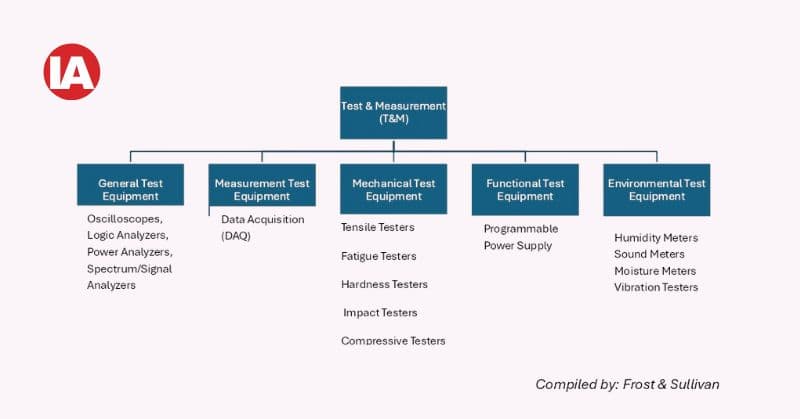
The Test and Measurement (T&M) market includes a wide range of instruments used to
evaluate, analyse, monitor, and validate the performance, functionality, safety, and quality of
products, systems, and components across various industries such as aerospace, automotive,
energy, infrastructure, and environmental sectors. The classification is provided in Table 1.
How innovation is fueling T&M growth
Bridging integration gaps with interoperable systems
One major hurdle in the T&M ecosystem is the lack of interoperability across legacy systems, resulting in data silos and inefficient workflows. With the market becoming increasingly competitive, innovation is essential to differentiation, particularly when hardware from different vendors lacks compatibility. For instance, according to Frost & Sullivan’s Growth Opportunities in the Data Acquisition Market, Global, 2021-2028, approximately 40%-50% of the market share is held by numerous smaller companies, further contributing to system fragmentation. To address this, companies are investing in open standards and collaborative development. For example, DEWESoft and HBK jointly created a software development kit (SDK) that enables seamless integration of diverse hardware platforms. These innovations empower companies to build flexible systems without having to reinvent the wheel, while leveraging existing infrastructure - saving time, cost, and effort.
Staying competitive through technological advancement
Features like miniaturisation, enhanced performance, and cost-efficiency are becoming essential. A case in point is Chroma ATE’s programmable power supply that emphasizes compact size, lightweight design, and the ability to operate in parallel with up to four units to deliver a combined power of 20kW. This solution allows three of these units to replace nine single-channel units, resulting in a 67% reduction in space usage – a significant advantage in a high-density testing environment. Such innovations allow T&M companies to meet client demands while optimising physical and operational footprints.
Powering Industry 4.0 with smarter test systems
The shift to Industry 4.0 has created demand for intelligent, digitally controlled T&M devices. Traditional systems no longer suffice. Newer solutions – such as digital programmable power supplies – go beyond supplying voltage: they enable real-time communication, self-regulation, and remote diagnostics through interfaces like I2C, PMBus, and RS485. These smart devices can dynamically adjust based on environmental and operational variables, reducing failure rates and boosting productivity.

Accelerating the sustainability agenda
Sustainability is now a strategic priority, and T&M companies are stepping up both through the solutions they offer and how they operate. To support this perspective, T&M companies draw inspiration to achieve this goal by reimagining design and production processes with innovation at the core. Some sustainability-focused initiatives spanning from monitoring wastewater impacts in semiconductor manufacturing to protecting marine ecosystems through advanced environmental monitoring technologies. Frost & Sullivan’s study, “Top 10 Growth Opportunities Related to Sustainability in Test & Measurement (T&M) Market, 2024”, further illustrates these efforts with real-world examples of innovative and impactful solutions. For example,
- Wastewater from semiconductor manufacturing is affected by metal impurities during the cleaning processes. Companies offer instruments to analyse wastewater from this industry.
- Instruments such as LC-MS, GC-MS, and X-Ray CT systems are used to detect harmful substances such as Per- and Polyfluoroalkyl Substances (PFAS), VOCs & SVOC (volatile & semi-volatile organic compounds), Inorganic Ions and Metals, POPs and pesticides, tap water contaminants.
- Monitoring marine ecosystems using autonomous underwater vehicles (AUVs) shows how T&M extends its utility to conservation and environmental research.
Sustainable business operations
- To reap the full benefits of sustainability from their products, Agilent Technologies has begun to integrate best practices into their product lifecycle to holistically monitor energy usage, carbon emissions, and waste generation, as well as the type of material used.
- Initiatives such as trade-in programs encourage recycling of old instruments, while packaging has been redesigned using reusable materials.
- Several companies have pledged to source 100% of their electricity from renewable sources and achieve zero landfill status by 2030.
Conclusion
The Test & Measurement industry is at a pivotal point. As technology advances and sustainability becomes non-negotiable, T&M companies are well positioned to lead the way. By embracing smart, interoperable, and adaptive systems – and aligning internal operations with decarbonisation and environmental goals – they can turn today’s challenges into tomorrow’s leadership. In doing so, they not only ensure product quality and compliance but also enable innovation, operational efficiency, and a sustainable future for manufacturing worldwide.
Srividhya Murali, Consultant, Industrial Growth Advisory, Frost & Sullivan, is a seasoned strategic insights professional with over 15 years of expertise in qualitative and quantitative market research, market intelligence, data analytics, and project leadership. Excel in conducting comprehensive market research and market intelligence projects for the manufacturing, Oil & Gas, Test & Measurements sector. The analytical mindset derived from the robust engineering background has aided in interpreting complex market research data into actionable insights for Global Fortune 500 clients. Customised strategic recommendations have helped clients leverage regional market and sales data to enter new markets, foster long-term partnerships, and understand market dynamics in order to strategise their investments for the near future. Skilled in collaborating with cross-functional teams to deliver on complex organisation-wide projects with an ability to manage time, multiple projects and prioritise tasks to meet deadlines.
Author