A Thinking Machine, Not Just a Moving One
How edge computing is turning the factory floor into a real-time intelligence layer.
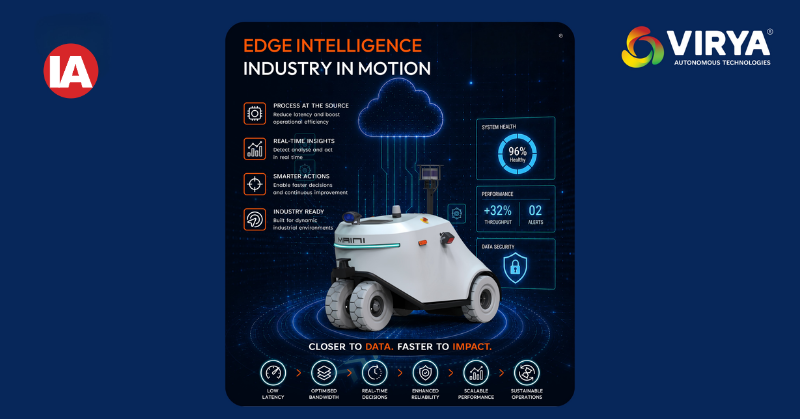
The robot effectively becomes a mobile edge-computing platform
For much of modern manufacturing history, data has been something companies reviewed after the fact. Production reports arrived at the end of the shift. Equipment performance was analyzed days later. Maintenance teams often learned about problems only after machines showed visible signs of failure.
That approach is becoming increasingly difficult to sustain. Modern factories generate enormous volumes of information every second—from sensors embedded in production equipment to autonomous vehicles moving materials across the shop floor. The challenge is no longer collecting data. The challenge is using it quickly enough to influence what is happening now.
This shift is driving growing interest in edge computing, a technology approach that processes information close to where it is generated rather than sending everything to a distant cloud server for analysis. By reducing the distance between data generation and decision-making, manufacturers are beginning to unlock a level of responsiveness that was previously difficult to achieve.
Why location matters in data processing
Cloud platforms have played a significant role in industrial digitalization over the past decade. They have enabled large-scale data storage, centralized monitoring, and advanced analytics across multiple facilities. However, not every decision can wait for data to travel across networks, be processed remotely, and return with instructions.
On a busy factory floor, even small delays can have consequences. A worker entering a robot path, an unexpected obstruction in a material handling corridor, or a developing machine's fault may require an immediate response.
Edge computing addresses this challenge by placing computing resources closer to the source of the data. Instead of relying entirely on external infrastructure, processing occurs directly on machines, industrial controllers, local servers, or autonomous robots themselves.
The result is a manufacturing environment that can respond to events as they unfold rather than react after the fact.
In sectors such as automotive manufacturing, pharmaceuticals, electronics, warehousing, and food processing, where uptime and operational continuity are critical, this ability to act in real time is becoming increasingly valuable.
Autonomous mobile robots and the rise of distributed intelligence
Few technologies illustrate the benefits of edge computing more clearly than Autonomous Mobile Robots (AMRs).
Unlike traditional Automated Guided Vehicles (AGVs), which typically follow predefined routes, AMRs continuously interpret their surroundings and make navigation decisions independently. To do so effectively, they rely on a constant stream of information from LiDAR systems, cameras, inertial sensors, wheel encoders, and other perception technologies.
Every movement generates data. Every obstacle requires evaluation. Every route decision demands computation.
Sending all this information to the cloud for processing would often introduce delays unacceptable in dynamic industrial environments. Instead, most modern AMRs perform a huge part of their computation onboard.
This local processing capability allows robots to find obstacles, update maps, recalculate paths, and adjust behavior almost instantly. As a result, navigation becomes smoother, safer, and more reliable even in facilities where layouts and traffic patterns change throughout the day.
The robot effectively becomes a mobile edge-computing platform—one that can sense, analyze, decide, and act within fractions of a second.
Moving beyond automation to operational awareness
The real value of edge computing extends beyond navigation.
As industrial systems become increasingly connected, manufacturers are discovering that operational intelligence can be generated continuously rather than periodically. Instead of waiting for reports at the end of a shift, supervisors can gain visibility into performance metrics as they evolve.
For example, a fleet of mobile robots can continuously check battery health, travel efficiency, idle time, traffic congestion, and mission completion rates. Patterns that once needed manual analysis can now be found automatically.
A recurring bottleneck near a loading station may become visible within hours rather than weeks. Battery replacement schedules can be adjusted before performance begins to degrade. Maintenance teams can receive alerts when operating conditions suggest that a component may require attention.
The difference is subtle but significant. Decisions move from being reactive to becoming predictive.
For manufacturers running under tight delivery schedules and increasingly complex production requirements, this capability can contribute directly to productivity and equipment availability.
Bridging the physical and digital worlds
One of the most significant developments in Industry 4.0 has been the gradual convergence of physical operations and digital systems.
Historically, factory equipment and enterprise software existed in separate worlds. Machines performed work, while information systems recorded outcomes. Today, those boundaries are becoming less distinct.
Edge-enabled systems help close this gap by creating a continuous feedback loop between operational activity and digital decision-making.
An autonomous robot navigating a warehouse is no longer simply transporting material from one location to another. It is simultaneously generating environmental information, checking its own performance, sharing operational status with fleet management software, and contributing data that can improve future workflows.
Each movement becomes both a physical action and a source of operational insight.
This integration is helping manufacturers build facilities that are not only automated but increasingly adaptive. Production systems can respond to changing conditions, optimize resource utilization, and improve efficiency without requiring constant human intervention.
The road ahead
As manufacturing organizations continue investing in digital transformation, edge computing is expected to play a larger role across factory operations.
The growing adoption of autonomous mobile robots, intelligent sensors, machine vision systems, and connected equipment is creating a need for faster decision-making and more decentralized computing architectures. Processing data at the edge is emerging as a practical solution to meet those requirements.
What makes this transition particularly important is that it changes the role of data itself. Information is no longer simply collected for reporting and analysis. Instead, it becomes an active participant in daily operations, influencing decisions as events occur.
For manufacturers, the goal is not merely to gather more information but to create systems capable of acting on that information at once.
That is ultimately the promise of edge computing. It brings intelligence closer to the point of action, shortens the gap between observation and response, and enables factories to run with a level of awareness that was once difficult to imagine.
The result is a production environment that is not only connected, but increasingly capable of understanding and adapting to its own conditions in real time—a characteristic that is likely to define the next phase of industrial automation.
Author