Addverb Accelerates Physical AI for Industrial Robotics with Newton and NVIDIA Isaac
Addverb leverages NVIDIA Omniverse, Isaac Lab and Jetson to bridge sim-to-real robotics for industrial AI deployment.
Scaling Deployment of Trakr Quadruped and Elixis-W Humanoid Robots via High-Fidelity Digital Twins
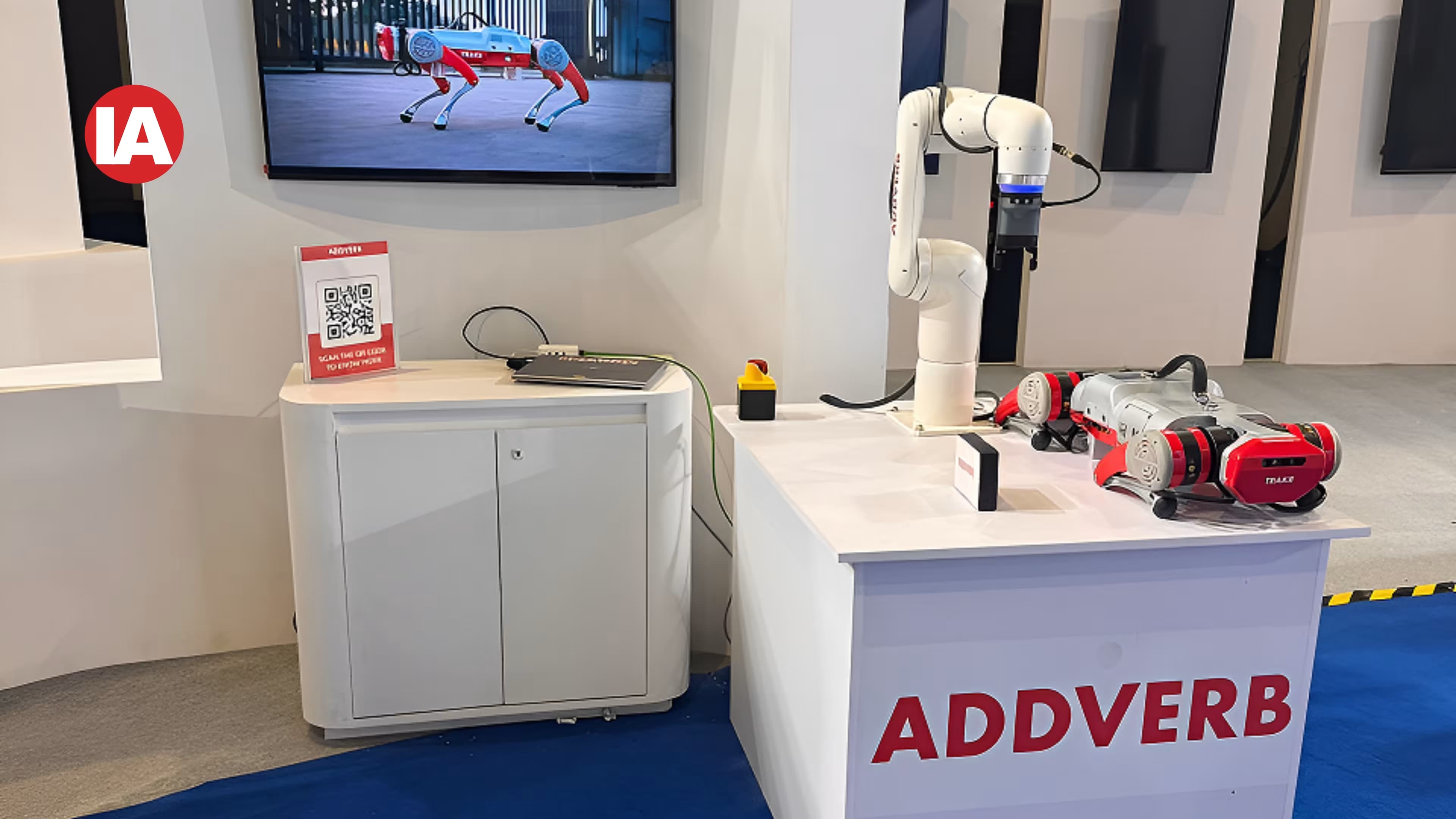
INDIA, February 18, 2026 — Addverb, a global leader in robotics and warehouse automation, has announced the expansion of its end-to-end development workflow using NVIDIA AI, simulation, and edge computing platforms. This enhanced ecosystem is currently being deployed to optimize Addverb's Trakr quadruped robot and Elixis-W wheeled humanoid, enabling the rapid design and training of robots capable of navigating complex industrial environments.
Bridging the "Sim-to-Real" Gap
The cornerstone of this collaboration is the reduction of time between virtual testing and real-world deployment. Addverb is utilizing a sophisticated stack of NVIDIA technologies to ensure its robots perform safely and consistently on the shopfloor.
The Physical AI Tech Stack
NVIDIA Omniverse & Cosmos: Used to build high-fidelity digital twins of warehouses. By using Cosmos World Foundation Models, Addverb can generate diverse synthetic data to test robot behavior in virtual replicas before physical deployment.
NVIDIA Isaac Lab: A GPU-accelerated framework used for Reinforcement Learning (RL). This allows Addverb to train robot "policies" (decision-making logic) at scale.
Newton Physics Engine: Addverb is evaluating this open-source engine (co-developed by NVIDIA, Google DeepMind, and Disney Research) to simulate complex physical interactions with unprecedented accuracy.
"By combining digital twins, NVIDIA GPU-accelerated robot learning, and edge AI, we are strengthening our ability to validate robotic systems faster and improve sim-to-real confidence," said Mr. Sangeet Kumar, Co-founder & CEO, Addverb.
Edge Intelligence and Real-Time Performance
For robots to operate autonomously in unstructured environments, they require massive on-board compute power. Addverb’s latest fleet is designed for low-latency, high-performance inference.
Hardware and Inference Capabilities
NVIDIA Jetson Orin NX: Powers the real-time perception and navigation of the Trakr and Elixis-W models.
NVIDIA TensorRT: Ensures low-latency processing, critical for avoiding obstacles and making split-second decisions in busy industrial zones.
NVIDIA Jetson Thor: Addverb is exploring this platform for Vision Language Action (VLA) models, allowing robots to understand and execute complex verbal or text-based instructions.
FAQ.
What is the Trakr quadruped designed for?
Trakr is a rugged, four-legged robot built for remote inspection, security patrols, and data collection in terrains where wheels cannot navigate, such as refineries or rubble-filled construction sites.
Why is the "Newton" physics engine significant?
Newton allows for the simulation of highly complex behaviors—like walking on uneven gravel or handling delicate objects—with better accuracy than previous engines. This ensures that what a robot learns in a simulation translates perfectly to the physical world.
Where can I see these robots in action?
Addverb is currently demonstrating these production-ready robots at the India Impact AI Summit 2026 at Bharat Mandapam, New Delhi, through February 20, 2026.