What the mining and construction equipment industry needs to scale: CII-BCG Report
CII-BCG report outlines a 10-point roadmap to scale India's mining and construction equipment industry.
A new report by CII and BCG lays out a 10-point agenda for what government and industry must do to ensure the sector can meet what India is asking of it
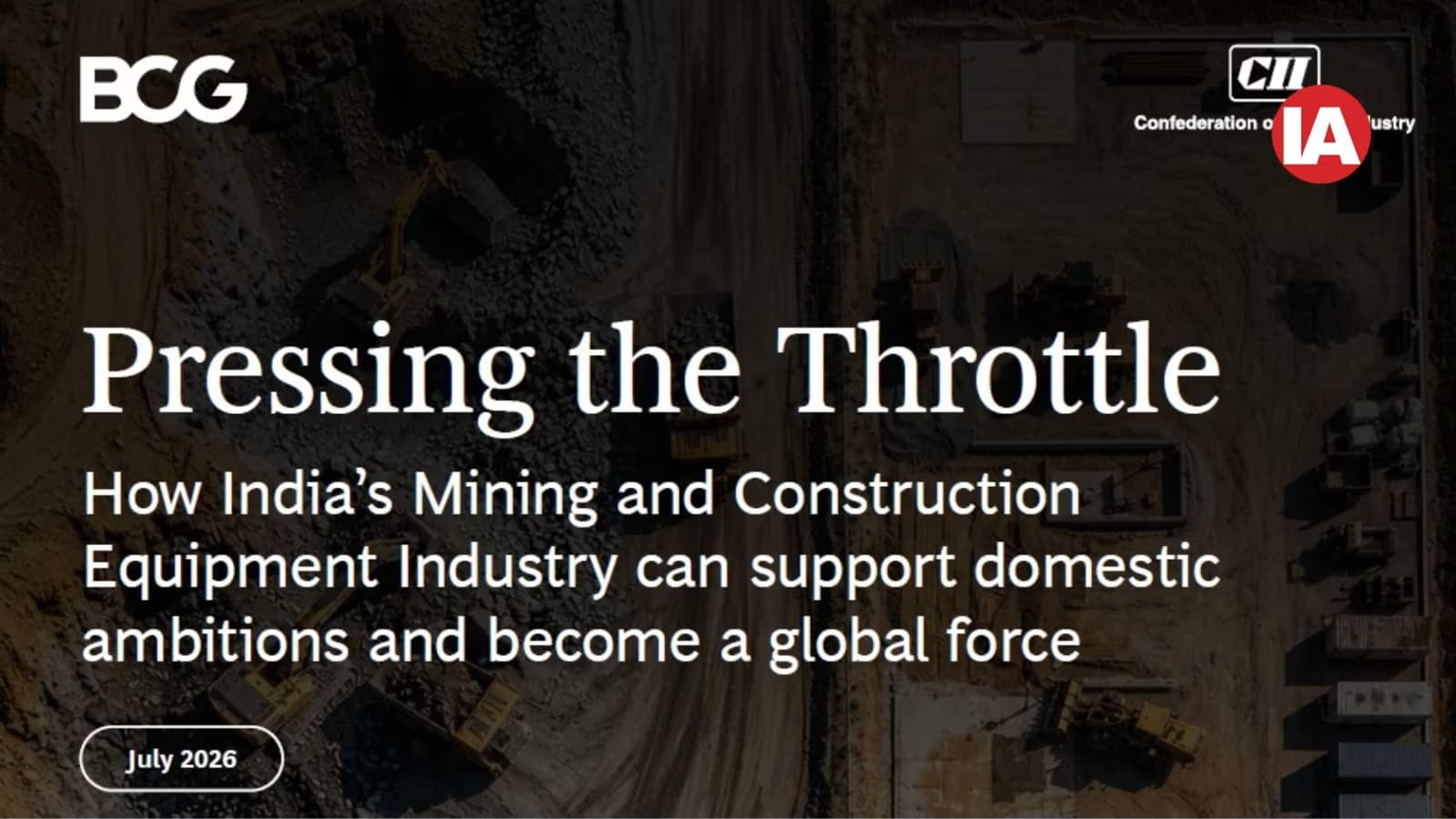
New Delhi, July 14, 2026: Before a road gets built, a mine opens, a port expands or a solar park goes up, equipment has to move earth, drill rock, lift steel and pave ground. That work falls to India's Mining and Construction Equipment industry, a sector that rarely makes headlines but sits at the foundation of everything India is building. A new report by the Confederation of Indian Industry (CII) and Boston Consulting Group (BCG), ‘Pressing the Throttle: How India's Mining and Construction Industry Can Support Domestic Ambitions and Become a Global Force’, takes stock of where the sector stands and what it will need to keep pace with the scale of India's ambitions.
The numbers reflect the sector's centrality. India's mining and construction output stands at around USD 430 billion, close to 11% of GDP, and supports the livelihoods of over 70 million people across the value chain. The equipment industry serving it has reached USD 17 billion in 2025 and is growing at 10-12% a year, among the fastest rates of any major market in the world. And the pipeline ahead is steep: capital expenditure across MCE-linked sectors is expected to nearly double from INR 5.5 lakh crore in 2025 to INR 9-10 lakh crore by 2030, as India pushes ahead on national highways, freight corridors, metro rail, ports, airports, critical mineral extraction and the clean energy build-out needed to hit 500 GW of non-fossil capacity by 2030.
What makes the opportunity larger still is that India's mechanisation intensity of roughly USD 5 of machinery demand per USD 1,000 of construction spending sits at about half the global average of USD 12. That gap means equipment demand has room to outpace construction spend itself as Indian sites become more productive. The sector, in other words, is not just riding India's growth. It is also deepening its role within it.
"India's vision of Viksit Bharat will be built on the strength of its infrastructure, manufacturing and mining sectors, and the Mining and Construction Equipment industry will play a pivotal role in enabling that transformation. As the sector evolves into a globally competitive industry, it can become a powerful enabler of India's manufacturing ambitions," said Vivek Bhatia, Chairman, CII Mining and Construction Equipment Division.
"India's Mining and Construction Equipment industry is at an inflection point. As infrastructure investment accelerates and the sector is reshaped by cleaner powertrains, connected fleets and automation, Indian manufacturers have an opportunity not just to keep pace with global change, but to help lead it. Those that invest early in technology and innovation will be best positioned to compete globally," said Abhishek Bhatia, Managing Director and Partner, Boston Consulting Group.
The report also looks at what the sector needs to stay fit for this role. Three areas stand out.
The technology the sector runs on is changing fast. Electrification, connected fleet management, autonomous equipment and new ownership models are reshaping the global industry. India is moving: BEML launched its first electric dump truck in 2025, Coal India's SECL has deployed real-time fleet monitoring across its operations, but Indian OEMs are at an earlier stage than global leaders. Keeping pace matters not just for exports, but for ensuring that Indian infrastructure projects can access the most productive, safest equipment available.
Localisation still has a long way to go. Overall localisation in construction equipment sits at around 50%, but the gap is concentrated in high-value components (hydraulics, electronic controls, undercarriages) that are still largely imported. Backhoe loaders are 85–90% localised; excavators sit at 55–60%. Deepening the supplier base, particularly in technology-intensive components, is as much a matter of industrial security as it is economics.
The export opportunity adds a second engine. India now exports more MCE than it imports, with shipments nearly tripling over the past decade to USD 4.9 billion in 2025. The global market for MCE imports runs to around USD 150 billion a year, and developing markets in Southeast Asia, Africa, the Gulf and South America, which currently buy close to half their equipment from China and are actively looking for alternatives. India has a credible offer in these markets today, and a larger one if it invests in distribution, after-sales networks and products designed for export rather than adapted from domestic models.
The report's 10-point agenda spans both government and industry.
For the government: a tiered duty structure that makes domestic manufacturing the more attractive option, public procurement preference for Indian-built equipment, anti-dumping action where needed, a dedicated nodal agency to replace fragmented ministerial oversight, and a fleet renewal scheme for ageing off-highway equipment.
For industry: serious investment in Tier-2 supplier development, committed export strategies with real distribution on the ground, and R&D investment at levels closer to what global leaders spend, currently 3-6% of revenue, against much lower levels among Indian OEMs.
"Realising this opportunity will require more than strong demand. India must deepen localisation, strengthen supplier ecosystems, invest in R&D and build products that can compete across global markets. With coordinated action between industry and government, the sector can establish itself as a globally competitive manufacturing and export hub over the coming decades," said Nikesh Murjani, Managing Director and Partner, Boston Consulting Group.
India is building at a scale and pace unlike anything in its history. The sector that makes that possible has had a strong decade, but it hasn't had the attention to match. This report makes the case that it deserves both.