Kvaser introduces the PCIe 4xLIN for next-level LIN connectivity
Kvaser launches the PCIe 4xLIN, a four-channel LIN interface for precise testing, debugging, and validation.
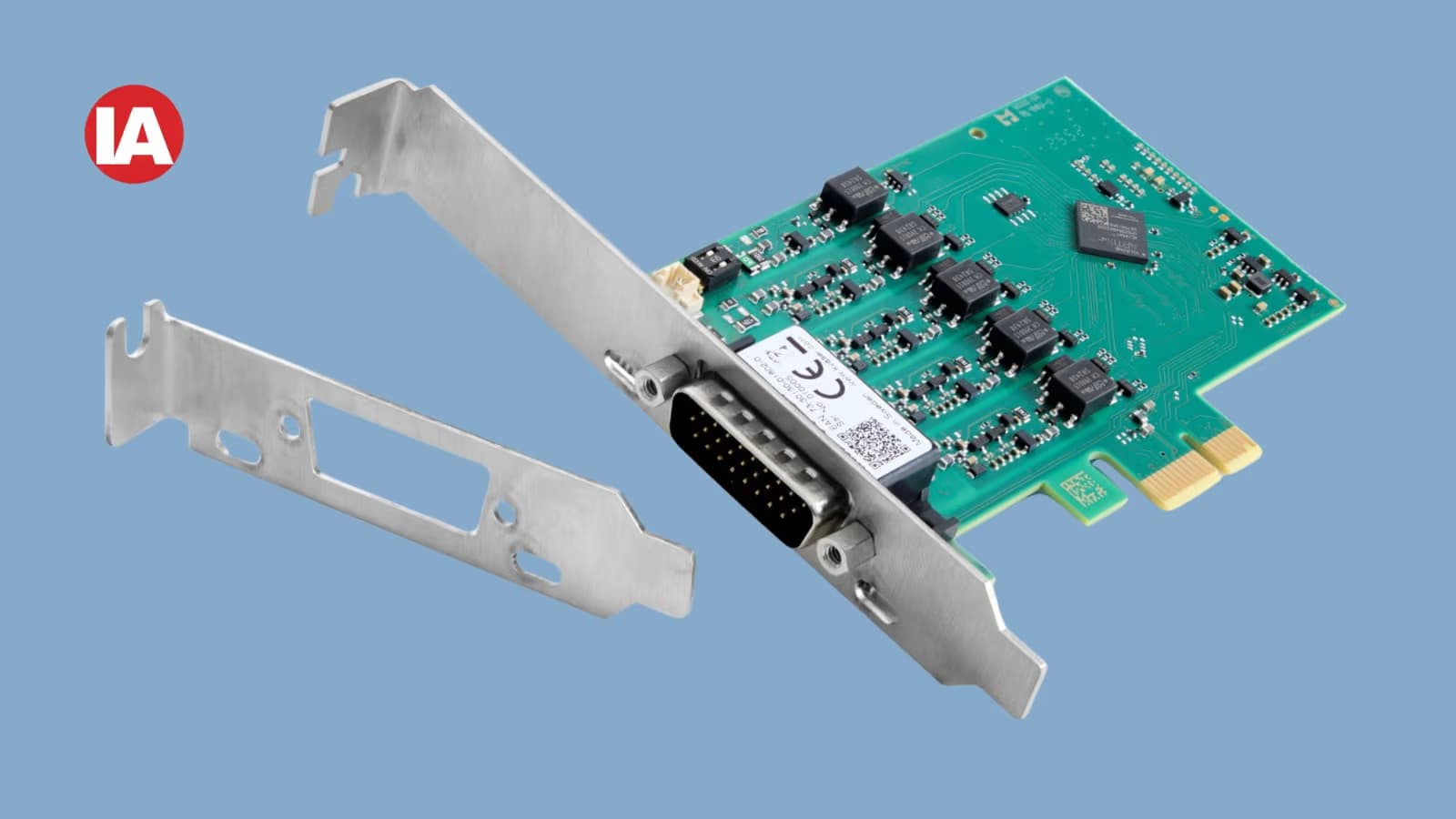
The Kvaser PCIe 4xLIN provides four individually galvanically isolated LIN channels through a single PCIe card
Mölndal, Sweden – June 29, 2026: Kvaser has introduced the PCIe 4xLIN, a compact four-channel LIN interface built for deterministic communication, precise timing analysis, and scalable validation setups. Designed for desktop, industrial, and HIL environments, the low-profile PCIe card integrates galvanic isolation with synchronised timestamping, giving engineers reliable, system-level visibility when testing and debugging LIN networks.
The Kvaser PCIe 4xLIN provides four individually galvanically isolated LIN channels through a single PCIe card. FPGA-based Kvaser LIN-IP technology enables communication up to 20 kbaud with 1 µs timestamp resolution, allowing developers to capture timing-sensitive events with high precision and improve visibility during debugging and validation. The interface also supports simultaneous operation with multiple Kvaser interfaces, enabling test setups to scale as system complexity grows.
Thomas Roberts, Kvaser’s CCO comments: “LIN continues to play a critical role in modern vehicle architectures, particularly as the number of distributed electronic functions grows. As systems scale, the challenge isn’t just accessing LIN data but in capturing and correlating it reliably across channels and interfaces. That’s exactly what the PCIe 4xLIN is designed to address.”
Faster integration with existing tools: The Kvaser PCIe 4xLIN is fully compatible with applications built on the standardised Kvaser LINlib API, integrating into existing setups without requiring software changes. Applications developed for other Kvaser LIN hardware can run without modification, enabling teams to move quickly between projects and interfaces.
The interface supports both Windows and Linux and works with the Kvaser CANlib SDK, which includes LINlib and other APIs, examples for C, C++, C#, Python, Delphi, and Visual Basic. It is installed directly in a PCI Express slot and is powered through the host system, reducing cabling and simplifying integration in compact systems and test racks.
Accurate, system-wide time synchronisation: The Kvaser PCIe 4xLIN supports Kvaser’s software-based TimeSync, helping engineers maintain synchronised timestamps across multiple devices and systems. In distributed test environments, this improves event correlation across LIN and CAN networks while reducing manual log analysis.
On Linux platforms, the interface exposes a PHC device for time synchronisation to a host-referenced clock source, using standard tools such as phc2sys. This provides a robust foundation for synchronised logging, automated testing, and accurate event analysis across connected systems.
Designed for demanding environments: The Kvaser PCIe 4xLIN is engineered for industrial and embedded systems, operating in temperatures from -40 °C to +85 °C. Its low-profile PCIe design includes both short and long mounting brackets for flexible installation.
A single 26-pin high-density D-SUB connector provides access to all four LIN channels, enabling compact system design. Typical applications include ECU development, automotive body electronics, HIL testing, multi-channel logging, and industrial LIN communication systems.
Availability: The Kvaser PCIe 4xLIN will be available from July 2026.