Digital twins transform process plants from opaque, reactive systems into transparent, predictive, and adaptive enterprises, says Benedicta Chettiar.
The process industry—encompassing oil and gas, chemicals, pharmaceuticals, power, metals, and food and beverage—operates in an environment defined by complexity, high capital intensity, and stringent safety and regulatory requirements. In this context, the digital twin has emerged as one of the most transformative technologies of the past decade.
Defining the Digital Twin as a Virtual Replica
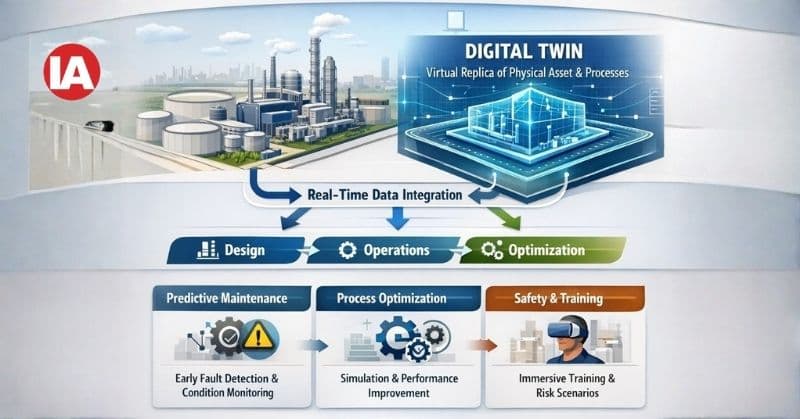
A digital twin is a dynamic, virtual replica of a physical asset, process, or entire plant that is continuously updated with real-time data. Its relevance in the process industry lies in its ability to bridge the gap between design, operations, and operational optimisation across the entire lifecycle of an asset.
Traditionally, process plants have relied on static models during the design phase and on historians and dashboards during operations. These systems often remain siloed, limiting visibility and predictive capability. Digital twins unify engineering models, operational data, and advanced analytics into a living system. This allows operators and engineers to not only see what is happening in the plant, but also understand why it is happening and what is likely to happen next.
Advancing Asset Performance and Reliability
One of the most powerful applications of digital twins is in asset performance and reliability management. By continuously comparing expected behavior with actual performance, a digital twin can detect anomalies early—long before they escalate into failures.
In a refinery, for example, a digital twin of a compressor or heat exchanger can predict fouling, vibration issues, or efficiency losses. Maintenance teams can then shift from reactive or calendar-based maintenance to condition-based and predictive strategies, reducing unplanned downtime and extending asset life.
Driving Operational Optimisation and Sustainability Targets
Operational optimisation is another major driver for industrial automation. Process plants operate under constantly changing conditions: feedstock quality varies, demand fluctuates, and energy prices rise and fall. A digital twin enables “what-if” simulations in real-time.
Operators can test changes in operating parameters, production rates, or energy usage in a virtual environment before applying them to the physical plant. This capability improves yield, reduces waste, and lowers energy consumption—critical outcomes in an era of margin pressure and sustainability targets.
Safety, Training, and Regulatory Compliance
Safety and training also benefit significantly. Process industries deal with hazardous materials and high-risk operations. Digital twins provide immersive, realistic environments for operator training and emergency response drills without exposing personnel or assets to danger. New operators can practice startups, shutdowns, and abnormal situations, while experienced staff can rehearse rare but critical scenarios, improving preparedness and reducing human error.
From a lifecycle perspective, digital twins dissolve the traditional boundaries between engineering, construction, and operations. Engineering data created during the design phase becomes the foundation of the operational twin. As-built and as-operated conditions are continuously fed back into the model, ensuring that documentation remains accurate over decades of plant life. This continuity reduces costly rework during revamps, debottlenecking projects, and regulatory requirements audits.
Decarbonisation and the Path to Net Zero
As the process industry confronts decarbonisation, digital twins are becoming indispensable. They enable plants to model emissions, energy flows, and the impact of new technologies such as hydrogen, carbon capture, and electrification. Companies can evaluate pathways to net zero with far greater confidence and speed.
In essence, digital twins transform process plants from opaque, reactive systems into transparent, predictive, and adaptive enterprises. Their relevance is no longer limited to innovation leaders; they are fast becoming a foundational element of how modern process industries design, operate, and evolve in a world that demands efficiency, resilience, and sustainability.
FAQ
1. What is a digital twin in the process industry?
A digital twin is a dynamic virtual replica of a physical asset, process, or an entire plant. Unlike static models, it is continuously updated with real-time data to bridge the gap between initial design and continuous operational optimisation.
2. How do digital twins improve safety in oil and gas?
They provide immersive, realistic environments for operator training and emergency response drills. This allows personnel to practice high-risk maneuvers, such as startups and shutdowns, in a safe virtual space without exposing themselves or physical assets to danger.
3. Can digital twins help reach sustainability targets?
Yes. Digital twins allow companies to model emissions, energy flows, and the impact of green technologies like hydrogen and carbon capture. By simulating "what-if" scenarios, plants can identify the most efficient pathways to decarbonisation and net-zero goals.
4. What is the role of predictive capability in industrial automation?
Predictive capability enables maintenance teams to detect anomalies—such as equipment vibration or heat exchanger fouling—long before a failure occurs. This shifts the strategy from reactive maintenance to condition-based care, significantly reducing unplanned downtime.
5. How does a digital twin assist with regulatory requirements?
In industries like pharmaceuticals and chemicals, compliance is critical. Digital twins maintain an accurate, continuous record of as-built and as-operated conditions, which simplifies the documentation process for regulatory requirements and audits.
6.Which sectors benefit most from digital twin technology?
While applicable across many fields, the technology is essential for the process industry, specifically oil and gas, chemicals, pharmaceuticals, power generation, metals, and food and beverage.
Visit for more insights: https://www.industrialautomationindia.in/
Benedicta Chettiar is Editor & Publisher of Industrial Automation; and Manager, Strategic Developments, at IED Communications. Besides these roles, Beni, as she is known, is also actively managing the affairs of Jyothi Process, a state-of-the-art printing press.
Author