Krisha Chettiar makes a case for circular economy as an imperative to face the dual challenges of economic viability and environmental responsibility.
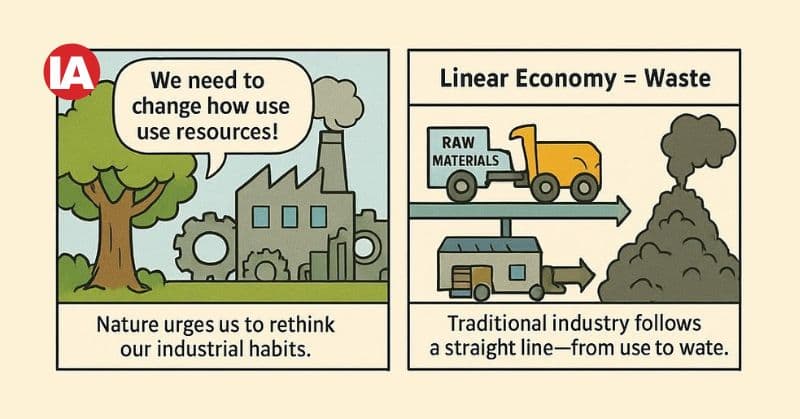
The existing linear economic paradigm is fundamentally unsustainable, as seen by the increasing demand on the world's resources, which range from fossil fuels to water and rare earth elements. With the globe struggling with resource depletion, eco1ogical degradation, and unstable supply chains, traditional manufacturing systems focused on extraction, use, and disposal are no longer feasible. In response, the circular economy—which is based on the ideas of waste reduction, regeneration, and reuse—has become a viable and strategic alternative. However, putting this paradigm into practice on a large scale requires intelligent systems—automation and digital technologies that make circularity operational and quantifiable—in addition to changes in policy and thinking.
Smart manufacturing is the key

The key infrastructure that makes circularity possible today is smart manufacturing. Manufacturing companies may monitor material flows, optimise energy use, and prolong product life cycles in real time by combining cyber-physical systems, the Internet of Things, and data-driven decision-making. What started as a conceptual model is transformed into a working, closed-loop production ecosystem through automation. For example, AI systems assist in readjusting production in accordance with real demand, which minimises waste and overproduction. Predictive maintenance, lifecycle management, and process efficiency—all essential components of circularity—are improved by machine learning algorithms. This is enhanced by blockchain technology, which guarantees trust and traceability. Blockchain confirms the origin, management, and sustainability of materials from sourcing to end-of-life reuse. Distributed ledgers offer a tamper-proof method of managing circular supply chains, while smart contracts automate compliance and verify environmental claims. Blockchain technology and artificial intelligence work together to create transparent, flexible, and regenerative industrial systems.
In shared economy models, waste management, and reverse logistics, their combined influence is especially noteworthy. Blockchain guarantees the safe traceability of recovered materials, while AI forecasts waste generation and optimises sorting. Manufacturers may recover value, maintain regulatory compliance, and strengthen consumer confidence in sustainable products because of this synergy. Business models are also changing as a result of the shift to circular automation. Companies are moving away from ownership and toward usage-based services, like leasing, remanufacturing, and service models, thanks to smart technology. These are more sustainable by nature, and real-time data and remote diagnostics are making them possible more and more. But there is some resistance to this change. SMEs frequently encounter financial and technological obstacles when implementing automation for circularity. Progress is also hampered by infrastructural limitations, data interoperability, and unclear regulations. However, the rationale for investing in automation as a circular facilitator becomes stronger as the economic and
ecological benefits become more apparent. The transition to circular manufacturing is ultimately an operational transformation rather than merely a sustainability objective. In order to do this, digital infrastructure must be in line with environmental principles. Automation is now about resilience, regeneration, and long-term value creation rather than merely efficiency. When combined with automated action, circular thinking transforms the way industries develop, create, and consume.
The net-zero approach

Due to economic pressures, sustainability objectives, and legal frameworks, the global transition to net-zero manufacturing is quickening. The net-zero approach transforms industrial processes by combining intelligent technology and circular economy principles, going beyond discrete emission reductions. Designing systems that replenish resources and value is more important than only minimising harm. At the core of this change is smart manufacturing. With the use of Industry 4.0 technologies, such as artificial intelligence (AI), the Internet of Things (IoT), digital twins, and sophisticated automation, factories can now optimise energy and material use, enable closed-loop processes, and adjust operations in real time. These technologies offer the reactivity, efficiency, and openness required to satisfy changing environmental regulations while preserving competitiveness.
AI-driven analytics are essential because they can forecast demand, cut waste, and match output to current needs. These insights are converted into quick, repeatable action through automation. Carbon tracking, responsible sourcing, and the validation of circular processes are made possible by blockchain and traceability technologies, which strengthen material accountability throughout supply chains. By prolonging product life cycles, designing for reuse, and lowering reliance on virgin resources, circular automation improves operational resilience. Additionally, it encourages adherence to new carbon pricing and regulations. Scalable circular models are essential to the industrial future, and automation makes this possible. Manufacturers may transform strategic ambition into quantifiable action by coordinating data, processes, and environmental objectives. The goal of this new paradigm is circular thinking, and the force behind it is automated action.
Waste as a recoverable asset
The circular economy is a revolutionary operational paradigm, not just a sustainability tactic. Its main goal is to minimise waste and maximise resource utility for long-term economic resilience as well as environmental benefits. According to this concept, waste is reframed as lost value—an opportunity that may be recovered and reincorporated into the production cycle given the correct resources and attitude. Lean and other well-known manufacturing techniques offer a solid basis for circularity. Circular goals are easily aligned with lean strategies like value stream mapping and the removal of process inefficiencies (Muda), variability (Mura), and overburdening (Muri). Adopting digital lean systems helps firms make better decisions and promote cross-functional cooperation in locating and removing operational waste that goes unnoticed.
This convergence is currently being accelerated by smart manufacturing technology. Advanced analytics, real-time monitoring tools, and fast industrial data systems are helping firms view waste as a recoverable asset rather than a byproduct. Production teams can monitor energy and material flow in great detail thanks to visual control systems and intelligent automation, which generate actionable insights that direct process optimisation and guarantee adherence to sustainability goals. Results are observable across industries: decreased inspection overheads, streamlined inventory, and better equipment use have demonstrated how digital technologies can directly result in quantifiable gains. More circular, efficient manufacturing is made possible by improved system performance visibility, predictive resource control, and integrated data sharing throughout value chains.
The ability to measure resource use across environmental, social, and economic dimensions; the ability to optimise and reduce resource consumption through real-time control and feedback; and the deployment of reliable track-and-trace systems that offer a full lifecycle view of parts, materials, and products are the three fundamental capabilities that underpin the circularity journey. These components are necessary to meet new international requirements like the Digital Product Passport and to implement closed-loop strategies. Smart manufacturing technologies are emerging as key components of the global circularity movement. Manufacturers have a scalable route to resource efficiency, regulatory readiness, and sustainable value generation when they combine digital infrastructure with lean culture. This combination of automation and circular thinking is a critical step for industry in creating operations that are future-proof in a world with limited resources.
Conclusion
The integration of circular economy concepts with smart manufacturing is no longer aspirational; rather, it is imperative as industries face the dual challenges of economic viability and environmental responsibility. The way we create, produce, and reuse resources is being drastically changed by the convergence of automation, data intelligence, and closed-loop thinking. This change aims to create resilient, adaptive, and regenerative industrial ecosystems rather than just lessening harm. Circularity and automation will become key pillars of competitive manufacturing over the next ten years. AI-driven life cycle optimisation, digital product passports, and real-time carbon tracking will all be commonplace in industrial operations. Even historically linear businesses will be pushed toward circular compliance models as regulations in important markets, especially in the EU and Asia, increasingly require traceability, material transparency, and waste accountability. Manufacturing's future will be determined by value—value that is recovered, kept, and regenerated—rather than volume. The vision will be established via circular thinking in that future, and it will be carried out by automated action. Businesses that view technology as a catalyst for change toward a genuinely regenerative industrial economy, rather than merely as a tool, will prosper.
Krisha Andrew Chettiar, Research Associate at Industrial Automation Magazine, combines a background in Economics and Statistics with a deep interest in the future of industrial technologies. As a third-generation contributor to this legacy, she brings fresh insight into automation trends with a keen research-driven lens.
Author