Building Flexible Pharmaceutical Production Through Modular Motion Platforms
Discover how HIWIN modular motion architectures, Cartesian robots, and precision linear guides support flexible, scalable pharmaceutical production lines.
Combining configurable motion technologies
How HIWIN is supporting pharmaceutical growth with modular automation as production becomes more diversified.
India’s growing pharmaceutical industry requires manufacturers to expand production while managing product diversity, regulatory expectations, traceability, and process consistency. Because batch, format, and layout changes may require equipment modification and revalidation, modular motion architectures can provide greater adaptability through standardised modules, coordinated control, and configurable platforms. Low-code engineering may also enable validated functions and templates to be reused where appropriate, while application-specific risk assessment and validation remain essential.

Motion platforms for pharmaceutical processing applications
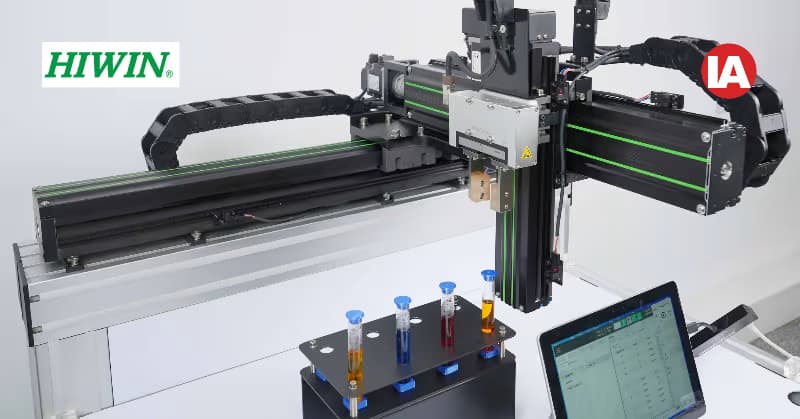
HIWIN Total Solution combines configurable motion technologies to meet specific process requirements rather than providing a fixed product package. The HRCR Cartesian Robot integrates modular linear axes into a coordinated multi-axis platform for applications such as vial handling, tray transfer, sample preparation, material loading, and pick-and-place operations. Its suitability depends on proper sizing, control tuning, and system validation.
High-speed positioning for packaging and labeling processes
Packaging lines require coordinated positioning across blister handling, labeling, cartooning, and product-transfer stations. HIWIN KH Series Single-Axis Robots can be integrated into short-stroke positioning applications such as labeling, blister handling, and secondary packaging. Performance depends on load conditions, drive settings, installation accuracy, and maintenance.

Translating HIWIN total solution into a pharmaceutical equipment architecture
HIWIN Total Solution can be understood as a layered motion and control architecture. At the component layer, linear guideways provide guidance and load support, while ball screws convert motor rotation into linear motion. At the axis layer, servo motors and drives provide actuation, and KH Series Single-Axis Robots serve as configurable positioning units. At the workstation layer, HRCR Cartesian Robots coordinate multi-axis handling and transfer. At the line level, the motion controller synchronises these axes with filling, inspection, labeling, and packaging equipment.
Applying the architecture across pharmaceutical equipment

Within vial-handling stations, the HRCR Cartesian Robot can coordinate sorting, transfer, and pick-and-place sequences across multiple axes. The configuration should be selected according to payload, travel, cycle time, and cleanliness requirements. For filling equipment, ball screws can support suitable dosing, nozzle-height adjustment, or indexing axes, while linear guideways provide guidance and load support. The design must consider axial load, stiffness, backlash, lubrication, sealing, and cleaning procedures.
Labeling and packaging equipment use short-stroke positioning for product alignment, label application, format adjustment, and transfer between stations. KH Series Single-Axis Robots can provide configurable axes for these tasks. Servo motors and drives supply the commanded torque, speed, and positioning response, while the motion controller coordinates these axes with sensors and adjacent stations. The common control basis may simplify reuse of motion functions when machines share similar operating logic, but it does not replace application software, safety design, or validation.

Conclusion: Modular motion as a basis for flexible pharmaceutical automation
As pharmaceutical production becomes more diversified, automation systems must balance flexibility, scalability, process consistency, and regulatory requirements. Cartesian robots, single-axis modules, linear guideways, ball screws, servo systems, and motion controllers can be configured for different processes, provided that sizing, environmental compatibility, control integration, risk assessment, and qualification are properly addressed.