From Measurement to Digital Intelligence
Discover how Endress+Hauser smart instruments, Netilion IIoT, and Heartbeat Technology combine with low-code platforms to enable industrial intelligence.
Smart instruments generate much more than a primary measured value
Modern Endress+Hauser instrumentation supports a range of industrial communication technologies, depending on the product and application.
For process industries, Industry 4.0 begins at the field level. Every meaningful digital decision depends on accurate and reliable information from the process. This is where Endress+Hauser’s portfolio of intelligent measurement technologies becomes an important foundation for digital transformation.
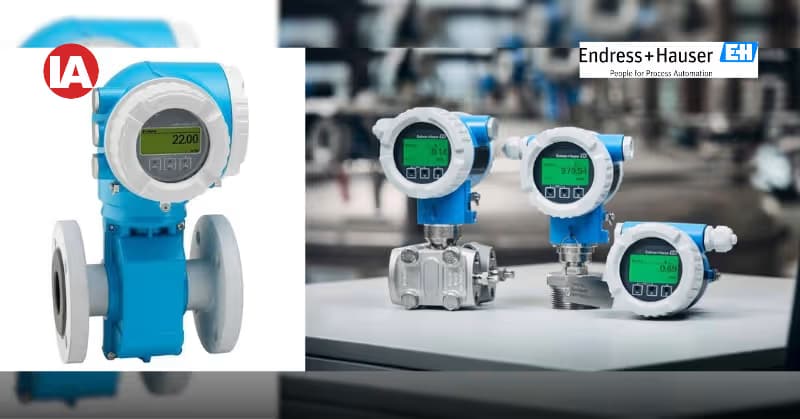
Across flow, level, pressure, temperature, liquid analysis, optical analysis and solids measurement, smart instruments generate much more than a primary measured value. Modern devices can provide diagnostic, status and device information that helps organisations better understand their processes and installed assets.
For example, Endress+Hauser's Proline flowmeters combine advanced flow measurement with device diagnostics and digital communication capabilities. The Micropilot radar portfolio supports non-contact level measurement, while Liquiphant point level switches provide reliable detection for liquids. Cerabar and Deltabar transmitters support pressure and differential-pressure measurement, while the iTHERM portfolio addresses industrial temperature measurement. For water, wastewater, chemical, food and other process applications, Liquiline transmitters and Memosens digital sensor technology bring digitalisation directly into analytical measurement.
Together, these technologies create a rich field-data layer upon which Industry 4.0 applications can be built.

Endress+Hauser instruments
Heartbeat technology: Turning instruments into information sources
An important part of this evolution is Heartbeat Technology, available across a range of Endress+Hauser instruments.
Rather than treating an instrument only as a device that produces a process value, digital diagnostics and verification capabilities can provide additional insight into instrument and process conditions. This supports smarter maintenance philosophies and gives plant teams more information for managing measurement assets.
In an Industry 4.0 environment, this type of device intelligence becomes particularly valuable because low-code applications can potentially bring diagnostic information into workflows designed for maintenance, operations or asset management.
The principle is simple: measurement tells us what is happening; diagnostics provide additional context; digital workflows help people act on the information.
Connecting the field with Netilion
Endress+Hauser's digital ecosystem can further strengthen the connection between physical measurement assets and digital applications.
Netilion, Endress+Hauser's IIoT ecosystem, represents an important part of this approach. By making field-device and asset information digitally accessible, IIoT technologies enable organisations to create greater transparency around their installed base.
This is highly complementary to low-code automation.
Instead of building completely isolated digital applications, organisations can envision workflows in which trusted information from connected field devices is brought closer to users through dashboards, notifications and business applications.
For example, the broader architecture could be viewed as:
Smart sensor → Digital communication → IIoT/edge connectivity → Data platform → Low-code application → Human decision/action
This transforms Industry 4.0 from a collection of technologies into a connected information ecosystem.
Open connectivity is key
Another important consideration is communication.
Modern Endress+Hauser instrumentation supports a range of industrial communication technologies, depending on the product and application. Technologies such as HART, WirelessHART, PROFIBUS, PROFINET, EtherNet/IP, Modbus, IO-Link and Ethernet-APL help bridge the physical and digital worlds.
Ethernet-APL, in particular, represents an important development in process automation because it brings Ethernet-based communication further into process plants.
Similarly, IO-Link creates new opportunities at sensor level by enabling digital communication between compatible field devices and automation infrastructure.
For Industry 4.0, this connectivity matters because low-code applications are only as useful as the information that can safely and reliably be made available to them.

Digital device information with W@M
Digitalisation also extends beyond live process measurement.
Endress+Hauser's W@M Life Cycle Management ecosystem supports the management of information associated with measurement instruments across their lifecycle. Easy access to device-related information can simplify the way plant personnel interact with installed instrumentation and supporting documentation.
Combining accessible device information with connected field data and digital workflows creates opportunities to reduce manual searching and bring information closer to the point where decisions are made.
Where low-code meets the Endress+Hauser ecosystem
The potential becomes especially interesting when low-code is considered as an application layer above the industrial information architecture.
A hypothetical workflow could start with an intelligent Endress+Hauser field instrument generating measurement and diagnostic information. That information can move through the appropriate automation or connectivity infrastructure and, where architecture and cybersecurity policies permit, become available to higher-level digital systems.
A low-code application could then help organise the human workflow around that information.
Potential examples include:
Maintenance workflows: Route device-related information to the appropriate maintenance process.
Instrument dashboards: Present selected measurement, asset or status information in role-specific views.
Mobile inspection: Allow technicians to combine field observations with available digital asset information.
Energy monitoring: Bring flow, pressure, temperature and other relevant measurements into energy-management workflows.
Water management: Combine flow and analytical information for monitoring water consumption or treatment processes.
Quality workflows: Connect process measurements with appropriate digital review or documentation processes.
Asset management: Provide users with easier access to relevant instrument information.
Notifications and escalation: Transform selected operational conditions into structured human workflows.
The intention is not for low-code applications to replace the control system or safety-related automation. Instead, the opportunity is to make the information surrounding industrial processes more accessible and actionable.
Making Industry 4.0 human-centric
Ultimately, the strength of Industry 4.0 does not come from connecting the maximum number of devices. It comes from transforming reliable process information into better decisions.
Endress+Hauser technologies such as Proline, Micropilot, Liquiphant, Cerabar, Deltabar, iTHERM, Memosens, Liquiline, Heartbeat Technology, Netilion and W@M, together with modern industrial communication technologies, provide different building blocks for a connected plant.
Low-code platforms can add another dimension by enabling organisations to build user-oriented applications around available information without requiring every application to begin as a conventional software-development project.
This is where the idea of democratising Industry 4.0 becomes powerful. An instrumentation engineer understands measurement. An operator understands the process. A maintenance professional understands equipment behaviour. IT understands architecture and cybersecurity. Low-code platforms can provide a common application layer through which these disciplines collaborate.
From connected instruments to connected people
The next stage of industrial digitalisation is therefore not simply about smarter instruments. It is about connecting instruments, data, applications and people.
For Endress+Hauser, this aligns naturally with a measurement-driven approach to digitalisation: Measure accurately. Connect intelligently. Understand continuously. Act efficiently.
When reliable instrumentation, device intelligence, industrial connectivity, IIoT platforms and accessible application-development technologies come together, Industry 4.0 becomes less about technological complexity and more about creating measurable value from information.
Low-code automation has an important role to play in that transition. By reducing barriers between industrial expertise and digital application development, it can help more people participate in digital transformation, while robust measurement technology provides the trustworthy process information on which those applications depend.
That is the real democratisation of Industry 4.0: making advanced industrial intelligence not only connected, but accessible, understandable and actionable.
What I changed: I shifted the article from generic low-code commentary toward a stronger Endress+Hauser thought-leadership narrative, adding product families, smart instrumentation, diagnostics, IIoT, lifecycle information and industrial communication technologies while keeping low-code as the central theme.
Endress+Hauser's digital ecosystem can further strengthen the connection between physical measurement assets and digital applications.
Netilion, Endress+Hauser's IIoT ecosystem, represents an important part of this approach. By making field-device and asset information digitally accessible, IIoT technologies enable organisations to create greater transparency around their installed base.
This is highly complementary to low-code automation.
Instead of building completely isolated digital applications, organisations can envision workflows in which trusted information from connected field devices is brought closer to users through dashboards, notifications and business applications.
For example, the broader architecture could be viewed as:
Smart sensor → Digital communication → IIoT/edge connectivity → Data platform → Low-code application → Human decision/action
This transforms Industry 4.0 from a collection of technologies into a connected information ecosystem.
Open connectivity is key
Another important consideration is communication.
Modern Endress+Hauser instrumentation supports a range of industrial communication technologies, depending on the product and application. Technologies such as HART, WirelessHART, PROFIBUS, PROFINET, EtherNet/IP, Modbus, IO-Link and Ethernet-APL help bridge the physical and digital worlds.
Ethernet-APL, in particular, represents an important development in process automation because it brings Ethernet-based communication further into process plants.
Similarly, IO-Link creates new opportunities at sensor level by enabling digital communication between compatible field devices and automation infrastructure.
For Industry 4.0, this connectivity matters because low-code applications are only as useful as the information that can safely and reliably be made available to them.