Quality Starts at the Core – Cleanroom Ceramic Production
Endress+Hauser highlights how cleanroom ceramic production ensures accuracy, stability, and reliability in capacitive pressure sensors.
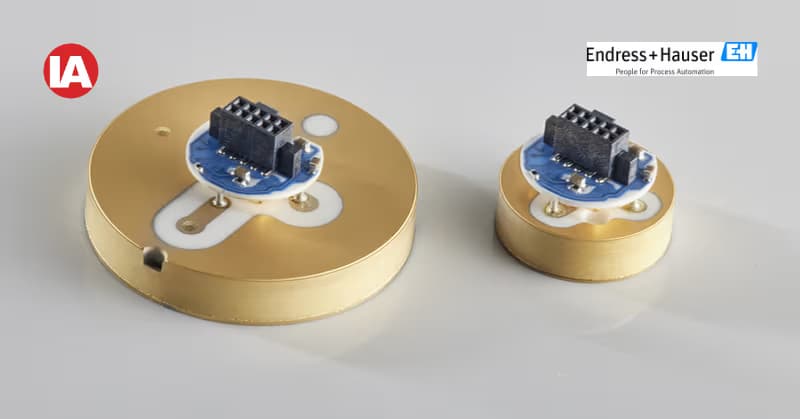
Capacitive ceramic pressure sensors
How cleanroom ceramic production defines the performance of capacitive pressure sensors.
In industrial automation, sensor quality is often discussed in terms of accuracy, robustness, or long-term stability. Yet the true foundation of these characteristics is established much earlier – during sensor production itself. For capacitive ceramic pressure sensors in particular, manufacturing conditions, material quality, and process control are decisive factors that directly determine performance in the field.
At Endress+Hauser Sensors & Components, capacitive ceramic pressure sensors are manufactured under strictly controlled cleanroom conditions. This approach is not an optional refinement, but a fundamental requirement to ensure stable measurement accuracy, reproducibility, and long-term reliability – especially in demanding industrial and hygienic applications.
Why ceramic sensors require cleanroom manufacturing
Capacitive ceramic pressure sensors are based on highly sensitive measuring structures. Even microscopic particles, surface contamination, or process deviations during production can negatively affect sensor functionality, signal stability, or long-term drift behaviour.
For this reason, Ceracore ceramic capacitive measuring cells are produced in a cleanroom environment. These conditions minimise particle-related disturbances throughout the entire manufacturing process and form an essential pillar of quality assurance.
Cleanroom production ensures that every step – from raw material inspection to final testing – takes place under controlled environmental conditions.
High-purity ceramic as a performance enabler
In addition to controlled manufacturing conditions, material selection plays a central role in sensor quality. The ceramic diaphragms used in Endress+Hauser’s capacitive sensors consist of 99.9% high-purity aluminum oxide (Al₂O₃). This material offers a unique combination of mechanical strength, chemical resistance, and long-term stability.
Ceramic diaphragms are inherently resistant to abrasive, corrosive, and aggressive media. In contrast to metallic membranes, they do not suffer from corrosion, fatigue caused by pressure cycling, or degradation due to chemical media. This makes ceramic capacitive sensors particularly suitable for harsh industrial environments as well as hygienic applications where product safety and cleanability are essential.
Furthermore, ceramic measuring cells operate as dry systems. Unlike oil-filled metallic sensors, there is no risk of process contamination. This oil-free design eliminates a critical failure mode and significantly reduces risk in sensitive industries such as pharmaceuticals, food & beverage, and life sciences.
From raw material to measuring cell: a controlled process chain
The quality of a capacitive ceramic sensor is the result of a precisely defined and fully traceable production chain. Each sensor element passes through a sequence of standardised manufacturing and inspection steps, all of which are documented and continuously monitored.
The process begins with the inspection of raw ceramic materials, followed by cleaning, gold coating and joining processes. Each stage is subject to defined quality checks to ensure consistency and reliability.
Before integration with electronics, the sensor element undergoes multiple inspections, including optical checks and electrical measurements. For absolute pressure versions, additional stress tests and rechecking procedures are applied to verify stability under extreme conditions.
Only after passing all defined quality gates is the sensor element combined with signal conditioning electronics, followed by final inspection and testing. Depending on the individual requirements and selected technical characteristics, each sensor is calibrated and compensated at multiple pressure and temperature points.
Reproducibility, traceability, and long-term sensor quality
Standardised processes, comprehensive documentation, and clearly defined inspection criteria ensure that every sensor meets the same performance requirements – regardless of batch size or application. Full traceability allows deviations to be detected early and corrected systematically.
Each sensor is tested against defined characteristics, enabling targeted quality control rather than random sampling. This systematic approach supports stable measurement accuracy and minimises long-term drift in real-world applications.
The result is a measuring cell that delivers consistent performance over extended service life, even under challenging conditions such as pressure shocks, temperature fluctuations, or exposure to aggressive media.
A foundation for reliable industrial automation
In industrial automation, sensors are often hidden deep inside machines and systems, yet their performance determines overall process reliability. By combining high-purity ceramic materials with uncompromising cleanroom production, Endress+Hauser Sensors & Components establishes a solid foundation for capacitive ceramic pressure sensors that meet the highest quality expectations.
Quality, in this context, is not a marketing promise - it is the result of disciplined manufacturing, material expertise, and continuous quality control. And it all begins at the core: in the cleanroom.
Ceracore Sensor USC30 and USC70, as well as Ceracore Transducer UTC30, cover measuring ranges from 100 mbar to 100 bar, offer outstanding overload resistance, long-term stability, andadditional process information such as temperature data. The capacitive ceramic devices are available with analog (ratiometric, absolute) or digital output signals (SPI, UART). The modular design of the product family provides the basis for customised product adaptations.
Endress+Hauser is globally known for its wide range of measuring technologies and field instruments. The business unit Endress+Hauser Sensors & Components focuses on the core technologies for level and pressure measurements. Its interdisciplinary team offers more than sensors alone – it provides over three decades of experience in customised solutions and co-development, tailored to individual application requirements.
These solutions are used across a wide range of industries, including water monitoring in rivers and reservoirs, pressure monitoring for safety measures in hazardous environments, laboratory applications, and tank level measurement in maritime operations. Endress+Hauser Sensors & Components supports customers from the initial product idea through to series production – establishing long-term, reliable partnerships based on individual customer requirements.
Seeing Quality in Action: Insights into the cleanroom from Endress+Hauser