Mobile Cobots & Safe Human-Robot Collaboration
Virya Autonomous Technologies Pvt Ltd explores how mobile cobots and AMRs enable safe human-robot collaboration in modern smart factories.
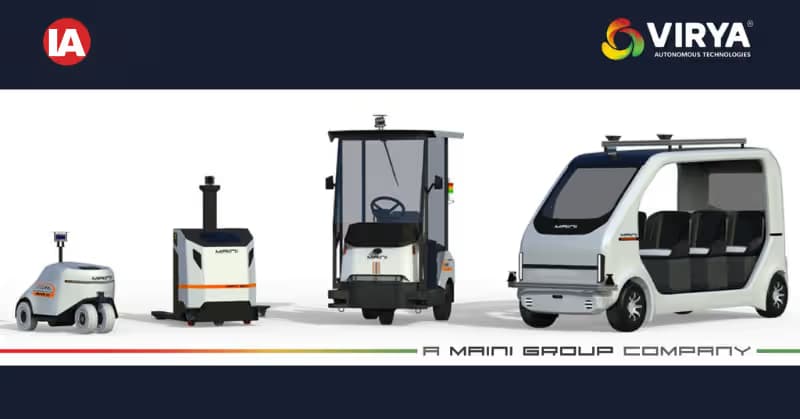
The Virya Autonomous Technologies range
Prahalad Ramarao offers a strategic perspective – Customer & Technology Views.
Virya Autonomous Technologies. As manufacturing ecosystems evolve, the conversation is shifting from automation in isolation to intelligent collaboration. Mobile Cobots and Autonomous Mobile Robots operating safely alongside people are redefining how factories approach productivity, scalability, and workplace safety.
Customer Perspective
1. What truly defines a cobot – and how is it different from traditional industrial robotics?
A collaborative robot, or cobot, is designed to operate safely in shared human environments. Unlike traditional industrial robots that function within fenced cells, cobots are engineered around coexistence. In intralogistics, AMRs serve as Mobile Cobots navigating shop floors, warehouses, and yards alongside people and manually driven equipment.
2. How does one gradually transition to a fleet of Mobile Cobots (AMRs) while still managing operator-driven MHEs?
Full automation rarely happens overnight. Successful deployments follow a phased coexistence strategy. AMRs initially handle repetitive routes while manual MHEs manage complex tasks. Over time, traffic zones are structured, workflows digitised, and fleet orchestration aligned with production logic ensuring operational continuity and faster RoI.
3. Will cobots reduce RoI due to continued human intervention?
Collaboration often accelerates RoI. Cobots eliminate non-value-added human strain while preserving adaptability. By automating repetitive transport without heavy infrastructure redesign, organisations achieve faster payback and scalable growth.
4. Do you foresee a future where robots completely replace humans in intralogistics?
Total replacement is neither practical nor desirable. Robots manage repetition and physical intensity, while humans focus on supervision, exception handling, and continuous improvement. The future is human-enhanced manufacturing.
Technology Perspective
5. How do modern AMRs ensure safe interaction in dynamic industrial environments?
Mobile Cobots operate in unpredictable environments. Safety is layered through 360° sensing, proximity-based speed modulation, certified safety-rated LiDAR systems, redundant braking mechanisms, and compliance with ISO 3691-4 ensuring predictable and intelligent behaviour.
6. What is fundamental to Virya AMRs operating safely as Mobile Cobots?
At Virya, safety evolves from platform to product. A rugged, heavy-duty vehicle foundation proven over decades ensures structural stability and braking reliability – especially when towing up to 8,000 kg. This is layered with robust autonomous hardware, redundancy, and customisation aligned to customer safety policies. Intelligent software and enterprise integration complete the ecosystem.
7. What is the greatest software differentiation between Mobile Cobots and fenced robotic systems?
Fenced robotics operate in deterministic environments and are process-centric. Mobile Cobots operate in dynamic environments and are context-centric — continuously interpreting movement, adjusting speed, rerouting, and coordinating across fleets.
8. What should one look for in an outdoor Mobile Cobot with respect to safety?
Outdoor collaboration introduces variable lighting, uneven terrain, slopes, and weather exposure. Evaluation must include sensor robustness, stable braking on gradients, load stability, IP-rated protection, and reliable communication architecture. Mechanical stability must precede autonomy.
9. As Cobot fleets scale, what becomes the next big safety challenge?
As fleets scale, safety becomes an orchestration challenge. Congestion, intersection conflicts, and density management require centralised fleet intelligence, real-time traffic governance, predictive analytics, and simulation-led deployment.
Closing Perspective
“The evolution of Mobile Cobots is not about replacing people or replicating fenced automation. It is about engineering intelligent coexistence – safely, predictably, and at scale.”
Author