Strategic Connectivity: The New Frontier in Modular Machine Design
As modular machine design and Industry 4.0 accelerate, connectivity has emerged as a strategic foundation rather than a supporting component. This Editors’ Choice article explores how intelligent, modular connectivity architectures are reshaping machine scalability, reliability, and lifecycle performance—and why early connector selection is now critical for future-ready industrial machinery, with practical insights from HARTING Technology Group.
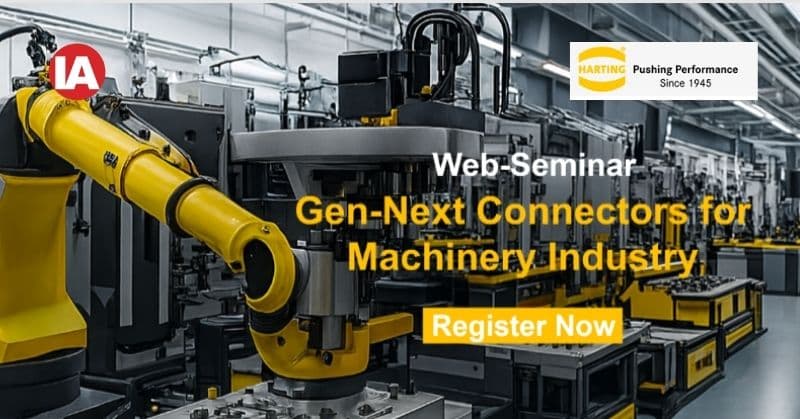
Representative image
In today’s rapidly evolving industrial landscape, machine design is no longer defined only by mechanical robustness or processing speed. The real differentiator increasingly lies in how intelligently a machine is connected—internally and externally. Industrial connectivity has moved from being a supporting element to a strategic design pillar that directly impacts scalability, uptime, safety, and lifecycle cost.
As digitalization, modular production, and smart manufacturing accelerate, machine builders and OEMs face a fundamental question: Are our connectivity choices enabling future-ready machines—or silently limiting them?
This Editors’ Choice article explores why selecting the right connectors portfolio is now critical for next-generation machinery design, how modular connectivity architectures transform machine development, and how an upcoming webinar by HARTING India aims to guide engineers through these critical transitions.
The Hidden Bottleneck: Traditional Wiring vs. Modern Scalability
For decades, point-to-point wiring and hardwired terminal blocks have been the backbone of machine electrical design. While proven and familiar, these approaches were conceived for an era of relatively static machines—systems that rarely changed configuration once commissioned.
Modern machinery is different. Today’s systems must prioritize interoperability and flexibility.
Why Traditional Wiring Fails Modern Industry 4.0 Standards
Today’s machines must:
Adapt to multiple product variants via rapid reconfiguration.
Support frequent upgrades without requiring total system overhauls.
Integrate advanced IIoT sensors, actuators, and digital subsystems.
Enable faster installation and global servicing.
Traditional wiring struggles to meet these demands. Large cable bundles, complex routing, manual termination, and limited standardization create significant challenges such as long assembly times, higher risk of wiring errors, and difficult troubleshooting. In many projects, wiring complexity becomes a silent cost driver, consuming engineering hours and increasing the likelihood of downtime.
Connectivity as an Enabler of Modular Machine Design
Next-generation machinery increasingly follows a modular design philosophy. Instead of building a monolithic system, machines are divided into functional modules—feeding units, processing stations, inspection modules, handling systems, and packaging sections.
The Advantages of Modular Industrial Architectures
Modular design delivers major advantages for OEMs:
Parallel Development: Engineering teams can work on machine sections simultaneously.
Mass Customization: Faster adaptation for different customer specifications.
Simplified Maintenance: Easier upgrades and rapid component replacement.
However, modular mechanics alone are not enough. Without modular connectivity, electrical and data interfaces remain a bottleneck. This is where plug-and-play connector-based architectures become essential. By using standardized power, signal, and data connectors at module interfaces, machine builders can transform electrical integration into a repeatable, scalable process.
Shifting from Hardwiring to Plug-and-Play Connectivity
Plug-and-play connectivity replaces extensive hardwiring with pre-terminated cables and standardized connectors. Instead of manually landing hundreds of individual wires, entire subsystems are connected using a few well-defined interfaces.
Key Benefits of Connector-Based Systems
Reduced Wiring Complexity: Connectorized systems drastically reduce individual terminations, lowering assembly time.
Faster Commissioning: Pre-tested cable assemblies allow machines to be assembled and tested at the factory before rapid deployment at customer sites.
Enhanced Reliability: Industrial-grade connectors offer consistent contact quality, vibration resistance, and high IP ratings for environmental protection.
Optimized MTTR (Mean Time to Repair): Faulty modules can be swapped without manual rewiring, drastically reducing production losses.
Future-Proof Scalability: New modules can be integrated using existing interfaces, enabling expansion without a total redesign.
Selecting a Future-Ready Connectors Portfolio
Not all connectors are created equal. Selecting the right portfolio requires an evaluation across several technical dimensions:
Power Requirements: Capacity for high-current motor power alongside low-power control circuits.
Signal and Data Transmission: Support for Industrial Ethernet, digital I/O, and high-speed fieldbus communication.
Environmental Resilience: Protection against dust, moisture, vibration, and EMI (Electromagnetic Interference).
High-Density Form Factors: Compact designs for space-constrained modern machinery.
A holistic connectors portfolio allows designers to select from a family of compatible solutions rather than mixing unrelated components, ensuring system integrity.
Defining Connectivity Strategy in the Early Design Phase
One of the most important lessons for machine builders is that connectivity strategy must be defined early. When connector concepts are introduced late, engineers often adapt connectivity to fit a finalized mechanical layout. This leads to compromises and rework.
Early planning enables:
Consistent module interface definitions.
Optimized cable routing and enclosure design.
Clear separation between power, signal, and data to prevent interference.
Impact on Total Cost of Ownership (TCO)
While connectors may represent a small fraction of the Bill of Materials (BOM), their impact on the Total Cost of Ownership is massive. Investing in high-quality connectivity reduces labor costs, minimizes downtime, and extends the machine's lifecycle through easier upgrades.
Supporting Industry 4.0 and Smart Manufacturing
Smart manufacturing relies on seamless data flow. Connectivity infrastructure is the physical foundation of this data ecosystem. Modern connectors must support high-speed Ethernet, robust EMC protection, and hybrid transmission of power and data. By integrating these capabilities, builders future-proof their designs for predictive maintenance and remote diagnostics.

Learn from Experts: HARTING Technology Group Webinar
To help machine builders and automation engineers navigate these challenges, Harting India is hosting a dedicated webinar: “Reinvent Machine Design with Modular Connectivity.”
The session focuses on:
Plug-and-play connector architectures for rapid deployment.
Early-stage design decisions for modular machines.
Reducing MTTR and improving global serviceability.
Real-world use cases for standardized connectivity.
Who Should Attend?
This webinar is essential for Machine Builders, OEM engineering teams, System Integrators, and Reliability Professionals involved in the design and maintenance of industrial machinery.
Conclusion: Connectivity as a Competitive Advantage
In a market where performance and flexibility define competitiveness, connectivity is a strategic differentiator. Machine builders that embrace modular, standardized, and high-quality connectivity architectures are positioned to deliver machines faster and adapt to future technological shifts with ease.
FAQs:
1. What is modular machine design?
Modular machine design is an engineering approach where a system is built using discrete, functional components or modules. This allows for parallel development, easier customization, and faster maintenance compared to traditional monolithic designs.
2. How does plug-and-play connectivity benefit OEMs?
Plug-and-play connectivity uses standardized connectors and pre-terminated cables. This reduces wiring errors, slashes assembly time, and allows for faster commissioning at the end-user's facility.
3. Why is early-stage connectivity planning important in machine design?
Planning connectivity early ensures that electrical and data interfaces are integrated into the mechanical layout, preventing costly rework and ensuring optimal cable routing and signal integrity.
4. What are the key factors in choosing an industrial connector portfolio?
Engineers should evaluate power requirements, data transmission speeds (like Industrial Ethernet), environmental protection (IP ratings), and space constraints to ensure the portfolio supports the machine's full lifecycle.
5. How does modular connectivity reduce Total Cost of Ownership (TCO)?
It reduces TCO by lowering labor costs during assembly, minimizing downtime through faster module replacement (lower MTTR), and extending the machine's life by making upgrades simpler.
6. Can modular connectivity support Industry 4.0 initiatives?
Yes. By providing robust, high-speed data interfaces and hybrid power/data transmission, modular connectivity creates the physical foundation needed for IIoT, predictive maintenance, and real-time data analytics.

Discover how strategic connectivity is shaping the future of modular machine design.
Register now to explore this technology shift in detail and stay ahead of the curve.
Also visit our LinkedIn post and share your thoughts in the comments.