Digital twins are becoming pivotal in test and measurement by enabling virtual replicas
Dr. Hemal Desai, Vice President – Marketing at Endress+Hauser India, shares insights into the evolving landscape of test and measurement (T&M) in industrial environments. From embracing IIoT and edge computing to the critical role of digital twins, Dr. Desai highlights how Indian industries are moving from reactive to proactive, data-driven practices, particularly in highly regulated sectors like life sciences, oil & gas, and aerospace.
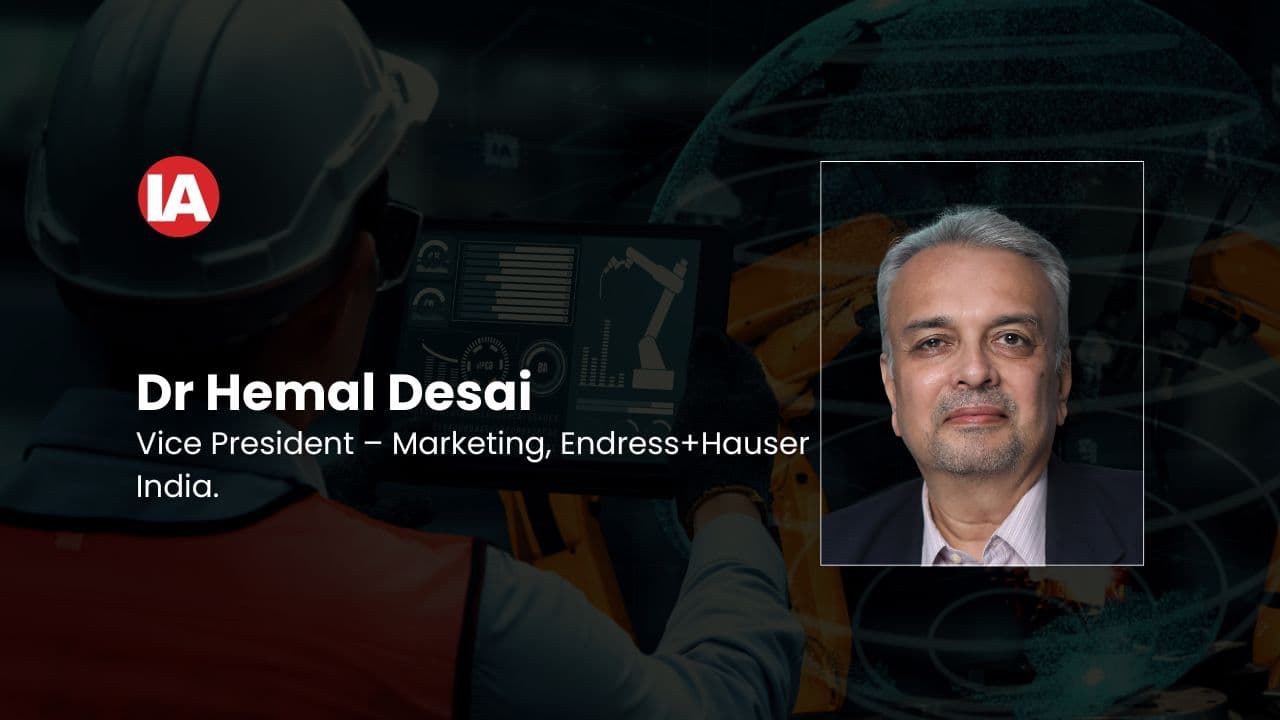
Dr Hemal Desai, Vice President – Marketing, Endress+Hauser India.
How would you describe the current maturity level of test & measurement practices in industrial environments such as manufacturing or process industries?
The maturity level of test and measurement (T&M) practices in industrial environments such as manufacturing and process industries in India is currently in a transitional phase, moving from traditional, manual methods toward more digitally integrated and data-driven approaches. Even though the adoption is fragmented, there is a growing awareness about improving testing maturity. Digital technologies like Industry 4.0 and regulatory requirements are driving the adoption of T&M practices.
What are the most pressing challenges companies face today in implementing effective T&M solutions?
Skill gaps, cost and legacy systems restricting compatibility are the biggest challenges in India.
What role does test & measurement play in compliance and safety assurance across critical industries like oil & gas, pharma, and aerospace?
Let me take an example of the Life Science Industry where compliance and safety play a non-negotiable role.
Ensuring Safety & Efficacy: T&M ensures that drugs meet stringent quality standards for potency, purity, and stability. Instruments like HPLC, GC-MS, and spectrophotometers are used for precise chemical analysis.
Meeting Regulatory Compliance: Compliance with FDA, CDSCO, and WHO-GMP guidelines mandates validated testing protocols and audit trails. Data integrity and electronic records (21 CFR Part 11) are increasingly scrutinised, making automated and traceable T&M systems essential.
In addition every measurement must be traceable to national/international standards. Regular calibration of instruments is essential to maintain accuracy, and increasingly, T&M systems are integrated with MES/ERP systems for real-time compliance tracking and reporting.
How are IIoT (Industrial Internet of Things) and edge computing reshaping the T&M landscape?
IIoT and edge computing are revolutionising test & measurement by enabling real-time, on-site data analysis and instant anomaly detection.
They reduce latency and reliance on centralised systems, boosting efficiency and responsiveness.
Smart sensors and edge AI allow predictive maintenance and adaptive testing in dynamic environments.
Together, they ensure continuous compliance, data integrity, and scalable automation across industries.
How do you see the role of digital twins evolving in the context of test and measurement?
Digital twins are becoming pivotal in test and measurement by enabling virtual replicas of physical systems for simulation and analysis. They allow real-time monitoring and predictive testing, reducing the need for physical prototypes and accelerating product development.
By integrating with IIoT and edge computing, digital twins provide continuous feedback loops for performance optimisation. They support what-if scenarios and stress testing under virtual conditions, enhancing safety and reliability.
In regulated industries, digital twins help ensure compliance through traceable, auditable simulations. As AI and data analytics evolve, digital twins will become more autonomous, enabling self-optimising systems in complex industrial environments.
Do you foresee a transition from periodic testing to continuous, real-time monitoring in more industries? What are the drivers?
Yes, there is a clear transition underway from periodic testing to continuous, real-time monitoring across more industries. This shift is driven by the need for predictive maintenance, minimised downtime, and higher operational efficiency.
Technologies like IIoT, edge computing, and AI are enabling instant data capture and analysis, making real-time insights feasible. Regulatory demands for traceability and compliance are also pushing industries toward continuous monitoring.
As systems become more complex and interconnected, real-time T&M ensures faster response to anomalies and supports proactive decision-making.
(The views expressed in interviews are personal, not necessarily of the organisations represented.)