In most plants, even basic optimisation through automation can bring 5-15% energy savings
Axis Solutions highlights how automation and IIoT can deliver measurable energy savings in industrial plants.
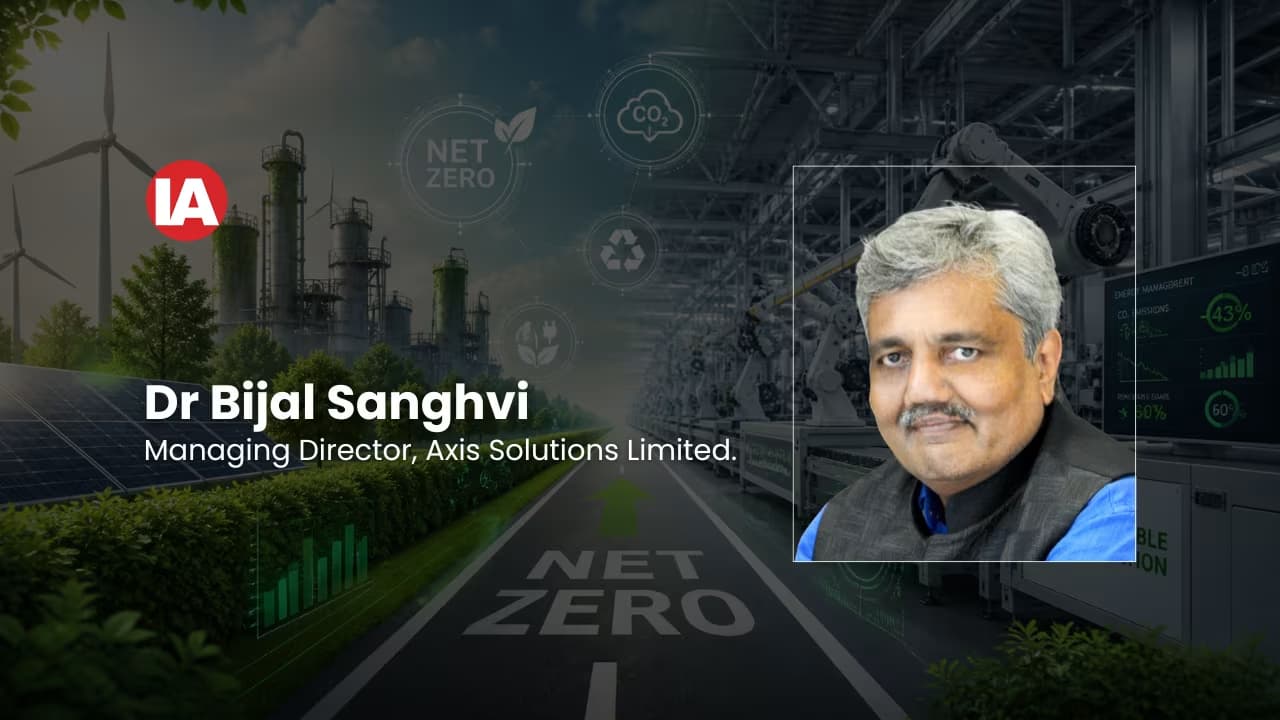
Dr Bijal Sanghvi, Managing Director, Axis Solutions Limited.
How can advanced automation architectures (AI-driven control systems, robotics, and autonomous operations) be quantitatively linked to measurable reductions in Scope 1 and Scope 2 greenhouse gas emissions at the plant level?
At the plant level, the real challenge is moving from intent to actual numbers. Automation helps here in a very practical way. When AI-driven control systems stabilise operations, you naturally avoid excess fuel usage, fluctuations, and unnecessary losses – this directly impacts Scope 1 emissions. On the electrical side, better load management and equipment optimisation help bring down overall power consumption, which reflects in Scope 2.
But this only works well when you start measuring it properly. Once utility monitoring system for specific consumption per unit of Plant output is in place and you can see consumption per unit of output, things become clearer. In most plants, even basic optimisation through automation can bring 5-15% energy savings. It may not sound dramatic, but it adds up in a big way over time.
What are the most impactful use cases where industrial AI and machine learning have demonstrably optimised energy consumption and resource utilisation in continuous and discrete manufacturing environments?
In most cases, the high-impact use cases are quite practical. In continuous industries, AI/ML is used to stabilise and optimise processes like compressors, boiler, furnaces, or distillation units – where even small parameter tuning reduces significant energy over time. Utilities like boilers, chillers, and compressed air systems are also areas where AI/ML quickly shows results because of their high energy consumption.
In discrete manufacturing, predictive maintenance makes a big difference by avoiding breakdowns, machine idling and the energy loss that comes with restarts. Vision systems also help reduce rejections, optimised repetitive tasks which improves overall material utilisation. So, it’s less about complex use cases and more about applying AI/ML where the maximum energy and resource losses already exist.
How does the integration of Industrial IoT and real-time data analytics enable predictive optimisation of processes, and what are the typical efficiency gains achievable in terms of energy, water, and raw material usage?
In most plants, the problem is not effort – it’s visibility. Once Industrial IoT system is in place and machines, utilities, and processes are connected, you start getting real-time data instead of delayed reports. That’s where the shift happens. With analytics on top of this data, you can start identifying patterns – where energy is getting wasted, where water usage is higher than normal, or where the process is drifting. This allows teams to act early, rather than correcting things after losses have already happened.
From what we’ve seen, this kind of setup typically brings 10-20% improvement in energy efficiency over time. Water and raw material usage also improve, especially in process-driven industries where small inefficiencies add up at scale. It’s not one big change – it’s continuous optimisation based on real data.
In what ways can automation systems be designed to support circular economy principles – such as reuse, remanufacturing, and waste minimisation – without compromising throughput and productivity?
In practice, it starts with better control and visibility. When automation systems can track material flow clearly – what is coming in, what is getting used, and what is going out as waste – it becomes easier to identify reuse opportunities. Simple things like automated segregation, controlled dosing, and process consistency help reduce waste at the source itself, without affecting throughput.
For remanufacturing and reuse, automation brings repeatability. Robotics and controlled processes ensure that refurbished or reworked components meet the same quality standards, so productivity is not compromised. Also, when production is more demand-driven through data, overproduction reduces, which directly cuts waste. So, it’s less about adding new layers and more about designing systems that are efficient, traceable, and consistent from the start.
What are the key barriers (technical, economic, and organisational) to scaling sustainable automation initiatives across brownfield industrial facilities, and how can they be systematically addressed?
In brownfield plants, the first challenge is technical. Most legacy systems are not designed for connectivity, so integration becomes difficult. You can’t replace everything, so retrofitting has to be done carefully, often in phases. The practical way forward is to start with add-on layers like energy monitoring or IIoT gateways, and then gradually build around existing systems instead of disrupting operations.
On the economic side, the concern is always the upfront cost versus visible returns. Many decisions get delayed because the benefits are long-term. This is where smaller pilot projects help – prove the savings in one area, and then scale. Organisationally, the biggest gap is adoption. If teams are not aligned or trained, even good systems don’t deliver. Involving operators early and focusing on simple, usable solutions makes a big difference.
How should manufacturers evaluate the lifecycle sustainability impact of automation investments, including embedded carbon in equipment, versus the long-term emissions reduction benefits they deliver?
Manufacturers need to look at this beyond just the initial investment. Automation systems do come with embedded carbon – from manufacturing, transport, and installation – but that’s only one part of the picture. The real question is how much energy and emissions the system will save over its operating life.
A practical way is to compare the current baseline with expected reductions in fuel and electricity per unit of production. When you project that over a few years, in most cases the savings clearly outweigh the initial footprint. It also helps to choose systems that are scalable and can be upgraded, so they last longer and don’t need frequent replacement. In the end, it’s about looking at long-term impact rather than just the starting point. For example, we are finding more and more demand for FRP/GRP FRP stands for Fibre (or Fiber) Reinforced Plastic/Polymer, and GRP stands for Glass Reinforced Plastic/Polymer analyser houses as compared to SS material due to rising demand for using sustainable products and also it can reduce carbon footprint by 30-45% as compared to steel.
(The views expressed in interviews are personal, not necessarily of the organisations represented)
Dr Bijal Sanghvi is the Managing Director of Axis Solutions Limited, a distinguished first-generation company having a Domestic as well as Global Presence, which has achieved remarkable milestones. His role spans across various verticals ranging from managing the overall development and operations of the firm with leadership roles across business strategy, business development and management of various business functions such as Production, Engineering, Manufacturing and R&D.