We are investing in making India the global hub for Enerpac's tensioning tool manufacturing
Enerpac India is expanding manufacturing, engineering, and innovation to make India its global tensioning hub.
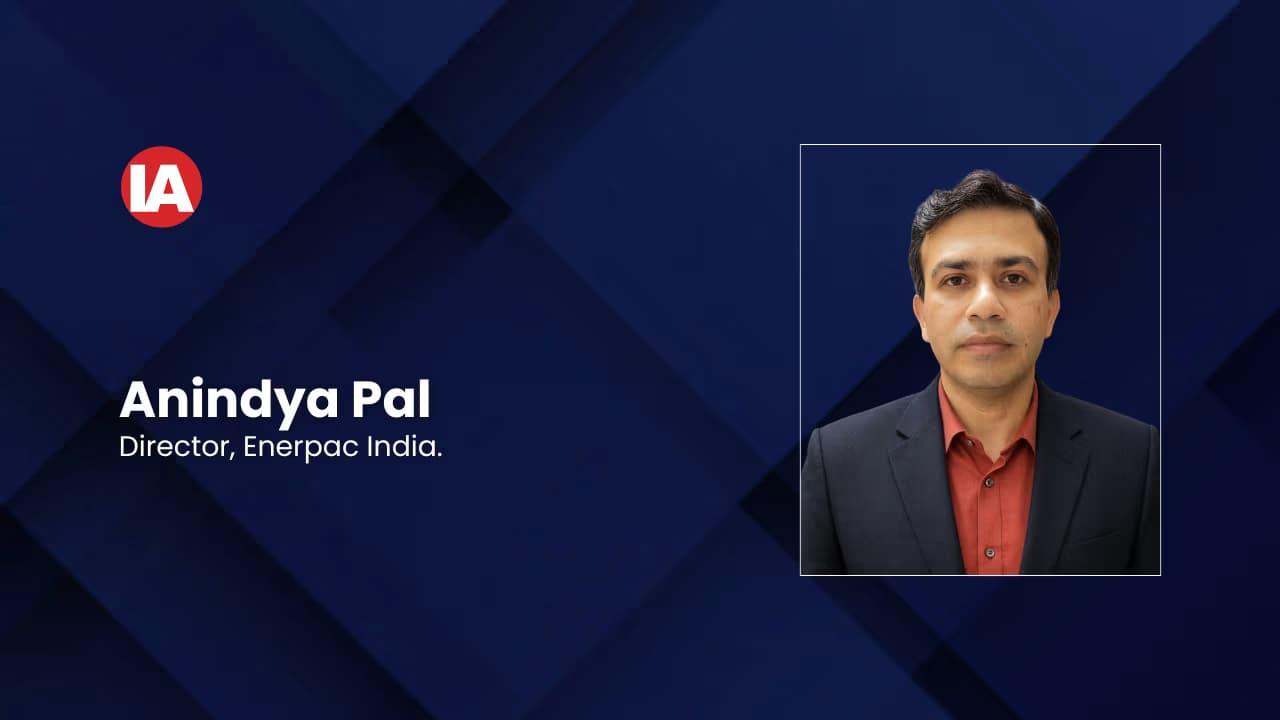
Anindya Pal, Director, Enerpac India.
Enerpac Group brings over 115 years of global expertise, along with more than two decades of presence in India. How has this combined legacy shaped your strategic priorities and growth trajectory in the Indian market?
Enerpac is a global premier brand for high-force precision hydraulic tools, with a legacy that dates to 1910. Our India journey over the past 35 years has provided a deep understanding of how industries and customer expectations have evolved over time. Earlier, we were largely a tool supplier with a catalogue-driven, distribution-based model. Today, we work much more closely with our customers as a solution partner, helping solve complex lifting, bolting, positioning, and other maintenance challenges through customised, application-driven product offerings.
The most striking shift has been our engagement detail in the customer's decision-making process. We have moved from just selling to distributors towards a focused customer engaged application selling process. As India's infrastructure and industrial sectors continue to scale, we have expanded our local engineering and manufacturing capabilities to broaden our product range.
On the growth side, our trajectory in India is being driven by the country's intense infrastructure and industrial expansion. As India builds taller & longer bridges, large capacity wind towers, and heavier process equipment, demand for engineered lifting, positioning, and bolting solutions continues to rise. Our growth strategy is anchored in deepening customer engagement, strengthening local application engineering, expanding our India manufacturing footprint, and broadening our distribution and service network into Tier-2 industrial clusters.
Enerpac supports mission-critical industrial applications across sectors such as energy, rail, and infrastructure. What differentiates your engineered solutions in addressing the complexity and precision required in these high-stakes environments?
What differentiates Enerpac's engineered solutions is our ability to combine global expertise with local customisation for application-specific requirements in complex industrial environments. We work closely with customers to understand the application details, level of precision and safety requirements. This can mean adding specific add-ons to standard tools or modifying specifications like load-carrying capacity, tool height, etc., to suit the application requirement.
In sectors like energy, rail, infrastructure, and manufacturing, operations involve heavy lifting, bolting, positioning, and other high-force applications where accuracy and reliability are critical. We have developed local capability to provide integrated systems with load monitoring, automation, and digital controls. For example, our synchronous lifting controllers provide real-time monitoring of differential loads across all lift points, ensuring that complex multi-point lifts are executed seamlessly and safely.
Another key differentiator is our local application engineering capability in Bangalore, India, and supported with in-house validation infrastructure, including a 1,000-tonne press for load verification. This ensures we provide tailored solutions while maintaining the global quality and safety standards Enerpac follows worldwide.
Given that many Enerpac solutions are deployed in some of the world's most complex and hazardous jobs, how does the company embed safety into product design, engineering, and on-site operations?
Safety is central to how we design our products and solutions, precisely because our tools are used in critical and demanding industrial environments. Our focus is always on helping customers carry out operations in a safe, controlled, and reliable way. In short, Enerpac makes complex, often hazardous jobs possible safely and efficiently.
From an engineering standpoint, we use features such as load monitoring, synchronised lifting systems, and digital controls to improve accuracy and safety. We also ensure minimal manual intervention as much as possible, especially in difficult, confined or remote job-site conditions.
A good example is our battery-operated hydraulic tools, which remove long cords and external connections. This improves mobility and ergonomics while reducing common safety risks such as trip hazards, and it is particularly valuable when working in confined spaces, at heights, or at remote sites.
Over the past two decades, how has Enerpac's India journey evolved in response to changing industrial demands, and what have been the key milestones in building a strong local presence?
Previously, we worked mainly through distributors on a transactional, catalogue-driven basis. Today, we collaborate closely with our channel partners to engage directly with end-users as a solution partner. As industries in India grow larger and more complex, customers keep asking for customised solutions with better safety, precision, and efficiency. To address this, our key focus has been to develop application engineering and custom-built solution capabilities in India. Today we have a dedicated team of engineers, application specialists and after-market support, who engage with our customers to provide purpose-built tool solutions. Our Enerpac Training Academy, active for over 15 years and having trained more than 500 professionals, has been instrumental in building local skills and after-market support, strengthening our long-term presence in India.
Another major milestone has been our expanding local manufacturing capabilities. We now produce standard steel and aluminium cylinders in Bangalore for both domestic and global markets.
In March 2026, Enerpac India achieved ISO 9001:2015 and ISO 45001:2018 certifications, an important marker of our continued investment and growth in India.
How is Enerpac aligning with the 'Make in India' initiative, particularly in terms of localised manufacturing, engineering, and the development of customised solutions for diverse industry requirements?

For Enerpac, 'Make in India' is not about cost arbitrage; it is a strategic manufacturing capability upgrade. The products we manufacture in India are built to international standards and exported to the Americas, Europe, and APAC. Every raw material, from seals to precision components, is sourced to Enerpac's global standards, and there is no relaxation in quality simply because a product is made locally. A key advantage we offer is our global warranty; any Indian OEM buying an Enerpac tool can take it anywhere in the world and be assured of after-market support and warranty coverage.
Beyond manufacturing, 'Make in India' for us also means building strong engineering, application, and after-market support capabilities within the country. A new initiative is our plan to design and manufacture standard and custom bolt tensioners in India and supply them worldwide. We are investing in making India the global hub for Enerpac's tensioning tool manufacturing, with the global supply for these tools set to come from our Bangalore facility, and exported to markets across the Americas, Europe, and APAC.
Enerpac has introduced advanced cordless solutions in India that have already proven their performance, precision, and safety in markets like the US and Europe. What impact do you expect these technologies to have on productivity and operational efficiency in India?
We believe cordless hydraulic solutions can make a significant difference to productivity, efficiency, and safety across India's industrial and infrastructure sectors, particularly in remote or challenging jobsite conditions. Customers today want to complete jobs faster, more safely, and with greater ease of operation, and cordless tools support exactly that. Digital transformation is a key pillar of our global growth, and we have invested substantially in e-tools for torquing and tensioning applications where precision and audit documentation are vital.
Our battery-operated hydraulic tools remove the need for long cords and external power connections, improving mobility and ergonomics while reducing common risks such as trip hazards. Instead of dragging cords or hoses, an operator can simply carry a self-contained tool and a spare battery to the worksite. This is especially useful in confined spaces, elevated work areas, and remote locations such as mining sites, where cabling and external connections are difficult to manage.
These tools also improve setup time, precision, and repeatability during critical operations. Importantly, when we launched our battery-operated torque wrenches in India, we ensured the batteries received BIS (Bureau of Indian Standards) certification. As a NYSE-listed company, transparency and adherence to local laws are paramount to us, so every product introduced in India meets local certification requirements while maintaining the same global quality and performance standards Enerpac follows worldwide.
From your perspective, what are the most significant emerging trends in industrial safety, efficiency, and productivity, and how is Enerpac positioning itself to address these evolving industry expectations?
The most significant emerging trends we see revolve around three connected themes: safety and ergonomics, digitalisation and data-driven control, and local product support & custom-built capability. Safety and ergonomics have become primary concerns for virtually every industry, particularly for work in remote locations or at heights, where operators need convenient, cord-free methods that boost productivity without compromising safety. At the same time, the future of heavy lifting is no longer just about raw power; it is increasingly about intelligent, documented, and repeatable control.
Our cordless, battery-powered tools directly answer the demand for safer, more ergonomic operations. Our investment in e-tools, synchronous lifting controllers, and integration of PLC automation, HMI, and SCADA systems gives customers real-time monitoring, precision, and audit documentation that modern, high-stakes projects require.
Looking ahead, we continue to expand our Make-in-India product offerings, both standard and custom-built. We are expanding our team of application engineers as we keep increasing our local capability and manufacturing footprint. In the past few years, Enerpac has established a global capability centre at Bangalore that consolidates finance, IT, Supply Chain and HR functions. These functional teams now support Enerpac’s operations and locations worldwide, delivering centralised services, standardised processes and scalable services across the organisation.