Edge computing improves operational responsiveness while reducing dependency on network latency
OMRON’s Sameer Gandhi explains how edge computing enables faster decisions, higher efficiency, and smarter manufacturing.
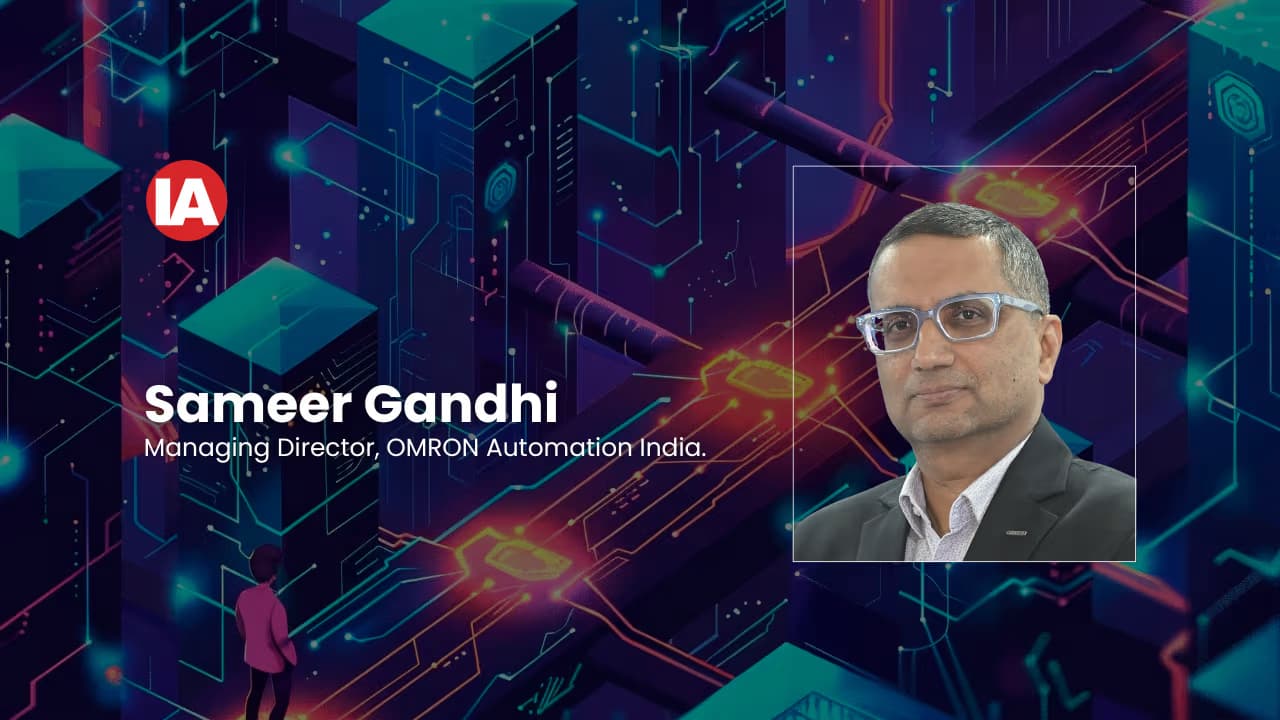
‘As industries continue to evolve, edge computing will play a defining role in shaping the future of manufacturing’
Sameer Gandhi, Managing Director, OMRON Automation India.
The manufacturing industry today is undergoing one of the most significant transformations in its history. Driven by the convergence of automation, artificial intelligence, industrial networking, and digital technologies, manufacturers are increasingly moving toward connected, intelligent, and autonomous operations. In this evolving landscape, data has become one of the most valuable operational assets. However, the real value of data lies not merely in its collection, but in how quickly and intelligently it can be transformed into actionable decisions.
This is where edge computing is playing a transformative role.
Traditionally, industrial data was transmitted to centralised servers or cloud platforms for analysis and decision-making. While cloud infrastructure continues to provide immense value for enterprise-level analytics and long-term optimisation, modern manufacturing environments require decisions to be made in milliseconds. Delays caused by data transmission, network dependency, or centralised processing can directly impact productivity, quality, machine safety, and operational continuity.
Edge computing addresses this challenge by bringing computing power closer to the source of data generation, at the machine, controller or sensor level. By processing data locally, manufacturers can achieve real-time responsiveness, lower latency, improved operational reliability, and faster decision-making.
At OMRON, we see edge computing as a critical enabler for the future of intelligent manufacturing. As industries move toward autonomous and data-driven production systems, edge intelligence is becoming increasingly important in enabling operational agility, resilience, and sustainable growth.
How is edge computing reshaping real-time decision-making on the shop floor in discrete manufacturing versus continuous monitoring and control in process industries?
Reshaping Real-Time Decision-Making Across Industries: The impact of edge computing differs across manufacturing sectors, but its core value remains the same, enabling faster and smarter decisions closer to operations.
In discrete manufacturing industries such as automotive, electronics, semiconductors, and packaging, production environments are highly dynamic and require precise coordination between robotics, motion systems, machine vision, sensors, and operators. In such environments, even a fraction of a second can influence cycle time, throughput, and product quality.
Edge computing enables real-time data processing directly at the equipment level, allowing immediate response to process deviations or quality abnormalities. For example, machine vision systems integrated with edge analytics can instantly identify defects, trigger corrective actions, and maintain production continuity without relying on centralised systems. Similarly, robotic systems can adapt dynamically to changing production conditions through localised intelligence and ultra-fast feedback loops.
In process industries such as pharmaceuticals, chemicals, food & beverage, water treatment, and energy, operational priorities focus more on continuous monitoring, process stability, and asset reliability. Here, edge computing allows real-time monitoring and control of parameters such as pressure, flow, temperature, vibration, and energy consumption. By processing this data locally, operators can respond immediately to process fluctuations, reducing operational risks and ensuring process continuity.
In both cases, edge computing improves operational responsiveness while reducing dependency on network latency and cloud availability.
Which specific applications – such as predictive maintenance, anomaly detection, or closed-loop control – derive the greatest value from low-latency edge analytics, and how do these differ across industry segments?
Applications Delivering the Highest Value: One of the most valuable applications of edge computing is predictive maintenance. Industrial equipment continuously generates operational data related to vibration, motor current, temperature, speed, and load conditions. Edge analytics enables this data to be processed in real time to identify abnormal trends and predict equipment failures before they occur.
This allows manufacturers to transition from reactive maintenance practices to predictive and condition-based maintenance strategies, reducing unplanned downtime and extending machine life.
Another critical application is anomaly detection. Modern production lines demand extremely high levels of quality consistency and process precision. Even minor process deviations can result in defects, wastage, or productivity losses. Edge-enabled analytics can identify such anomalies instantly and initiate corrective actions in real time, significantly improving first-pass yield and process reliability.
Closed-loop control systems are another area where edge computing delivers substantial value. Applications involving robotics, motion control, autonomous guided vehicles, and precision assembly require deterministic responses within milliseconds. Localised processing at the edge ensures ultra-low latency and enables highly synchronised machine operations.
Additionally, energy optimisation and sustainability initiatives are increasingly leveraging edge intelligence. Manufacturers today are under growing pressure to improve energy efficiency and reduce carbon emissions. Real-time energy monitoring at the machine and line level enables manufacturers to identify inefficiencies, optimise resource consumption, and support sustainability goals.
What are the practical challenges of integrating edge devices with existing PLCs, SCADA, particularly in brownfield industrial environments?
Challenges in Brownfield Integration: While the advantages of edge computing are significant, implementation in existing industrial environments presents practical challenges.
A large percentage of manufacturing facilities globally continue to operate using legacy automation infrastructure consisting of PLCs, SCADA systems and proprietary industrial protocols developed over several decades. Integrating modern edge technologies into such brownfield environments requires careful planning to ensure compatibility, interoperability, and operational continuity.
One of the biggest challenges is achieving seamless communication between legacy systems and modern edge platforms. Different communication standards, fragmented data architectures, and limited connectivity capabilities can create integration complexities.
At OMRON, we strongly believe that digital transformation should not require complete replacement of existing infrastructure. Instead, manufacturers need scalable and phased modernisation strategies that preserve prior investments while enabling future readiness. Open industrial communication protocols, interoperable architectures, and modular automation platforms are therefore essential for successful edge adoption.
Another challenge lies in managing industrial data effectively. Data alone has limited value unless it is contextualised into meaningful operational insights. Manufacturers need edge platforms capable not only of collecting data, but also of analysing, filtering, and converting it into actionable intelligence aligned with operational KPIs.
Workforce readiness is another important factor. As manufacturing systems become increasingly intelligent and connected, organisations must invest in developing digital competencies and cross-functional collaboration between operational technology (OT) and information technology (IT) teams.
How should organisations balance workloads between edge and cloud to optimise performance, scalability, and cost, while ensuring data consistency and governance?
Balancing Edge and Cloud Architectures: The discussion around edge and cloud is often misunderstood as a competition between two technologies. In reality, the future of industrial automation will depend on hybrid architectures where edge and cloud complement each other.
Edge computing is best suited for applications requiring deterministic performance, ultra-low latency, operational continuity, and localised intelligence. Cloud platforms, on the other hand, provide scalability for enterprise analytics, AI model training, centralised monitoring, and multi-site optimisation.
The key challenge for organisations is determining which workloads should remain at the edge and which should be managed centrally in the cloud.
Operational decisions that require immediate action – such as motion control, safety responses, anomaly detection, or machine-level optimisation – should typically remain at the edge. Strategic analytics involving historical trends, enterprise resource planning, predictive modelling, and long-term optimisation are better suited for cloud environments.
Achieving the right balance between edge and cloud enables manufacturers to optimise performance, scalability, cost, and governance while maintaining operational reliability.
With distributed intelligence at the edge, how are companies addressing cybersecurity risks and ensuring resilience of mission-critical operations?
Cybersecurity and Operational Resilience: As industrial systems become increasingly connected and decentralised, cybersecurity has become a critical business priority.
Distributed intelligence at the edge expands the attack surface across manufacturing networks, making industrial cybersecurity more complex than ever before. Manufacturers must therefore adopt comprehensive cybersecurity strategies that include secure network architectures, authentication protocols, access control mechanisms, encryption, continuous monitoring, and incident response capabilities.
At the same time, resilience is becoming equally important. Manufacturing operations today cannot afford disruptions caused by cyber incidents, network failures, or infrastructure downtime.
With increasing connectivity at the edge, certified cybersecurity in PLCs is essential to protect critical manufacturing operations. OMRON PLCs incorporate robust, standards-aligned security features to enable safe and resilient industrial automation.
One of the advantages of edge computing is that localised intelligence allows critical operations to continue even if cloud connectivity is interrupted.
This operational independence significantly improves system resilience and business continuity for mission-critical industrial environments.
What measurable business outcomes – such as reduced downtime, improved yield, or energy efficiency – have been realised through edge deployment, and what factors determine successful scaling across multiple sites?
Delivering Measurable Business Outcomes: Ultimately, the success of edge computing must be evaluated through measurable business outcomes rather than technology deployment alone.
Across industries, manufacturers implementing edge-enabled architectures are already realising tangible benefits, including:
• Reduced unplanned downtime
• Improved product quality and yield
• Faster root-cause analysis
• Higher equipment effectiveness
• Improved energy efficiency
• Reduced operational costs
• Increased workforce productivity, and
• Enhanced operational agility.
However, scaling these benefits across multiple plants and operations requires more than technology implementation. Successful transformation depends on clear business objectives, strong leadership alignment, cybersecurity governance, standardised architectures, and workforce enablement.
At OMRON, our approach to industrial digital transformation extends beyond products and technologies. We aim to partner with customers in building intelligent manufacturing ecosystems that are adaptive, connected, resilient, and future-ready.
Through our expertise in sensing, control, robotics, safety, AI-driven automation, and industrial data solutions – combined with strategic collaborations in digital transformation – we are supporting industries in accelerating their journey toward smarter manufacturing.
As industries continue to evolve toward autonomous and sustainable operations, edge computing will play a defining role in shaping the future of manufacturing.
The factories of tomorrow will not be differentiated merely by how much data they generate, but by how intelligently, securely, and quickly they can act on that data.
(The views expressed in interviews are personal, not necessarily of the organisations represented)