Edge computing is becoming the backbone of factories and plants that run themselves
UST’s Vinod Neelanath explains how edge computing is enabling autonomous, intelligent, and resilient industrial operations.
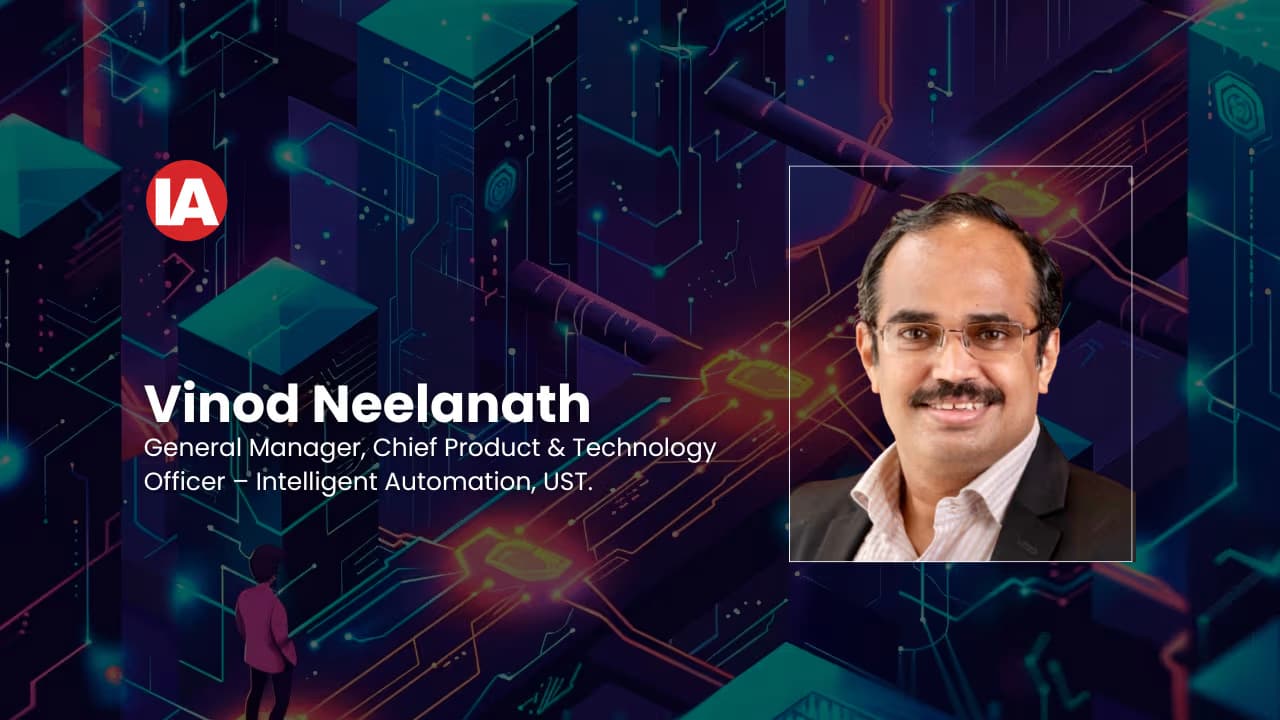
Vinod Neelanath, General Manager, Chief Product & Technology Officer - Intelligent Automation, UST.
How is edge computing reshaping real-time decision-making on the shop floor in discrete manufacturing versus continuous monitoring and control in process industries?
Enterprises are changing fast. Factories everywhere want operations that run themselves, smarter and quicker than ever with Automation. Being increasing autonomous is the major shift happening now and it needs just in time actions. Edge computing’s driving a lot of this, it means analysing data right where it is created, instead of pushing everything up to the cloud and waiting for answers.
Industrial sites, plants, factories, all sorts, produce mountains of data. Sensors, PLCs, SCADA, robots, cameras, machines, you name it. Before, companies just stored most of it or sent it to central servers, which made everything slower. Now, that doesn’t cut it. When you need instant reactions, like spotting a machine about to break, checking quality, or optimising processes, waiting isn’t an option.
Our own experience working with distributed edge platforms, telecom-grade intelligence, and AI-powered automation has made one thing clear: you only get real value when decisions happen as close as possible to where things are happening. Edge computing does exactly that, it slashes latency and lets factories respond on the spot.
Which specific applications – such as predictive maintenance, anomaly detection, or closed-loop control – derive the greatest value from low-latency edge analytics, and how do these differ across industry segments?
It’s not a one-size-fits-all. Manufacturing companies and process industries use edge computing differently because what matters to them isn’t always the same.
If you’re in discrete manufacturing, cars, electronics, assembly lines, then, speed, coordination, and precision are everything. You’ve got robots, conveyors, and inspection machines, all working together non-stop. Edge computing lets decisions happen right on the shop floor. AI vision can catch defects in a split second and fix them immediately. Robots react to sensor data on the fly, adjusting their actions without waiting for orders from the cloud.
Process industries are a different story, think oil and gas, chemicals, pharmaceuticals, utilities, food. Here, what matters is steady operations, safety, and never stopping. They monitor things like temperature, pressure, vibration, and flow, all the time. Edge systems analyse this data for abnormalities, catching problems early and acting fast. It keeps everything safer and running smoothly.
Bottom line: Factories use Edge for speed and agility while process plants use it for stability and reliability.
Where edge analytics really shine
Some industrial applications stand out with low-latency edge analytics.
Predictive maintenance: If you want less downtime, edge computing is gold. Pumps, motors, turbines, compressors, CNC machines, all constantly spit out data. Edge systems analyse vibration, temperature, and other signals in real time to predict failures before they happen. That means fewer breakdowns and better equipment usage. In industries where every minute of downtime hurts, predictive maintenance immediately pays off. We’ve seen how local AI boosts response times and gets operations ahead of the curve
Anomaly detection: Old-school monitoring relies on fixed thresholds, but most failures start as tiny changes. Edge AI spots odd patterns quickly, like a slight tweak in vibration or power use that hints a machine is going south. For utilities, chemicals, and telecoms, catching these early can stop major disasters
Closed-loop control: Robotics and precision systems can’t afford delays. Edge computing lets them analyse and react instantly, keeping production sharp and reliable
AI-powered quality inspection: Machine vision plus edge AI means inspecting products in real time. Cameras and AI models catch defects instantly, cut waste, boost yields, and reduce the need for hands-on checks, all without slowing the line
What are the practical challenges of integrating edge devices with existing PLCs, SCADA, and DCS infrastructures, particularly in brownfield industrial environments?
It’s not all smooth sailing. Most factories still use legacy PLCs, SCADA, and DCS systems that weren’t built for AI. Adding edge devices takes middleware, protocol translators, and custom fixes.
Operational tech teams care about uptime above all else. Unlike IT, they can’t afford risky rollouts or frequent outages, so edge deployments need careful planning and slow, staged introductions.
Factories also have all kinds of gear from dozens of vendors stretching back decades. Trying to unify data and observability across that ecosystem is tough. Bad data, noisy sensors, inconsistent telemetry, gaps, all make edge AI less effective.
Success involves more than plugging in new tech. We will need strong integration, operational discipline and governance.
How should organisations balance workloads between edge and cloud to optimise performance, scalability, and cost, while ensuring data consistency and governance?
Edge computing won’t replace the cloud. Enterprises will need both.
Edge’s great for workloads where speed matters, like, AI inference, anomaly spotting, machine control, and local analytics. The cloud’s still key for long-term storage, big-picture analytics, AI model training, digital twins, and optimising across sites.
Usually, it works like the below:
- Real-time decisions at the edge
- Historical analysis and reports in the cloud
- AI models trained centrally, and
- AI inference at the edge.
This hybrid model gives you scalability and resilience.
One big plus is, when your cloud link drops, local systems keep running. No outages, just business as usual. We have used this hub and spoke model for the Cruise liners operations effectively when they are at sea.
Still, running a distributed setup means more governance headaches. Companies need clear rules for data, lifecycle management, observability, and compliance, especially when scaling across sites.
With distributed intelligence at the edge, how are companies addressing cybersecurity risks and ensuring the resilience of mission-critical operations?
Cybersecurity is front and centre as intelligence spreads. Every edge device adds an attack point. If something gets hacked, it’s not just data, it’s physical operations and worker safety on the line.
To keep things safe, organisations are adopting Zero Trust, encrypted communications, strong device IDs, and always-on monitoring.
Segmenting IT and OT networks matters, too. Edge systems have to talk to each other, but without putting critical operations at risk.
From our experience working with distributed edge systems, Operational resilience is a must, more often critical than raw processing capability. Edge systems need to keep working during network hiccups, hardware faults, or cyber incidents. You need high availability, backup systems, and local redundancy.
What measurable business outcomes – such as reduced downtime, improved yield, or energy efficiency – have been realised through edge deployment, and what factors determine successful scaling across multiple sites?
Industrial players using edge computing are already reaping benefits, less downtime, improved utilisation, better yields, faster anomaly detection, less waste, lower energy use, improved safety, quicker response times and overall reduction in operational costs.
Predictive maintenance cuts downtime and improves planning and equipment lifespan. AI-driven quality inspections found more defects, did it faster, and reduced manual labour.
Energy-hungry industries use edge analytics to optimise power, slashing costs and their footprint.
But rolling out Edge across facilities takes more than one-off pilots. You need standardised deployment, solid governance, repeatable frameworks, and tight integration between IT and OT teams.
Edge computing isn’t just a tweak to your infrastructure anymore. It’s becoming the backbone of factories and plants that run themselves, smart, resilient, and increasingly autonomous. As Edge AI, industrial IoT, 5G, and automation technologies continue to mature, factories and industrial plants will increasingly move toward autonomous operations capable of making intelligent decisions in real time with minimal human intervention.
(The views expressed in interviews are personal, not necessarily of the organisations represented)
Vinod Neelanath is a seasoned technology leader and AI innovator with extensive experience in intelligent automation, product engineering, and digital transformation. As the General Manager, Chief Product & Technology Officer – Intelligent Automation, UST , he leads R&D, product management, architecture, engineering, and product success for UST's intelligent automation platforms and solutions. With deep expertise in Agentic AI, hyperautomation, intelligent document processing, IoT, and edge computing, Vinod has played a key role in driving innovation initiatives for Fortune 50 enterprises and scaling ideas into multimillion-dollar ventures. An advocate of AI-led digitalisation, he has led global teams in developing cutting-edge platforms across AI, automation, and emerging technologies