Distributed edge intelligence brings great benefits, but also demands robust cybersecurity and resilience measures
ARC Advisory Group’s Patrick Arnold explores how edge computing improves agility, resilience, and industrial performance.
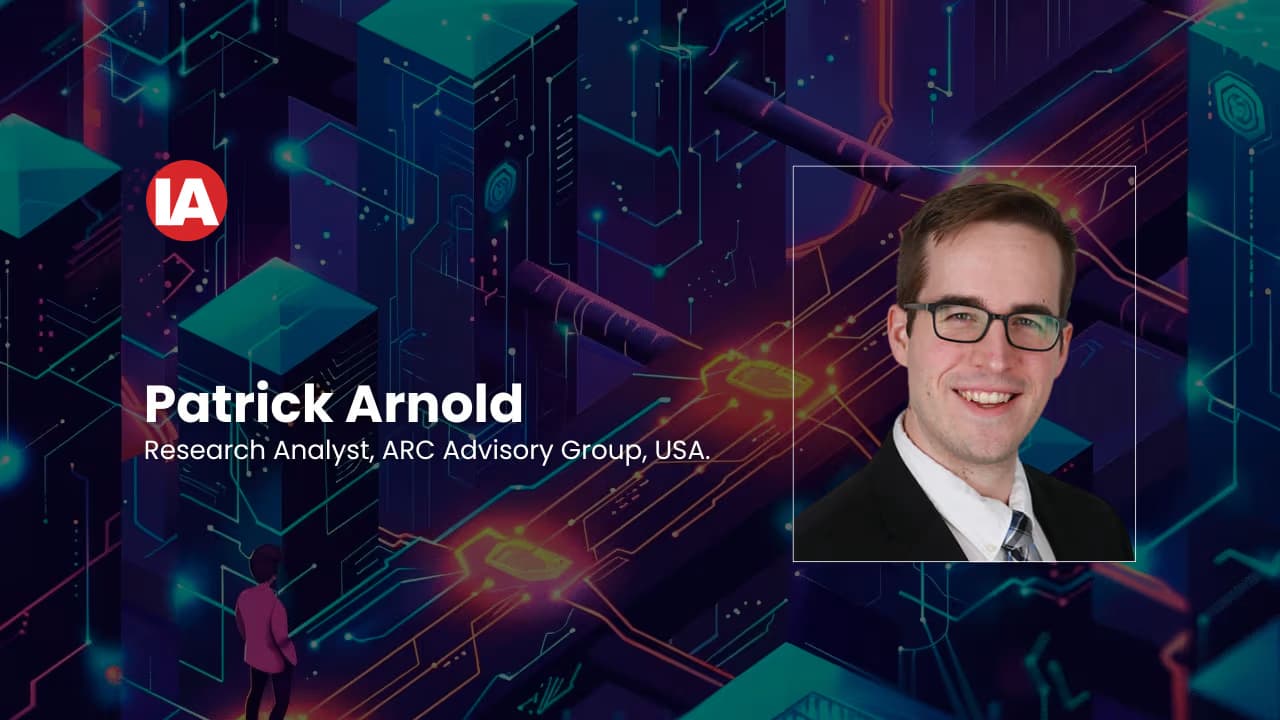
Patrick Arnold, Research Analyst, ARC Advisory Group, USA.
How is edge computing reshaping real-time decision-making on the shop floor in discrete manufacturing versus continuous monitoring and control in process industries?
Edge computing is boosting real-time decisions in both discrete and process industries, but in slightly different ways. On the discrete manufacturing shop floor, edge devices enable ultra-fast, event-driven responses. Production operations like automotive assembly and packaging rely on quick edge processing to coordinate robots and machines, do quality checks, and quickly adjust workflows without needing to wait on a remote server. In these industries, speed, throughput, and uptime are the name of the game.
In continuous process industries, edge computing takes on a more supervisory and optimisation role. Local edge analytics continuously monitor process variables for anomalies or optimise conditions alongside existing DCS/SCADA control systems. Continuous control loops prioritise stable operations and safety, so edge analytics typically feed insights or fine-tune setpoints without disrupting control processes. Latency is still important, but measured in seconds or milliseconds rather than microseconds. Edge computing here supports continuous optimisation by gradually adjusting process conditions and performing predictive modeling close to the process. This keeps cloud costs down while preserving high availability and safety requirements of the plant.
Which specific applications – such as predictive maintenance, anomaly detection, or closed-loop control – derive the greatest value from low-latency edge analytics, and how do these differ across industry segments?
Low-latency edge analytics really shine in time-sensitive applications. Key use cases like anomaly detection and real-time quality inspection see outsized benefits from processing data at the edge. By analysing the data locally, faults and anomalies can be caught instantly, which would be impossible if relying on round-trips to the cloud and back. The specific applications differ by industry segment. For example, automotive factories use edge-based computer vision to perform in-line quality checks and coordinate multi-robot assembly. Food and beverage operations find great value in on-site anomaly detection to ensure product integrity and compliance in real time. Oil & gas and heavy process industries use edge analytics for predictive maintenance of critical rotating equipment and safety monitoring, where local processing identifies pressure or temperature anomalies early and triggers immediate actions to prevent incidents.
What are the practical challenges of integrating edge devices with existing PLCs, SCADA, and DCS infrastructures, particularly in brownfield industrial environments?
Integrating new edge devices with legacy PLC/SCADA/DCS systems poses significant challenges in brownfield plants, especially concerning interoperability with legacy processes and data integration. Many existing facilities run on proprietary protocols and older networks which cannot always be easily replaced. This makes data access and communication a hurdle, requiring protocol converters or OPC UA servers to bridge legacy PLCs and SCADA with new edge gateways. Ensuring consistent data models and context is also difficult. Older systems often use proprietary tags and formats, complicating their integration into a unified data fabric. ARC emphasizes the importance of open standards in tackling these issues. Adopting common protocols and information models allows edge platforms to securely gather and model data from multiple legacy devices in a uniform way. Don’t create more data silos in an attempt to fix the old ones.
Another challenge is maintaining deterministic performance and safety when adding edge devices. Brownfield automation systems were engineered for reliability and fixed function; adding new compute layers must not disrupt or degrade control loops but often perform their value-adding functions alongside them. This means carefully isolating edge data collection from core control networks and using open architectures that can evolve gradually. Lifecycle constraints also loom large. Brownfield plants can’t afford long downtime for upgrades, so edge solutions must be deployed incrementally alongside existing PLCs/DCSs.
Equally crucial is managing edge devices over their lifetimes with secure device identity, certificate updates, and software patching in alignment with industrial cybersecurity practices like IEC 62443. Successful integration often requires gradual, modular modernisation: proving the concept on a few assets, then scaling to more equipment once the new process is validated.
How should organisations balance workloads between edge and cloud to optimise performance, scalability, and cost, while ensuring data consistency and governance?
Industry has seen several over-corrections in its journey to explore the balance between edge and cloud. Historically, workloads were performed on the plant floor and cloud platforms were met with extreme skepticism. Fast forward a few years, and many are shipping all their data to the cloud and quickly find their bills climbing. In modern practice, leading companies adopt a hybrid architecture where low-latency, high-volume tasks are handled at the edge, while the cloud provides global scale and long-term analytics. Edge-first patterns push compute to on-site devices for near-instant decisions and resilience if connectivity fails. Cloud-assisted approaches complement the edge by offloading compute-heavy or non-urgent workloads such as training AI models on corporate cloud infrastructure, then deploying them to edge devices for live inference.
To ensure data consistency and governance, organisations establish unified data architectures spanning edge and cloud. ARC highlights that an industrial data fabric or digital transformation platform can tie together these tiers, providing common data models, metadata, and policy enforcement across all levels. This way, data processed at the edge is contextualised properly before it’s shared with the cloud, avoiding silos or duplication. For example, an edge device might filter raw sensor data and forward only key insights upstream for long-term storage and enterprise analytics. Meanwhile, the cloud layer pushes master data and updated algorithms back to the edge, ensuring local decisions align with global standards and remain consistent across sites. Governance is maintained by centrally managing data access, security policies, and data quality, even as computing is distributed.
With distributed intelligence at the edge, how are companies addressing cybersecurity risks and ensuring resilience of mission-critical operations?
Distributed edge intelligence brings great benefits, but also demands robust cybersecurity and resilience measures. With more connected edge devices in mission-critical roles and a greater number and variety of software providers being involved in assembling the more complex solutions, the attack surface expands. Leading organisations are adopting ‘zero trust’ security frameworks at the industrial edge by treating every device, user, and network segment as potentially untrusted until verified. This means strong device identity management, mutual authentication for communications, and strict access controls so devices only interact as authorised. Network segmentation is another strategy. Isolate edge systems and use firewalls or software-defined networks to contain breaches.
Companies also emphasize fail-safe design and redundancy. Edge controllers are often configured to maintain local control in case of cloud or network outages. This involves measures like local data buffering, stateful failover, or fallback to a safe mode if an edge node goes down. Continuous monitoring and patching of edge device software is critical to address emerging threats, and many have adopted centralised lifecycle management tools to update and monitor these distributed devices. Modern industrial network infrastructure is converging IT/OT management and security, enabling unified policies across edge nodes. The end goal is cyber-resilient, mission-critical operations where each edge node is hardened against attacks, continuously monitored for anomalies, and capable of autonomous, secure operation even under unfavourable conditions.
What measurable business outcomes – such as reduced downtime, improved yield, or energy efficiency – have been realised through edge deployment, and what factors determine successful scaling across multiple sites?
Companies deploying edge computing are realizing tangible business improvements, especially when scaled across multiple sites. Processing data and decisions on-site reduces unplanned downtime as equipment faults are caught and addressed more promptly. ARC research shows that manufacturers implementing predictive analytics and edge-based control achieve significant reductions in downtime and improved overall equipment effectiveness. These gains often start as small improvements (a few percentage points in yield or uptime) that compound into major financial benefits at full production scale.
Scaling edges across multiple facilities requires more than technology, it hinges on standardisation, governance, and change management. Successful organisations adopt a unified platform approach that can extend from one production line to an entire enterprise. This ensures all sites use the same architecture and tools, making it easier to replicate solutions without costly rework and enabling teams to share best practices.
Another key success factor is demonstrating RoI early. Many companies start with pilot projects and, once business value is proven, commit resources to scale up. As ARC notes, broad adoption of edge-enabled operations depends as much on economic value as technical readiness. Firms that invest in technical training and change management are best positioned to sustain and amplify the initial gains across multiple sites.
Patrick Arnold is Research Analyst at ARC Advisory Group, USA.
Patrick's primary focus at ARC is industrial IoT networking solutions, including topics such as network infrastructure, software, and edge computing. Prior to joining ARC, Patrick worked as a process control engineer in the oil and gas industry, programming PLC and SCADA systems to promote connectivity and consistency in plant operations. Patrick's experience also includes petrochemical research as well as machine learning and analytics.
(The views expressed in interviews are personal, not necessarily of the organisations represented)