The future of industrial automation in India will be modular, interoperable and service- backed
Lauritz Knudsen outlines how modular automation will drive India's industrial growth and efficiency.
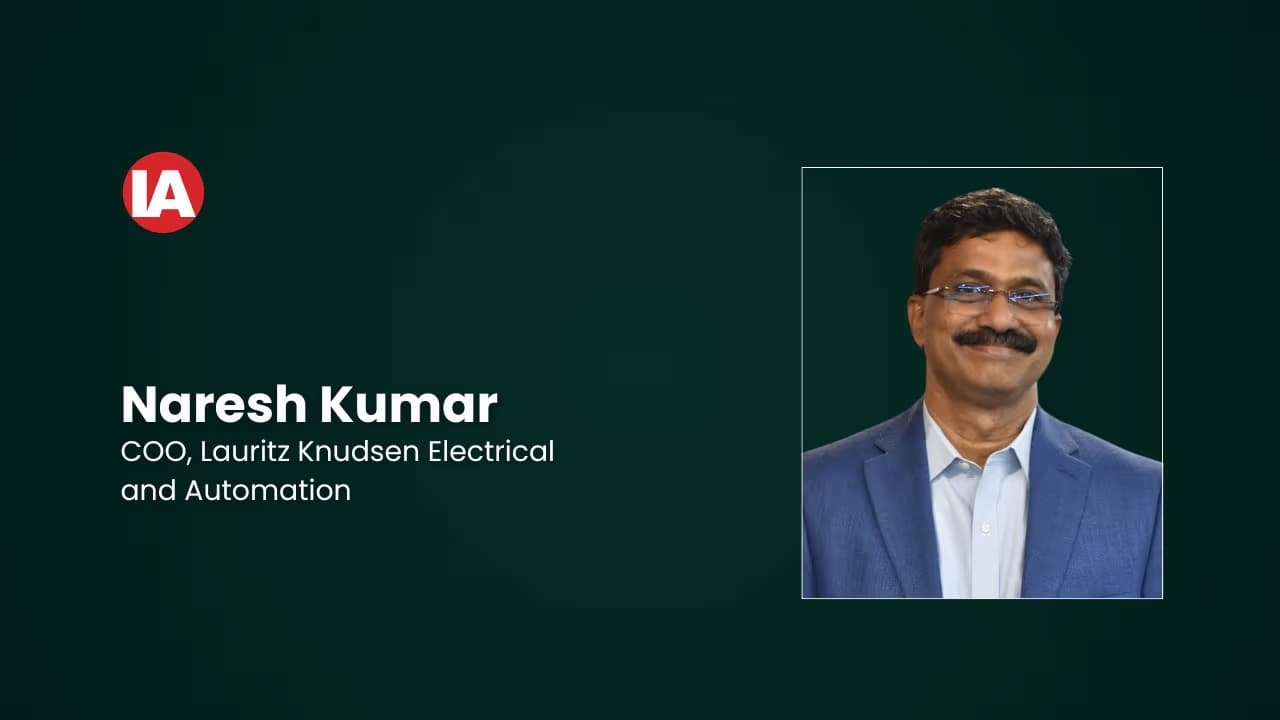
Naresh Kumar, Chief Operating Officer, Lauritz Knudsen
How do you see India-designed technologies addressing the unique operational, environmental, and cost challenges across industrial, new energy, and agricultural sectors compared to imported solutions?
India's operating environment is highly diverse. A manufacturing plant in an industrial cluster, a solar installation in a high-temperature region and an irrigation system on a rural farm do not face the same conditions. Across all these settings, customers deal with voltage fluctuations, dust, humidity, heat, variable load profiles and varying levels of technical support on the ground.
There is another dimension that matters just as much and is often overlooked. A significant share of these customers has never used advanced automation before. The real story of Indian industry is not only about upgrading existing users to smarter systems. It is about bringing automation to people and enterprises who are accessing it for the very first time.
At Lauritz Knudsen, that is central to how we design. Our approach is anchored in designing and building for India, not just for its harsh operating conditions, but for its diverse user base. A rice mill operator in a Tier-3 town, a farmer managing irrigation pumps, an MSME running a small production line, these customers need solutions that are rugged, affordable, simple to commission and easy to operate without deep technical expertise.
SMARTCOMM, our process automation and monitoring platform, reflects this philosophy directly. It delivers monitoring, control, diagnostics and energy management in a way that is intuitive and accessible for operators at every level of technical maturity. When a mill operator or a farmer can take control of their operations through a simple interface, without needing a specialist on-site, that is what India-designed technology is meant to achieve.
For us, Make in India is not only about where a product is manufactured. It is about how deeply the product understands India, its conditions, its users and its scale requirements, and how reliably it performs across the installed life of the asset.

With increasing demand for efficiency and reliability, how are the industrial and automation sectors in India evolving to deliver scalable, high-performance solutions across diverse applications?
India's automation sector is undergoing a structural shift. Customers are moving from a product-led view to an ecosystem-led view. What makes India's story distinct is that this evolution is happening simultaneously at two levels. Among established industrial users, the demand is for smarter, more connected systems. Among a fast-growing number of first-time users, the demand is simply for reliable access to automation that was previously out of reach.
At Lauritz Knudsen, around 26 percent of our Intelligent Motor Control Centre customers are first-time users. These are businesses and operators who have never deployed this level of automation before. That number tells you where India's real automation growth is coming from. It is not only about making sophisticated systems smarter. It is about making automation accessible to those who were previously outside its reach entirely.
This reality is shaping how solutions need to be designed and delivered. Customers increasingly expect connected switchgear, motor control, PLCs, SCADA, protection and energy management to work together seamlessly. They also need these systems to be simple to adopt, easy to scale and backed by strong on-ground support. SMARTCOMM addresses this directly. It gives customers the benefits of connected automation and monitoring without the complexity that has traditionally made these systems inaccessible to smaller or first-time users.
The future of industrial automation in India will be modular, interoperable and service-backed. More importantly, it will be inclusive, designed for the full spectrum of Indian industry, from the most advanced manufacturing plant to the rice mill that is automating for the first time.
Can you share specific examples where Made-in-India R&D initiatives have translated into tangible outcomes such as energy efficiency improvements in manufacturing or enhanced productivity in agriculture?
The most meaningful measure of Made-in-India R&D is not the technology itself. It is who is using it and what difference it is making on the ground.
Consider what is happening in rice mills and sugar mills across India. These industries run on tight margins, in demanding conditions, often in semi-urban and rural locations. Lauritz Knudsen powers 2 lakh tonnes of cane crushed per day across sugar mills and automates over 8,000 tonnes of rice mills in India. For many of these operations, this is their first serious engagement with industrial automation. The outcomes are direct and measurable. Energy consumption comes down; motor protection reduces equipment failures and SMARTCOMM brings monitoring and control visibility that these operators have never had access to before. When a mill operator can track motor health, energy draw and process parameters from a single interface without needing a specialist on-site, that is automation delivering real value in the places that need it most.
In agriculture, SMARTCOMM Irrigation Management System enables farmers to monitor and control irrigation remotely, reduce manual intervention and optimise water and energy use. The interface is deliberately simple, designed for users who may not have a technical background but need reliable, everyday control over their operations. Across India, farmers and rural enterprises are increasingly adopting connected agriculture solutions developed by Lauritz Knudsen, bringing automation to communities where it was previously inaccessible.
In new energy, Lauritz Knudsen has supported over 1,350 solar projects. In one 100 MW installation, predictive diagnostics and remote fault isolation helped reduce downtime by 30 percent, improving energy yield directly. On the service side, ProServe actively monitors over 1,50,000 critical electrical assets, with more than 15 percent of service tickets resolved remotely, bringing the discipline of predictive maintenance to enterprises that previously operated entirely on a reactive basis.
What are the key technological and logistical considerations when deploying automation and electrical solutions in remote or high-intensity regions, and how is Lauritz Knudsen addressing these challenges?
Deploying in remote or high-intensity environments requires a different product and service philosophy. The system must be rugged, simple, connected and serviceable. Alongside these requirements sits a consideration that shapes the entire brief — many users in these environments are engaging with automation for the very first time.
A solution that is technically capable but difficult to operate will not succeed in these markets. Products must be easy to install, intuitive to use and straightforward to maintain, because the operator on the ground may not have a background in electrical engineering or automation. SMARTCOMM is built around precisely this need. It makes monitoring, control and diagnostics accessible through a practical, field-ready interface that does not require specialist training to use day to day.
From a product standpoint, solutions must withstand heat, dust, humidity, voltage variation and continuous operating cycles. In areas with inconsistent connectivity, they must support meaningful diagnostics and control without depending on a stable internet connection. From a service standpoint, reach is non-negotiable. A failure in a remote location carries a disproportionate operational cost because of travel time and the scarcity of local expertise.
At Lauritz Knudsen, we address both through India-specific product design, local manufacturing and a strong service ecosystem. ProServe brings 500 plus field service engineers, 110 plus authorised service centres and 30 nationwide branch hubs, with presence across Tier 1, 2, 3 and 4 cities and major industrial corridors. More than 15 percent of service tickets are resolved remotely through digital diagnostics, reducing response time and keeping critical assets running. A solution is only as strong as the support behind it. For us, product reliability and service reach are two sides of the same commitment.
As India scales its infrastructure and industrial base, what role do integrated automation and electrical ecosystems play in ensuring reliability, resilience, and long-term sustainability?
India is commissioning assets, power plants, manufacturing facilities, renewable parks, urban infrastructure, that will be operational for the next 30 to 40 years. The question is not only whether they can be built on time. The more important question is whether they can perform safely, efficiently and predictably across their entire lifecycle.
Integrated electrical and automation ecosystems are central to that. When switchgear, automation, protection, power quality, monitoring and services work together, customers gain three compounding advantages. Reliability improves because operators have real visibility into asset health. Resilience improves because faults are detected and isolated before they become failures. Sustainability improves because energy is tracked and optimised continuously rather than managed only when problems surface.
There is a dimension of this that is particularly relevant to India's growth story. Integration also makes automation accessible to enterprises that are new to it. When protection, control and monitoring work together in a cohesive system, even a first-time user, whether a manufacturer in a Tier-3 cluster or a utility managing a new energy asset, can extract operational value without needing a large technical team. That is critical in a country where much of the industrial growth is coming from businesses that are building their automation capability from the ground up.
At Lauritz Knudsen, our portfolio across switchgear, automation, software and services is designed to deliver this kind of integrated reliability. As India builds out airports, metros, data centres, manufacturing clusters, renewable parks and smart cities, resilient infrastructure will not come from individual products. It will come from integrated systems that are designed to perform together over the long term.
How is the convergence of automation, IoT, and data analytics shaping precision agriculture in India, and what opportunities do you see for technology providers in this space?
Precision agriculture in India is moving from a concept to a practical requirement. Farmers are dealing with water stress, energy reliability issues, labour constraints and climate variability. Automation, IoT and data analytics are beginning to make a tangible difference, and the opportunity will only be fully realised if technology is designed for the people who need to use it.
That is the lens through which Lauritz Knudsen approaches agri-automation. The core applications,remote pump monitoring, irrigation scheduling, motor protection and energy optimisation, directly reduce manual intervention, improve water use efficiency and protect equipment from electrical faults that can set a farming operation back by an entire season. Across India, farmers and rural enterprises are increasingly turning to connected, automated agriculture solutions developed by Lauritz Knudsen, with adoption expanding steadily beyond early pilot projects into mainstream agricultural markets.
SMARTCOMM IMS brings these capabilities together in a platform that is simple, practical and field-ready. A farmer does not need to be a technology expert to use it. The interface is built for people who need reliable daily control over their operations, and that simplicity is a deliberate design choice. It is what makes adoption possible at scale, beyond pilot projects.
For technology providers, the opportunity in precision agriculture is not in building the most sophisticated system. It is in making automation genuinely useful, accessible and maintainable for rural enterprises and small farmers. That means affordable products, easy installation, strong local service and training that builds user confidence over time. The market is significant; it will be unlocked by those who design for India's agricultural realities and not just for its aspirations.
Looking ahead, where do you see the most significant growth opportunities for Lauritz Knudsen and the industrial automation sector in India?
Three growth vectors stand out clearly.
The first is the scale of India's industrial ambition across the full spectrum of enterprise. At one end, large and established organisations in sectors such as manufacturing, energy, infrastructure and utilities are growing rapidly and investing heavily in upgrading their electrical and automation systems. These are customers with complex, high-uptime requirements who need integrated, enterprise-grade solutions and long-term lifecycle partnerships. At the other end, Tier-2 and Tier-3 industrial clusters, rural enterprises and emerging infrastructure corridors are seeking reliable automation for the first time. The fact that 26 percent of our IMCC customers are first-time users reflects the scale of this first-time adoption. Both segments are growing, and Lauritz Knudsen is built to serve both, through our 100 plus city Technology Day initiative, which takes our portfolio into India's manufacturing heartland, as much as through our partnerships with large industrial and infrastructure players.
The second is the new energy economy. Solar, storage, microgrids, distributed energy resources and EV-ready infrastructure all require intelligent electrical protection, automation, monitoring and lifecycle support. India has made strong progress in renewable capacity. The next phase is about reliability, grid integration and long-term asset performance, areas where our expertise runs deep.
The third is the industrial efficiency imperative. As energy demand rises and sustainability commitments strengthen, manufacturers across every sector will need to produce more with less energy, less downtime and better visibility into their operations. Connected switchgear, predictive maintenance and energy management platforms will be at the centre of this shift.
For Lauritz Knudsen, all three vectors align directly with our strengths, 70 plus years in India, local R&D, a wide portfolio across switchgear and automation, and a service ecosystem that reaches deep into the country. Our role is to be a trusted partner in India's industrial transformation, for large enterprises scaling their ambitions, for mid-sized manufacturers upgrading their systems, and for the many who are beginning their automation journey for the very first time.