Industries are seeking automation solutions that are easier to integrate, operate and scale
ABB India's AR Madhusudan discusses automation, energy efficiency, digitalisation, and the future of smart industrial growth.
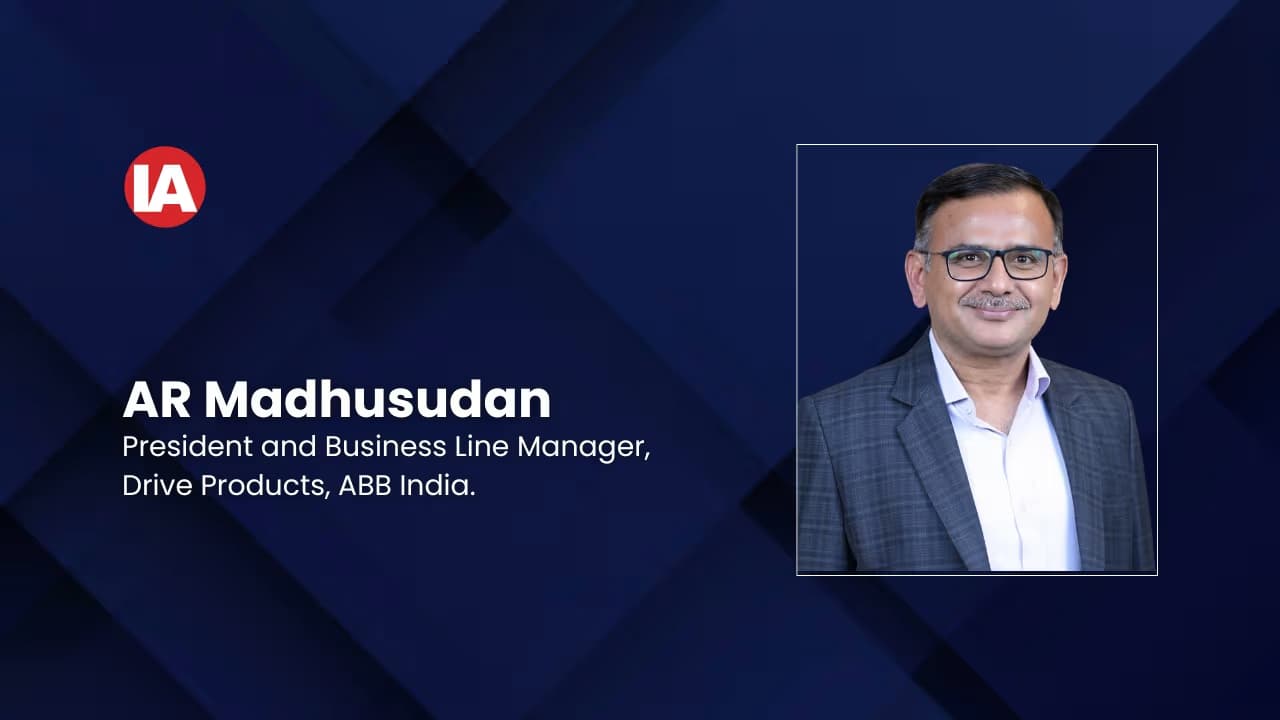
AR Madhusudan, President and Business Line Manager, Drive Products, ABB India
What are the key trends driving demand for ABB range of advanced drives, PLCs, and motion control solutions across various sectors today?
India's industrial growth is supported by investments in infrastructure, industrial capacity and ad-vanced manufacturing. At the same time, businesses are under increasing pressure to improve energy efficiency, enhance productivity and build more resilient operations. To achieve this, a broad spectrum of industries is accelerating the adoption of automation and intelligent motor control.
Since electric motors account for a significant share of industrial electricity consumption, optimising motor-driven applications presents one of the fastest and most practical opportunities to reduce energy use. Hence, energy efficiency today has become a business imperative.
Additionally, as manufacturing expansion in India accelerates, there is a preference for integrated automation solutions. Across industries, whether it is pharmaceuticals, food processing, textiles, metals or machine building, industries are seeking automation solutions that are easier to integrate, operate and scale. This is where combining advanced variable frequency drives (VFDs) with programmable logic controllers (PLCs) and motion control solutions create a real differentiation.
We are also seeing infrastructure-led demand. India is witnessing sustained investments in infrastructure and industrial development, from metro rail, airports and water infrastructure to data centres and renewable energy. These projects increasingly require energy-efficient, reliable and digitally connected motor control and automation systems. With our wide and diverse portfolio of drives, automation and motion control solutions, we remain well-positioned to address these needs.

How are ABB's drive and motion automation technologies helping customers reduce energy consumption, improve productivity, and achieve their decarbonisation goals?
Electric motors consume around 45 percent of the world’s electricity and 70 percent of industrial energy. Pairing an efficient motor with a VFD which controls speed and torque to match the actual process need is the single highest-impact intervention most plants can make. For applications such as pumps, fans and compressors, this can deliver substantial energy savings, typically by 25 percent or more, while simultaneously reducing mechanical wear and extending equipment life.
However, the value today extends well beyond speed control. When drives are integrated with PLCs, operators can gain better visibility and control over their processes while with servo products, they can achieve precision, high-speed synchronisation and machine productivity.
Overall, they can optimise production, minimise downtime, improve product consistency and make maintenance more predictive rather than reactive.
The impact is evident across industries, from delivering improved productivity and precision for a major textile equipment maker to enabling over 60 percent reduction in energy costs for a cold storage facility in northern India. ABB's drives and automation are helping customers address different business challenges through a common objective – improving efficiency, performance and sustainability.
Industrial automation is evolving rapidly with the integration of digital technologies, AI, and analytics. How is ABB incorporating these capabilities into its drive and motion control portfolio to create greater value for customers?
While we continue to advance our core portfolio of drives, PLCs and motion control solutions, we are continuously enhancing our portfolio with digital tools that simplify engineering, product selection, commissioning and lifecycle management. We are providing digital tools to improve customer experience and provide a unified engineering environment and ease of integration. Through the ABB Startup Challenge in India, our initiative to foster collaboration with startups, we are leveraging AI innovation to advance smart drive technology.
Beyond engineering and support, connected drives also generate valuable operational data. Our drives are designed with connectivity as a core capability. They can securely communicate with higher-level automation systems, edge devices and cloud-based platforms, providing continuous operational data for monitoring, diagnostics and optimisation. The result is a shift from reactive to predictive maintenance, which can mean avoiding unplanned downtime and costs for our customers. As industrial systems become more connected, protecting operational technology environments becomes critical. We continue to strengthen cybersecurity capabilities across our drives and automation portfolio while ensuring that digital technologies remain practical, reliable and easy for customers to adopt.

The renewable energy sector is expanding at an unprecedented pace. What role do ABB's drive and control technologies automation play in supporting renewable energy projects, and where do you see the biggest opportunities in this segment?
India's renewable energy transition is entering a new phase where reliability, flexibility and efficient power management are becoming just as important as generation capacity.
ABB provides PLC-based SCADA (supervisory control and data acquisition) system and power plant controllers (PPCs), which helps operators get real-time insights on key plant parameters and provide complete visibility of renewable plant operations. This cybersecure and IoT-enabled solution is widely being leveraged across India helping enable efficient operations of hybrid plants, including solar, wind and battery energy storage systems (BESS). So far, we have automated over 18GW capac-ity in the country.
As renewable installations grow larger and increasingly incorporate battery energy storage systems, automation assumes a more significant role in managing system stability, optimising asset utilisation and ensuring safe operations. One of the significant opportunities we see is in hybrid renewable projects integrating solar, wind and battery storage.
India's ambitious clean energy targets create significant opportunities for advanced automation technologies that enable both sustainability and operational excellence.
How is ABB adapting its motion and power technologies to meet the reliability, efficiency, and scalability requirements of modern data centres?
Data centres are rapidly becoming one of the most critical infrastructure segments, driven by the growth of AI, cloud computing and digital services. Intelligent cooling and automation can help operators maximise uptime while improving energy efficiency and ensuring their facilities can scale seamlessly. At ABB, we are continuously adapting our drive and automation technologies to help operators meet these evolving requirements with solutions that are more energy efficient, connected and scalable.
Cooling systems account for a significant share of a data centre's energy consumption, making them a key area for optimisation. ABB's HVAC-dedicated variable speed drives help chillers, cooling tower fans and pumps operate precisely according to real-time cooling demand rather than at fixed speeds, reducing energy consumption while maintaining reliable thermal management. Our ultra-low harmonic (ULH) drives also help improve power quality by minimising harmonic distortion, sup-porting the reliable operation of sensitive electrical infrastructure.
We are also strengthening the automation layer through our PLC solutions, enabling centralised control, seamless integration and real-time monitoring of critical cooling equipment. By combining intelligent motor control with integrated automation, we are helping customers build data centre infrastructure that is more reliable, energy efficient and scalable.
Could you highlight some of the key innovations emerging from ABB India's R&D efforts and how they are shaping the next generation of drive and automation solutions?
Innovation at ABB is focused on making industrial technology smarter, simpler and more sustainable. For our team in India, it is also driven by a deep understanding of local customer needs, backed by the strength of ABB's global technology ecosystem.
For example, our ACS560 general-purpose drive has been engineered for India, in India. It is designed to meet the evolving needs of the Indian market by combining energy efficiency, ease of use and robust performance. With all essential features built in, it also provides a Hindi-language control panel. Our packaged drive portfolio integrates the drive with essential switchgear and protection components into a factory-engineered solution. This simplifies engineering, reduces installation time and provides customers with a compact, reliable solution for critical industrial applications even in harsh conditions.
We also remain focused on improving connectivity and ease of integration so customers can deploy automation solutions more quickly. Our India facility is also home to one of ABB’s key centres of expertise for drives and we also have a dedicated Motion OEM hub, designed to foster close collaboration and innovate together with our partners and teams. By combining local market insights with global technology expertise, we are developing solutions that not only address India's industrial requirements but also contribute to ABB's worldwide innovation ecosystem.
Looking ahead over the next five years, what are your key priorities for ABB India's Drive Products business in terms of technology development, market expansion, localisation, and supporting India's industrial transformation?
India's industrial transformation and growth present a significant opportunity, but it also raises the bar for efficiency, resilience and sustainability. Looking forward, our key priority continues to help customers operate more efficiently, improve productivity and accelerate their sustainability journey through intelligent drive and automation technologies, helping industries outrun – leaner and cleaner.
To achieve this, we will continue to advance our portfolio with solutions that are more intelligent, connected and easier to use. Serving more than 20 industry segments, our focus is on developing both versatile solutions for general industrial applications and purpose-built technologies for sectors such as water and wastewater, HVAC and other critical infrastructure. At the same time, we are well positioned to support India's fast-growing segments, including data centres, renewable energy, electronics and advanced manufacturing, with integrated drive and automation solutions.
Localisation will continue to be a key pillar of our strategy. With over two decades of low-voltage drive manufacturing in India, we have built a strong foundation to respond quickly to customer requirements while delivering high-quality, innovative solutions tailored to the needs of Indian industry. By leveraging our local manufacturing, engineering expertise and strong global collaboration, we will continue to deliver high-quality, innovative solutions engineered for India and beyond.
Finally, sustainability remains at the core of everything we do. We will continue enabling our cus-tomers to improve energy efficiency, reduce emissions and build more resilient operations through our technologies, while advancing sustainability across our own operations and manufacturing foot-print.