Powering the AI Era: Enabling Sustainable and Resilient Data Centre Cooling
Copeland's Abel Gnanakumar explores how advanced HVAC, hybrid cooling, and sustainable tech are addressing rising rack densities in AI data centres.
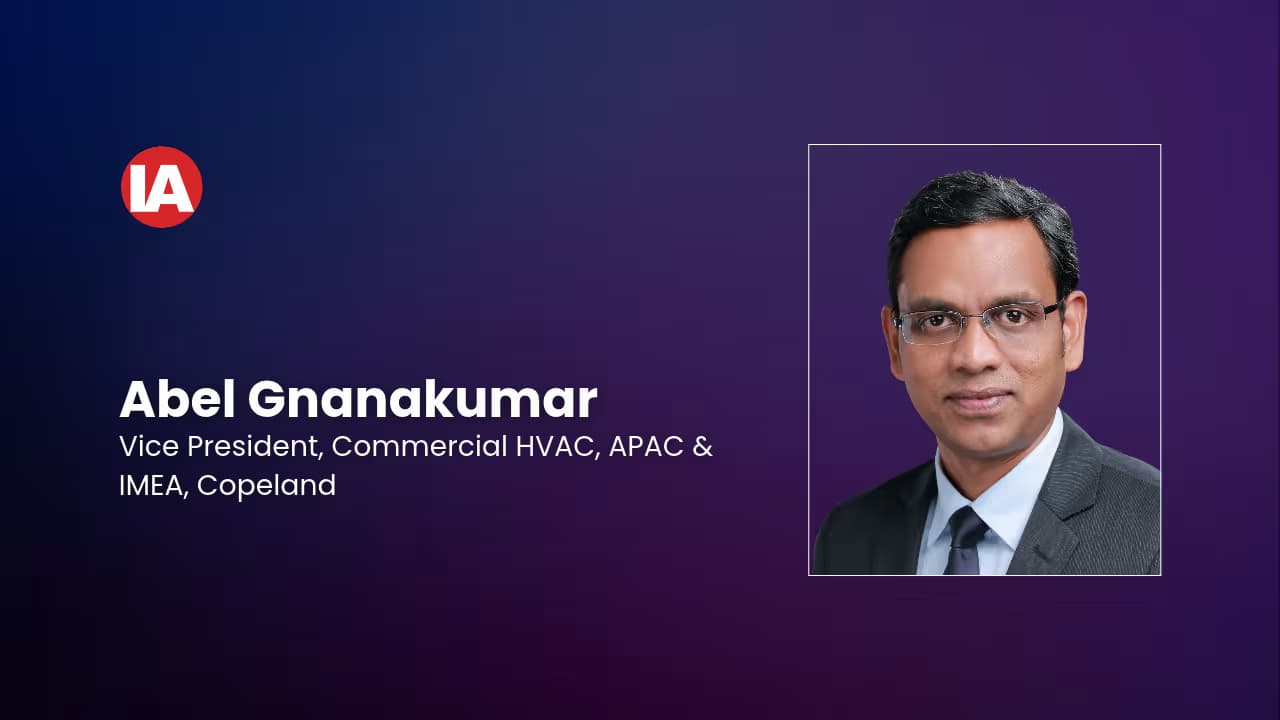
Abel Gnanakumar, Vice President, Commercial HVAC, APAC & IMEA, Copeland.
Artificial intelligence is driving unprecedented growth in data centres, with computing densities increasing rapidly. How do you see AI, cloud computing and high-performance computing reshaping cooling requirements, and what new design priorities are emerging for data centre operators?
AI, cloud and high-performance computing workloads are fundamentally redefining the cooling equation for data centre operators. Rack densities that averaged 5-10 kW a decade ago are now touching 30 kW or higher on a modal basis, and dedicated AI training racks are running well beyond that. Uptime Institute's 2026 Global Data Center Survey found average enterprise rack density rose from 9 kW to 11 kW in a single year[1], while AFCOM's State of the Data Center Report 2026 recorded a jump from 16 kW to 27 kW at the modal level[2]. The most demanding AI training clusters, built around the latest GPU platforms, can require well over 100 kW per rack[1].
This step-change is pushing three design priorities to the top of operators' agendas: cooling systems that can flex efficiently across highly variable, bursty AI loads; hybrid architectures that combine air and liquid cooling within the same facility rather than treating them as an either/or choice; and compression and controls technology that sustains efficiency even as density and ambient conditions change. At Copeland, our oil-free centrifugal compressor with Aero-lift™ bearing technology and variable-speed platforms are engineered into next-generation chiller and hybrid cooling systems developed with our OEM partners to meet these evolving requirements without compromising reliability.
Data centres today must simultaneously improve uptime, reduce energy consumption and lower their carbon footprint. From your perspective, what are the biggest cooling and sustainability challenges facing operators across India and the Asia-Pacific region, and how do they differ from those in more mature markets?
Operators across India and Asia-Pacific are managing a complex balance between rapid expansion, rising compute intensity and tightening sustainability expectations. APAC is projected to account for approximately 40% of global data centre capacity by 2030, with the hyperscale segment growing at roughly 30% CAGR through the decade[3].
Compared with mature regions such as North America and Europe, where much of the infrastructure is older but operates within well-established regulatory frameworks (Germany's Energy Efficiency Act, for instance, now mandates a PUE of 1.2 or lower for new facilities)[4], many APAC regions, including India, are building predominantly greenfield capacity. That gives operators the opportunity to design in efficiency from day one, but it also comes with region-specific challenges. These include sustained high ambient temperatures that increase cooling loads for much of the year, water stress that limits evaporative cooling options in several markets and power grid constraints that make every efficiency gain more valuable. Regulatory frameworks and skills ecosystems around advanced cooling and low-global warming potential (GWP) refrigerants are also still maturing across several APAC regions relative to Europe or North America. Addressing this requires solutions engineered for local climate and infrastructure realities rather than a direct import of designs from other regions, an approach Copeland takes by working closely with regional OEMs and data centre stakeholders.
Power Usage Effectiveness (PUE) has become one of the most closely watched performance metrics. How can advanced compression technologies, intelligent controls and integrated cooling systems help operators achieve significant improvements in PUE while maintaining the reliability required for mission-critical facilities?
PUE remains the industry's most closely watched proxy for cooling efficiency, and the global average, now around 1.52, according to Uptime Institute's 2026 Global Data Center Survey[5], shows there is still considerable headroom, even as the best hyperscale facilities already operate closer to 1.1–1.3.
Advanced compression technology is central to closing that gap. Copeland's oil-free centrifugal compressor with Aero-lift™ bearing technology is designed for mission-critical chiller applications and delivers meaningful efficiency gains over conventional compression in air-cooled systems, while supporting compatibility with lower-GWP refrigerants. Variable-speed compressors and controls that modulate output precisely to match real-time loadrather than cycling on and off are equally important, since data centre loads, especially AI-driven ones, are far more dynamic than in the past. Integrating compression, controls and cooling-system design as one intelligent unit, rather than optimising each in isolation, is what ultimately moves the needle on PUE without compromising the redundancy and reliability that mission-critical facilities require. We have seen this in practice: Copeland's variable-speed scroll solutions, deployed with Canatal for China Mobile's data centre, achieved a PUE below 1.25 and an annual energy efficiency ratio (AEER) of 12.5 W/W[6].
Traditional air cooling is increasingly being complemented or even replaced by liquid cooling and hybrid approaches for AI workloads. How do you see the future of these technologies evolving, and what role will Copeland's innovations play in supporting next-generation data centre architectures?

Air cooling alone becomes physically inadequate once rack densities cross roughly 30–40 kW, a threshold a growing share of AI deployments already exceed. That is why liquid cooling, led by direct-to-chip approaches, is moving from a niche technology to a mainstream requirement for AI-ready facilities. The global data centre liquid cooling market was valued at approximately USD 4.8 billion in 2025 and is projected to reach USD 27.1 billion by 2035, growing at over 18% CAGR[4], with liquid-cooled systems capable of PUEs as low as 1.05-1.15 compared with 1.4-1.8 for air-cooled facilities[4].
That said, very few operators will make a wholesale switch overnight. For existing facilities in particular, hybrid approaches, combining conventional air-cooled infrastructure with liquid cooling for high-density zones, offer a practical, phased path that supports evolving workloads without disrupting uptime. Copeland's role is to make that transition easier for our OEM partners: our compression, controls and adaptable cooling technologies are engineered to work across air, liquid and hybrid architectures, so operators can modernise incrementally rather than being locked into a single approach as workloads and technologies continue to evolve.
Cooling infrastructure is no longer just a utility, it has become a strategic enabler of business continuity. How are predictive diagnostics, digital monitoring and intelligent controls helping operators move from reactive maintenance to predictive asset management, thereby minimising downtime and improving resilience?
Cooling failures are among the costliest categories of data centre outage. Uptime Institute's most recent outage analysis found that 54% of operators' most recent significant outages cost more than USD 100,000, with one in five exceeding USD 1 million[7], and power- and cooling-related issues remain among the leading causes.
This is why predictive, rather than reactive, asset management has become a strategic priority. Digital monitoring embedded in compressors and cooling systems can continuously track vibration, temperature, refrigerant pressure and run-hours, flagging deviations from normal operating patterns well before they become failures. Combined with intelligent controls and integration into building and data centre management systems, this allows operators to schedule maintenance around actual equipment condition rather than fixed calendar intervals, extending equipment life while reducing unplanned downtime risk. For mission-critical facilities, where even a few minutes of cooling interruption can cascade into a full outage, this shift from reactive repair to condition-based, predictive maintenance is becoming as important to resilience planning as redundancy design itself. It is an area where compressor and controls manufacturers, cooling OEMs and operators increasingly need to work together, sharing data to build more accurate predictive models over time.
The industry is also transitioning toward low-GWP refrigerants and more sustainable cooling solutions. What technological and regulatory developments are accelerating this shift, and what practical steps should operators take today to future-proof their cooling infrastructure without disrupting ongoing operations?
Answer: The refrigerant transition is being driven by technology and regulation moving in the same direction. On the regulatory side, the Kigali Amendment to the Montreal Protocol, which India ratified in 2021commits signatories to phasing down high-GWP HFCs over the coming decades[8], while regions such as the EU have their own F-Gas restrictions accelerating adoption of lower-GWP alternatives. On the technology side, compressors and
system designs compatible with these refrigerants have matured significantly. Copeland's oil-free centrifugal compressor with Aero-lift™ bearing technology, for example, was engineered from the outset for compatibility with lower-GWP refrigerants without compromising the efficiency or reliability mission-critical facilities need[9].
For operators, the practical path forward is to build in refrigerant flexibility rather than wait for a mandate. That means specifying new chiller and cooling investments with lower-GWP compatibility today, even where current regulations don't yet require it, and taking a phased retrofit approach for existing assets, prioritising equipment nearing end-of-life or major overhaul rather than disrupting operational facilities mid-cycle. Working closely with OEMs and compressor manufacturers early in the planning process, rather than treating refrigerant choice as a late-stage decision, is what allows this transition to happen without compromising uptime.
Many countries in the region are witnessing a surge in hyperscale facilities as well as edge data centres. How should cooling strategies differ between these environments, and what opportunities do you see for improving efficiency through modular, scalable and digitally connected cooling solutions?

Hyperscale and edge facilities sit at opposite ends of the cooling design spectrum, and the region's growth in bothAPAC hyperscale capacity expanding at roughly 30% CAGR and edge deployments at around 20% CAGR through 2030[3], means operators need distinct strategies for each.
Hyperscale facilities are increasingly designed around high, relatively uniform densities from day one, favouring centralised chiller plants, liquid-ready infrastructure and N+1 or 2N redundancy at scale, where efficiency gains compound dramatically given the sheer size of these sites. Edge data centres, by contrast, are typically smaller, more distributed, often unmanned, and need to be deployed quickly and consistently across many sites with limited on-site technical staff. Here, the opportunity lies in modular, factory-integrated cooling units that are pre-engineered, quick to install and standardised across a fleet, paired with remote digital monitoring so a central team can manage cooling performance and diagnostics across dozens or hundreds of dispersed sites without needing to be physically present at each one. In both cases, the common thread is intelligent, connected controls, whether optimising a single hyperscale chiller plant or an entire distributed edge network, that let operators extract more efficiency and reliability from their cooling infrastructure as it scales.
Looking ahead, what emerging technologies or innovations, whether in compressors, controls, refrigerants, AI-enabled optimisation or thermal management, do you believe will have the greatest impact on enabling sustainable, resilient and energy-efficient data centres over the next five to ten years?
Over the next five to ten years, I expect the biggest impact to come from the convergence of several technologies rather than any single breakthrough. On the hardware side, oil-free, magnetic-bearing centrifugal compressors will continue to displace conventional compression in mission-critical applications, delivering higher efficiency while supporting the industry's shift to lower-GWP refrigerants. Liquid cooling direct-to-chip today, with immersion and other approaches maturing over timewill become a standard part of AI-ready facility design rather than a specialised add-on, working alongside air cooling in hybrid architectures rather than replacing it outright.
The bigger shift, though, may be in controls and intelligence: AI-enabled optimisation that continuously tunes cooling output to match highly dynamic, AI-driven IT loads in real time, moving well beyond the static setpoints most facilities operate on today. Combined with predictive diagnostics and digital twins that model a facility's thermal behaviour before problems occur, this will let operators run cooling systems much closer to their true efficiency limits without sacrificing reliability. None of this happens in isolation, it will require continued, close collaboration between compressor manufacturers, cooling OEMs, hyperscale and colocation operators, and policymakers, so that innovation, regulation and deployment move at the same pace as AI-driven demand itself. With over a century of engineering expertise and collaboration with 20+ global data centre cooling OEMs, Copeland intends to remain part of that collaborative core[3].
Sources:
- Uptime Institute, 16th Annual Global Data Center Survey (2026), as reported by Data Center Knowledge – https://www.datacenterknowledge.com/ai-data-centers/ai-rack-density-s-real-limits-power-cooling-failure-risk
- AFCOM, State of the Data Center Report 2026, as reported by Upsite Technologies – https://www.upsite.com/blog/what-is-going-on-with-rack-density/
- Source: Copeland DCWA messaging, FY25 – https://docs.google.com/document/d/1nKai7gvcyiN2VYqktz55YdXKjY_uGrPu/edit?pli=1
- Global Market Insights, Data Center Liquid Cooling Market Size & Share, 2026-2035 – https://www.gminsights.com/toc/detail/data-center-liquid-cooling-market
- Uptime Institute, Global Data Center Survey 2026 average PUE of 1.52 – https://intelligence.uptimeinstitute.com/resource/growing-pue-advantage-larger-data-centers
- Copeland Data Center webpage China Mobile / Canatal case study – https://www.copeland.com/en-in/end-markets/commercial-industrial/data-center
- Uptime Institute, 8th Annual Outage Analysis (2025/26), as reported by Data Center Knowledge – https://www.datacenterknowledge.com/outages/data-center-outages-decline-for-fourth-straight-year-but-issues-persist
- Cooling Post, "India ratifies Kigali amendment" – https://www.coolingpost.com/world-news/india-ratifies-kigali-amendment/
- Copeland, "Copeland introduces oil-free centrifugal compressor" (media release) – https://www.copeland.com/en-us/news/copeland-introduces-oil-free-centrifugal-compressor
Mr Abel Gnanakumar is an experienced business leader with over 26 years of expertise across cold chain solutions, sustainable HVAC manufacturing and strategic business growth. He currently serves as the Vice President – Commercial, Asia, Middle East & Africa (APAC & IMEA), Copeland, where he leads regional sales, operations and business expansion, with a focus on localisation and Make in India initiatives. He was associated with Emerson until 2020 and holds a B.Tech degree from Bharathiar University.