Low-code is broadening who can participate in Industry 4.0 automation, without having to manually code every step
MathWorks India’s Vijayalayan R explores how low-code platforms, model-based design, and simulation accelerate Industry 4.0 automation engineering.
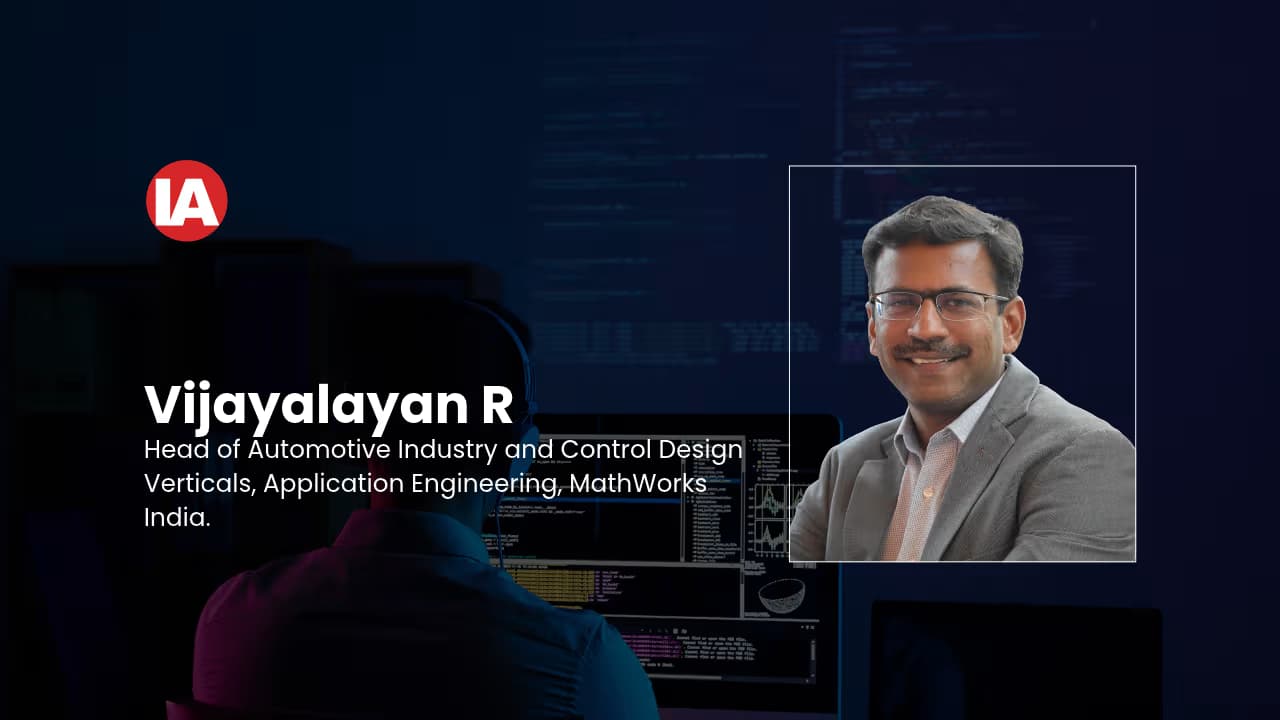
Vijayalayan R – Head of Automotive Industry and Control Design Verticals, Application Engineering, MathWorks India.
How are low-code automation platforms changing the way enterprises approach Industry 4.0, particularly by enabling engineers, plant teams and other business users with limited coding expertise to participate directly in developing automation applications?
Low-code is broadening who can participate in Industry 4.0 automation. Engineers and plant teams can use visual tools and models to turn their domain knowledge into automation applications without having to manually code every step.
Low-code is not about replacing engineering expertise. Domain engineers, controls engineers, and data scientists still bring different skills. The value is in helping them implement ideas faster and collaborate without having to become programming experts. When these environments also include simulation capabilities, engineers can test those ideas and validate system behaviour before deployment.
We see low-code as a way to help engineers work at a higher level of abstraction, while keeping engineering knowledge and validation at the centre.
What impact can low-code platforms have on the speed of application development and deployment – from identifying a process-improvement opportunity to implementing and scaling the solution – and how can this translate into faster innovation and time-to-value for enterprises?
The benefit is not limited to building an application more quickly. The larger opportunity is to shorten the complete engineering cycle, from exploring an idea to testing, implementation and deployment.
Visual applications and reusable models allow engineers to investigate ideas without starting every project with handwritten code. Once a design has been tested in simulation, engineers can generate code from it for deployment, helping maintain equivalence between what was simulated and what is implemented. The generated code can then be integrated into automation projects and executed on programmable controllers.
This also helps teams identify problems earlier. Instead of discovering an issue during commissioning, they can find it while modelling and simulating the system. Virtual commissioning can take this further by allowing the controller and plant model to be tested together before connecting the software to production equipment.
Low-code workflows make complex engineering designs more accessible without requiring in-depth programming expertise. Agentic AI extends this by helping engineers execute analyses, simulations and tests, examine the results and iterate. The engineer remains central, defining the objectives, constraints, and acceptance criteria, and ultimately deciding whether the solution is technically sound.
Agentic AI accelerates this cycle further by helping engineers execute analyses, simulations, and tests, and iterate on the results. The engineer remains central, defining the objectives, constraints and acceptance criteria and ultimately deciding whether the solution is technically sound.
The result is faster iteration, earlier validation, and a shorter path from an engineering idea to business value.
With the shortage of specialised automation and IT skills, how can low-code platforms help enterprises bridge the skills gap while empowering their existing workforce to develop, modify, and maintain applications without extensive programming or IT training?
Low-code can help enterprises make better use of the expertise they already have. Domain engineers understand the equipment, processes, and operating challenges.Visual applications and model-based workflows allow them to apply that knowledge without first becoming expert programmers.
At the same time, specialist teams can create validated components, models, deployment processes, and engineering standards that others can reuse within defined boundaries. This also gives data scientists, automation engineers and operations teams a common environment to evaluate design choices and collaborate more effectively.
So, low-code should not simply be viewed as a response to a shortage of programmers. It is an enterprise enablement strategy that allows domain experts to spend more time solving engineering problems and less time on unnecessary coding.
How can enterprises ensure that applications created by in-house teams through low-code platforms integrate seamlessly with existing PLCs, SCADA, MES, ERP, IoT, and other Industry 4.0 systems, rather than creating another layer of isolated technology?
Integration should not be an afterthought. It needs to be considered at the start. If a low-code application cannot exchange information with controllers, operational systems and enterprise platforms, it risks becoming another technology silo.
Enterprises should look for workflows that support established industrial interfaces and deployment targets. Depending on the application, this can include OPC UA, PLC engineering environments, APIs, and generation of IEC 61131-3, C or C++ code for industrial controllers.It is also useful to keep the engineering design separate from a particular hardware target. Teams can model and validate the required behaviour first, then implement it for the selected controller. This improves portability and reduces the need to recreate the engineering logic for each platform.
For example, in a manufacturing quality application, an AI model could inspect a product and provide the result to a PLC for an immediate control action, while the inspection result is also passed through the plant's integration architecture to the MES as part of the production and quality record. The exact MES integration would depend on the plant architecture.
A Beckhoff Automation implementation provides a useful example. An AI model was developed and optimised using MATLAB® tools, compiled for the TwinCAT environment, and integrated with other capabilities on the PLC. Low-code should therefore be part of the industrial architecture, with models, generated code and standard interfaces connecting engineering, operational, and enterprise environments.
What governance, cybersecurity, data management and quality controls are essential when automation development becomes more distributed across business and plant teams, so that the flexibility of low-code does not compromise enterprise-wide standards, safety or security?
As more people participate in automation development, enterprises need clear boundaries around who can create, review, approve, modify, and deploy an automation application.Low-code does not remove the need for engineering controls.Applications and algorithms should remain connected to requirements, version controlled, tested, and reviewed before deployment, while reusable components need clear ownership and defined conditions for use.
For industrial-control applications, teams also need to evaluate how software interacts with the physical system. Simulation, automated testing, PLC-in-the-loop testing and virtual commissioning can help expose issues before deployment. Data collection, preparation, access and monitoring also need appropriate governance.
These controls become even more important with agentic AI, where an agent may carry out multiple steps rather than assist with one task. Enterprises will need defined constraints, approved tools, human oversight, testing, and clear approval points before changes move into production.
Broader participation should lead to more consistent governance.
Ultimately, how should enterprises measure the success of a low-code automation strategy – such as productivity gains, reduced development time, lower costs, faster deployment, workforce productivity, and scalability? What does a successful enterprise-wide low-code automation roadmap look like?
The real measure of a successful low-code strategy is not how many applications are created or how many lines of code are avoided. It is whether the approach delivers better engineering and operational outcomes.
Enterprises should look at measures such as development and commissioning time, reuse of validated models and components, late-stage defects, maintenance effort, and how quickly a proven solution can be adapted to another machine, controller or site. Workforce productivity is equally important: are engineers spending less time on repetitive implementation and more time solving higher-value engineering problems?
A successful roadmap typically starts with focused use cases where value can be demonstrated, establishes reusable engineering assets and standards, and then scales those practices across teams and sites.
Ultimately, enterprise-scale low-code is about reuse with governance, enabling local teams to innovate faster while building on common engineering standards, validated assets, and proven workflows.
(The views expressed in interviews are personal, not necessarily of the organisations represented.)
Mr Vijayalayan brings over two decades of industry experience, with a background spanning embedded systems, control engineering and automotive technology. Before joining MathWorks, he worked as a team lead in the Embedded Systems Group at Cranes Software International Limited and as a Scientist B at the Gas Turbine Research Establishment (GTRE). He holds a bachelor's degree from Manonmaniam Sundaranar, helping automotive companies develop and validate technologies for vehicle electrification, software-defined vehicles and next-generation mobility.
He brings over two decades of industry experience, with a background spanning embedded systems, control engineering and automotive technology. Before joining MathWorks, he worked as a team lead in the Embedded Systems Group at Cranes Software International Limited and as a Scientist B at the Gas Turbine Research Establishment (GTRE). He holds a bachelor's degree from Manonmaniam Sundaranar University and a master's degree in control and Instrumentation from IIT Madras.
Given his leadership role and technical expertise, he is well placed to speak on automotive engineering, simulation-led development, vehicle electrification, software-defined vehicles and the role of AI in engineering workflows.