Robotics Beyond Assembly: Real-World Use Cases
At Tata Motors, collaborative robots (cobots) are transforming automotive manufacturing by handling intricate trim-line tasks such as applying sealant and tightening bolts, roles traditionally performed manually. This new generation of robotics brings AI-driven agility and edge intelligence not only to assembly, but also to precision welding, packaging, and continuous quality inspection—reducing errors, fatigue, and downtime while enabling rapid reconfiguration and real-time production optimisation across the plant.
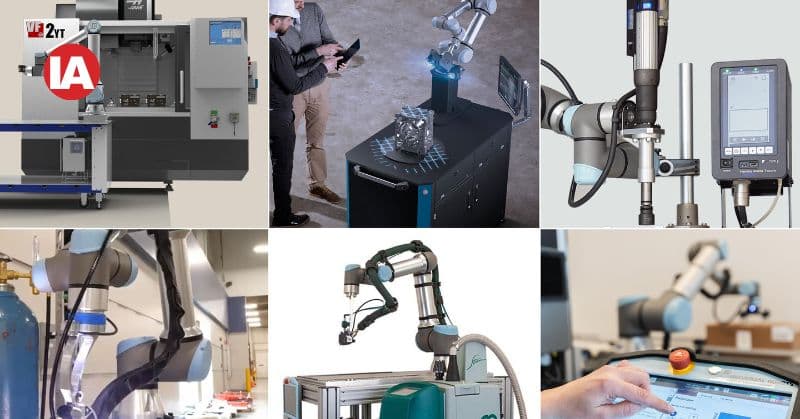
At Tata Motors, cobots now do manual activities like applying sealant and tightening bolts on trim lines, reducing errors and fatigue.
Robots are no longer confined to spot-welding cells. In India, robotics is progressing well beyond assembly. Automotive manufacturers now deploy collaborative six-axis robots for complex trim-line tasks like torquing and sealant application, once considered too variable for automation. These cobots offer faster RoI, reduce ergonomic risks, and can be rapidly reconfigured by in-house teams. In quality control, AI-enabled vision systems – like GM's paint-repair cell – detect sub-millimeter defects and adapt sanding paths in real time, eliminating rework and inspection delays. For packaging and intralogistics, mobile manipulators and gantry robots now execute bin-picking and palletizing tasks in sync with MES data, enabling just-in-time material flow. This shift reflects a broader trend: robotics, empowered by edge AI and integrated data systems, are transitioning from isolated applications to scalable, plant-wide optimisation tools.
Adaptive robotics in welding: Intelligence and precision come together
Adaptive robotic systems that can react instantly to changes in the real world are replacing rigid welding cells on the modern manufacturing floor. Even when part geometries or materials change, robots utilising sensor fusion technology and edge computing can now weld with amazing precision. Welding pathways or parameters can be instantly corrected thanks to real-time processing of feedback from thermal imaging, force sensors, and arc stability. Cycle durations are shortened, needless rework is eliminated, and defects are greatly decreased with this degree of autonomy. Welding is continuously optimised and is no longer merely automatic.
Automated inspection: From reactive to predictive
Robotic intelligence is revolutionising inspection procedures. Inspection, which was once thought of as a post-process activity, is increasingly moving upstream and becoming inline. Real-time component inspection is done by robots equipped with high-resolution cameras, laser scanners, and AI-driven analytics, frequently during the manufacturing process. Additionally, inspection data is fed back into the production control system, which aids in both long-term process optimisation and real-time quality control. The benefits of this robotic vision revolution include traceability, root cause investigation, and predictive maintenance.
Intralogistics and packaging: The next robotics frontier
In packaging and logistics, where performance is determined by volume, speed, and variability, robots are being used more and more. Today's robots, in contrast to classic fixed automation,
have force-controlled grippers, AI-enhanced vision systems, and mobility platforms that can adjust to various product shapes, packing materials, and palletizing patterns.They are perfect for order fulfillment, warehouse management, and just-in-time kitting because of their versatility. By operating around-the-clock and integrating with corporate systems for demand-driven production, robotic packaging is not only decreasing human weariness and inaccuracy in repetitive activities but also increasing line efficiency.

Image by usertrmk on Freepik
Intelligent robots for welding and quality control
Beyond traditional assembly, robotics has found use in welding and inspection as manufacturing processes require higher uniformity and tighter tolerances. These days, welding robots include intelligent path planning capabilities, real-time feedback loops, and adaptive control systems. These technologies enable robotic welders to detect joint misalignment or material variation and modify operations in the middle of the process. In order to ensure consistent quality and reduce rework, high-performance sensors and AI-driven algorithms assist in detecting and correcting weld penetration or arc length irregularities in real-time.
In a similar vein, inspection has changed from being a manual spot check to being a continuous, automated procedure. Robots equipped with cutting-edge imaging tools, like 3D cameras, laser profilers, and hyperspectral sensors, do rapid quality checks without stopping production. These robots provide data into cloud analytics or MES (Manufacturing Execution Systems) for immediate assessment, integrating with data ecosystems that facilitate traceability and predictive maintenance.
Adaptive robots in difficult production settings
Robotics has advanced from fixed automation to adaptive, context-aware systems as global manufacturers need adaptability. Robots are being used to do welding and inspection activities that formerly needed highly skilled physical intervention in industries including heavy engineering, automotive, and aerospace. These robots negotiate difficult geometries, uneven parts, and changeable material qualities using machine vision, force sensing, and AI-driven control. They are particularly helpful for welding curved or composite surfaces where accuracy is crucial.
Continuous process feedback is made possible by the integration of these technologies with manufacturing execution systems (MES), which enhances system intelligence in addition to product quality. Inspection robots with thermal imaging and 3D scanning capabilities can assess weld integrity, surface flaws, or dimensional tolerances on their own. They can then feed the data onto cloud platforms for real-time analysis. These features expand the use of robotics far beyond conventional, linear assembly lines by enabling manufacturers to maintain high standards with little downtime, even in high-mix, low-volume manufacturing scenarios.
Company | Technology | Features | Relevance |
| IRB Series Robots with AI vision
| Seamless integration for welding and inspection with AI-based path adjustment | Excels in data-driven robotic welding and inline inspection
|
| ARC Mate Series
| High-speed arc welding and multi-robot control
| Widespread use in automotive and metal fabrication |
| KR C4 Controller with sensors
| Integrated inspection and adaptive welding in complex assemblies
| Flexible deployment for inspection, welding, and modular packaging lines |
| Motoman ArcWorld
| Modular welding cells and real-time inspection feedback | Strong in multi-process environments with smart arc systems |
| UR Collaborative Robots (Cobots)
| Lightweight, collaborative robots for packaging and inspection tasks | Perfect fit for human-robot collaboration in packaging and QC
|
| FH Vision Systems with Robotics
| Smart vision-based inspection systems integrated with robots | Merges high-resolution inspection with robotic sorting and feedback |
| FD-V Series Robots
| Compact weld robots with offline programming tools
| Popular in Asia for robotic welding in SMEs and large factories |
| TX2 Series with Cleanroom Integration
| Sterile and precision robots ideal for pharma packaging and inspection | Ideal for sterile packaging environments and delicate tasks
|
| CV-X Series Vision with Robots
| Advanced defect detection in visual inspection and part alignment | Critical for automated vision inspection in electronics and automotive |
| T-Series SCARA Robots
| Precision handling and small part packaging for electronics
| Best for compact assembly and packaging lines requiring speed and accuracy |
Emerging startups
● Path Robotics: Specialises in AI and computer vision-based autonomous welding. Ideal for small-batch and custom production without CAD programming, offering real-time adaptability to metal parts.
● Bright Machines: Delivers software-defined microfactories for packaging and inspection. Known for modular, high-speed systems tailored to fast-moving industries like consumer electronics and medical devices.
● GrayMatter Robotics: Focuses on intelligent surface finishing. Uses advanced AI to automate sanding, polishing, and inspection across complex geometries and changing conditions.
● Wandelbots: Provides a no-code platform for robotic training via demonstration. Empowers even non-programmers to reprogram robots quickly for inspection and packaging in flexible production environments.
● Covariant: Develops deep learning-based pick-and-place robots. Excels in handling unpredictable items, transforming sorting and packaging in e-commerce and logistics sectors.
Beyond conventional assembly, robotics is quickly advancing, turning welding, inspection, and packing into intelligent, flexible procedures. Vision-guided inspectors find tiny flaws, AI-powered welders make adjustments in real time, and intelligent packaging bots manage a variety of SKUs with little assistance. This change aims to create robust, data-driven operations rather than merely automating tasks. Real-time decision-making and predictive control are made possible by the complete integration of robotics with MES and IIoT systems. Manufacturers will have the freedom to quickly reorganise lines and precisely react to fluctuations in demand as edge AI and modular robot platforms advance. Not only will robots obey commands in the near future, but they will also anticipate demands, maximise performance, and propel the next wave of industrial competitiveness.
How far behind is the rest of your plant if your robots are still delayed on the manufacturing line?
References
1. https://www.assemblymag.com/articles/96973-beyond-the-welding-line-robots-and-automotive-assembly
2. https://www.iiot-world.com/smart-manufacturing/discrete-manufacturing/industrial-robotics-manufacturing-automation/
3. https://www.sciencedirect.com/science/article/pii/S2667241321000057
4. https://www.researchgate.net/publication/379439076_Robotics_in_Manufacturing_A_Review_of_Advances_in_Automation_and_Workforce_Implications
Author

Industrial Automation Market Outlook & Strategic Insights
The industrial automation market is entering a phase of accelerated transformation, where resilience, intelligence, and adaptability are becoming core operational priorities. As highlighted in this research report, the shift toward AI-driven automation, digital twins, and connected factory ecosystems is redefining how industries approach manufacturing and process optimization.
Organizations are no longer investing in automation solely for efficiency, but to build scalable, secure, and future-ready industrial systems capable of handling global disruptions and evolving market demands.
Key Technologies Driving Automation Growth
- Artificial Intelligence (AI) and Machine Learning for predictive operations
- Industrial IoT (IIoT) for real-time monitoring and control
- Digital Twins for simulation and optimization
- Robotics and Autonomous Systems for flexible manufacturing
- Cybersecurity frameworks for protecting industrial environments
Real-World Industry Applications
Industries across the globe are leveraging automation technologies to enhance productivity and operational resilience:
- Automotive manufacturing with robotics and assembly automation
- Pharmaceutical production with process automation systems
- Energy and infrastructure with predictive maintenance solutions
- FMCG and logistics with smart supply chain automation
👉 Explore companies implementing these solutions: Industrial Automation Companies Directory
Strategic Importance for Businesses
For decision-makers, industrial automation is no longer optional. It plays a critical role in reducing risks, improving efficiency, enhancing supply chain resilience, and enabling data-driven decision-making across industries.
Explore the Industrial Automation Ecosystem
- Industrial Automation Companies
- Automation Products & Solutions
- Latest Industrial Automation News
- Industrial Automation Magazine
- Women in Industrial Automation
Future of Industrial Automation
The future of industrial automation lies in autonomous systems powered by AI, real-time data, and intelligent control frameworks. Businesses that adopt these technologies early will gain a significant competitive advantage in a rapidly evolving industrial landscape.
Latest Updates
Perseus Information Security Consulting becomes fully accredited certification body for ISASecure ACSSA Program
11/06/2026Honeywell introduces Experion Cognition to deliver autonomous control room operations for Borouge International
11/06/2026ABB expands non-invasive sensing portfolio to advance simpler and safer temperature measurement
11/06/2026India's clean industry pipeline up 30% in six months, reaching a $433 billion investment opportunity
10/06/2026Digital Magazine


The Minds of Manufacturing
Our interviews offer a direct window into the boardrooms of the world's leading automation providers. We focus on strategic discussions that help our readers understand not just the 'what', but the 'why' behind today's industrial technology developments.
Executive Perspective on Industrial Transformation
Our Interviews section features the most influential voices in the industrial sector. We sit down with CTOs, Engineering Directors, and Industrial Strategists to discuss the practical aspects of implementing Industry 4.0 standards and the impact of AI on manufacturing.
These conversations go beyond technical specifications, exploring the vision and strategy required to lead a factory in the modern age. Complement these insights by exploring our Cover Stories for implementation success, find local vendors in the Supplier Directory, or stay up to date with our Latest News feed. Exclusive market forecasts are also available through our Research Reports.