By Nikita Kumawat, Co-Founder and Executive Director, Brandworks Technologies
For years, India’s electronics manufacturing industry was largely associated with a single global narrative: ‘Assemble in India’. When I started working in electronics manufacturing, success was largely measured through output volumes, line efficiency, turnaround times, and defect rates.
Now the conversations in manufacturing facilities are very different. Making a lot of things and doing it efficiently is still important, but there is also growing attention on questions such as: What is the data telling us? Can this process predict a failure before it happens? Can a production line learn from previous mistakes? How can engineers make better decisions in real time?
These are not just operational questions; they reflect a much broader shift taking place across India’s electronics industry.
The evolution of smarter manufacturing
Over the past ten years, India's electronics industry has grown remarkably. As per the Government statistics, India's electronics manufacturing increased from over ₹1.9 lakh crore in 2014-15 to over ₹11 lakh crore in 2024-25, while exports of electronics increased by more than eight times during that time .
Automation, artificial intelligence and smart manufacturing make a difference when manufacturing advances and things become more complicated to monitor, as managing manufacturing complexity using only traditional procedures is difficult, especially when current electronic manufacturing involves several suppliers, strict quality standards, thousands of components, and packed delivery deadlines.
Exhibiting a CAGR of 14.70%, global smart manufacturing is projected to grow to USD 1,339.17 billion by 2034, from USD 446.45 billion in 2026, which, in 2025, was valued at USD 394.35 billion. Presently, manufacturers use AI beyond to stay competitive; they use it more for business expansion and growth. Day-by-day, manufacturing is becoming smarter, more efficient, and more resilient, and this is the fact about manufacturing that mostly intrigues me.
From reactive operations to predictive manufacturing
One lesson manufacturing teaches very quickly is that small problems rarely stay small. A minor variation in component placement can eventually lead to product failures. A machine running slightly outside its optimal parameters can quietly affect quality for days before anyone notices. A delayed response to equipment wear can bring an entire production line to a halt.
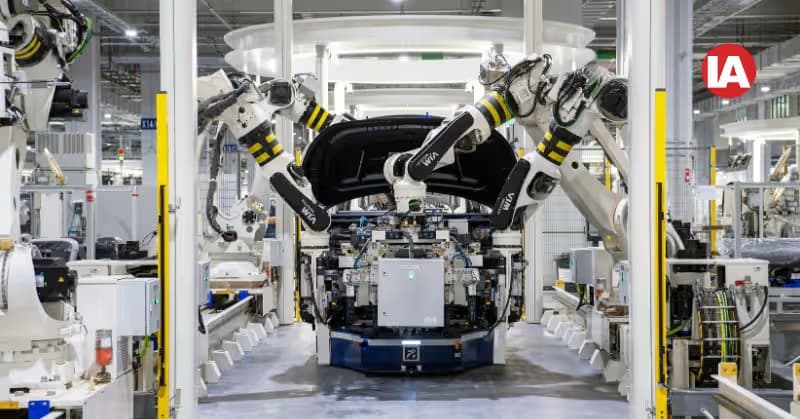
Previously, spotting these issues depended heavily on human observation and experience. However, today artificial intelligence is introducing a completely new layer of visibility to the floor. Let's use contemporary Surface Mount Technology (SMT) lines as an example, where hundreds of thousands of tiny components are mounted onto printed circuit boards every hour. No human operator can inspect every component with complete accuracy at that pace. Here, Artificial Intelligence plays a key role by filling this gap and inspecting every board in real-time, checking the quality of solder, confirming component placement, and identifying defects that manual inspection might not detect.
When it comes to electronics manufacturing, AI analytics are what actually give us visibility across the entire floor. We use this tech to monitor machine health live. It tracks the things that matter, like vibration, temperature, and baseline performance. The goal is clear - find the problem before it halts production. It keeps equipment running, maximises asset lifespan, and frankly, saves a fortune on maintenance.
The greatest manufacturing gains come from human-AI collaboration
Throughout my manufacturing career, I have seen how automation frees workers from time-consuming, repetitive jobs, allowing them to focus on higher-value tasks such as making strategic choices, resolving difficult problems, and producing real value throughout the whole production process with the use of technology.
Artificial intelligence is already shaping this transition, with adoption levels across manufacturing estimated at 35-40 per cent. The factory floor is no longer simply a place where products are assembled. It is increasingly becoming a real-time source of intelligence.
Engineers create value not simply by collecting data, but by turning it into meaningful insights that turn into better decisions. Currently, collecting data is not a challenge as AI has made data collection easier than ever before. Every machine, sensor, production line, and quality checkpoint is continuously generating valuable data.
The evolution of the modern engineering
One of the biggest transformations I have observed in the industry is happening within engineering teams themselves. Today, an engineer might work with automated inspection systems for a portion of the day, analyse production data for another, and use simulation tools to assess process changes, but the boundaries between traditional engineering disciplines are becoming less rigid.
The fact that India's engineering expertise is rapidly adjusting is what I find inspiring. Even a few years ago, it was rare for the next generation of engineers to join the industry with such high levels of digital fluency. They feel at ease working across disciplines and are beginning to see manufacturing as a technology-driven industry rather than just an operational one. The entire industry will be impacted in the long run by that change.
Innovation as the next manufacturing frontier
As manufacturing capabilities continue to mature, the scope of opportunities is far broader. India has an opportunity to strengthen its position across the entire value chain – from design and engineering to product development and advanced manufacturing.
For companies operating in electronics manufacturing, this opens the door to moving beyond execution and playing a deeper role in product creation and engineering-led innovation. That is where long-term value is likely to be created. Technologies such as advanced automation, digital twins, and intelligent forecasting are supporting manufacturers to make better decisions, shorten product development cycles, and also improve resource efficiency across operations.
The future factory will be defined by intelligence
The next phase of growth will be defined not by capacity expansion alone, but by India's ability to deepen its design, engineering, and high-complexity manufacturing capabilities. The infrastructure is established, the prototyping ecosystems are in place, and the advanced manufacturing capabilities needed to compete globally are expanding across the country. The opportunity now is to move further up the value chain and create greater value through innovation-led manufacturing.
I believe the future belongs to manufacturers that successfully mix intelligent technologies with the expertise of humans. Surely, as technology keeps improving, data, AI, and automation will strengthen decision-making, but innovators and engineers will always remain the driving force behind meaningful progress. With a continuously evolving manufacturing ecosystem and a strong engineering foundation, India has the opportunity to emerge as a global leader in manufacturing that sets new benchmarks for quality and innovation.
Nikita Kumawat is the Co-Founder and Executive Director of Brandworks Technologies, a design-led electronics manufacturing and OEM/ODM partner driving India’s hardware transformation. With a background in Electronics & Telecommunications Engineering and experience across Tata Communications, Tech Mahindra, and EY, she left corporate life to build a homegrown innovation-centric enterprise. Under her leadership, Brandworks has scaled from a small power-bank unit into a full-service tech manufacturer serving 40+ leading brands and expanding globally. Known for championing Make in India, inclusive growth, and R&D-driven design excellence, Nikita fosters a people-first culture with over 70% women in the workforce. She has been featured among ET Edge 40 Under 40 West 2025 for her visionary impact.
Author