Engineering a Sustainable Future: How AI-Driven Design Fuels the Circular Economy
As industries across the globe transition toward more sustainable practices, generative design is emerging as a powerful digital tool that aligns engineering innovation with the principles of the circular economy. By using artificial intelligence (AI) and advanced algorithms to explore thousands of design possibilities, generative design enables engineers to create products that use fewer resources, perform better, and remain valuable throughout multiple lifecycle stages.
The Core of Generative Engineering
Generative design allows engineers to define functional requirements—such as load conditions, materials, manufacturing methods, and design constraints—while AI algorithms automatically generate numerous optimized design options. These designs are often structurally efficient, mimicking natural forms like bones or tree branches, where material is used only where it is strictly necessary.
The Environmental Power of Lightweighting
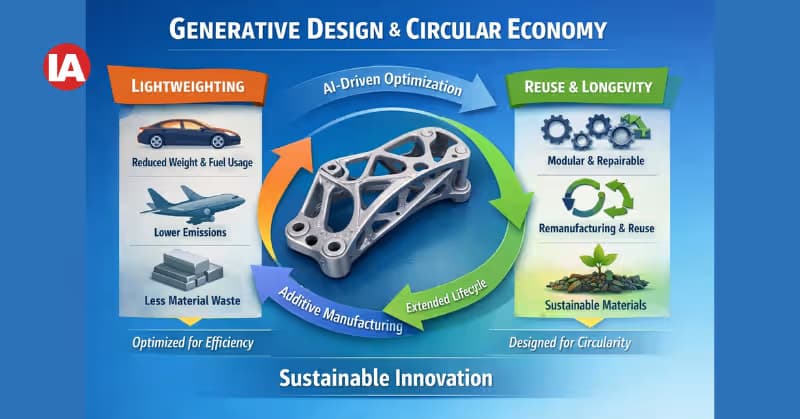
One of the most immediate sustainability benefits of generative design is lightweighting. Traditional engineering design often relies on conservative safety margins, which can lead to components being heavier than necessary. Generative design removes unnecessary material while maintaining strength and performance.
| Benefit Category | Impact of Lightweighting |
| Energy Consumption | Lighter vehicle and aircraft structures drastically reduce fuel usage and carbon emissions. |
| Material Extraction | Lower material volume requirements lead to reduced raw material extraction and processing energy. |
| Waste Reduction | When paired with additive manufacturing, scrap and material waste are virtually eliminated. |
Designing for Reuse and Extended Lifecycles
A key contribution of generative design to circularity lies in designing for reuse and extended lifecycles. Circular economy principles emphasize keeping products and materials in use for as long as possible. Generative design supports this goal by enabling:
Modular Architectures: Creating products with easily replaceable or upgradable parts.
Structural Integrity for Remanufacturing: Components are designed to be refurbished rather than discarded.
Easy Disassembly: Algorithms can optimize designs for "design for disassembly," facilitating efficient recycling and material recovery.
Accelerating the Adoption of Sustainable Materials
Generative design also helps manufacturers experiment with alternative and sustainable materials. Engineers can simulate how recycled materials, bio-based composites, or secondary raw materials behave within a structure. By testing multiple design iterations digitally, companies can identify the most efficient use of such materials without costly physical prototyping.
Furthermore, the digital nature of generative design supports data-driven lifecycle optimization. Sustainability is no longer an afterthought; it is an integral part of the product development process from the very first simulation.
FAQ
What is the role of generative design in the circular economy?
It helps decouple economic growth from resource consumption by creating designs that are lighter (saving material) and modular (enabling reuse and remanufacturing).
How does lightweighting reduce environmental impact?
Lighter components require less energy to transport and operate, particularly in the automotive and aerospace sectors, leading to a significant reduction in lifetime carbon emissions.
Can generative design work with traditional manufacturing?
Yes. While it is often associated with 3D printing (additive manufacturing), designers can set constraints for traditional methods like CNC machining or injection molding.
Why is "design for disassembly" important?
It allows products to be taken apart easily at the end of their life, ensuring that individual components can be reused or recycled rather than ending up in a landfill.