Dr Mahesh Patil, CTO, Vipany Engineering Services and Co-Founder, Urjayanam Technologies.
The future of manufacturing should not begin with a question such as How much automation, AI or IoT can we deploy? It should begin with a more fundamental question: What outcome do we want to achieve – for the customer, the product and the business?
That outcome may be better quality, higher yield, lower downtime, greater process predictability, faster product introduction or quicker response to a customer problem. Once the desired outcome is clear, the next step is to establish the baseline, optimise the process and identify the variables that actually influence performance. Technology should then be introduced incrementally, measured against the baseline and scaled only when the business case is demonstrated.
This is where sensors, machine vision and data fusion are transforming the factory.
From measuring events to understanding processes
Industrial sensors have traditionally answered a fundamental question: what is happening to a physical parameter at a particular point in time? Temperature, pressure, force, vibration, current, position, speed and many other variables can now be captured continuously and at increasingly lower cost.
However, a single sensor provides only a piece of the story. A modern production line may involve incoming material from multiple batches and suppliers, component variation, machine condition, tooling, assembly parameters, environmental conditions, robot motion and operator or system interventions. Machine vision adds another dimension by observing what conventional sensors cannot easily describe – appearance, geometry, orientation, surface condition, assembly completeness and subtle visual changes.
The real value emerges when these signals are correlated.
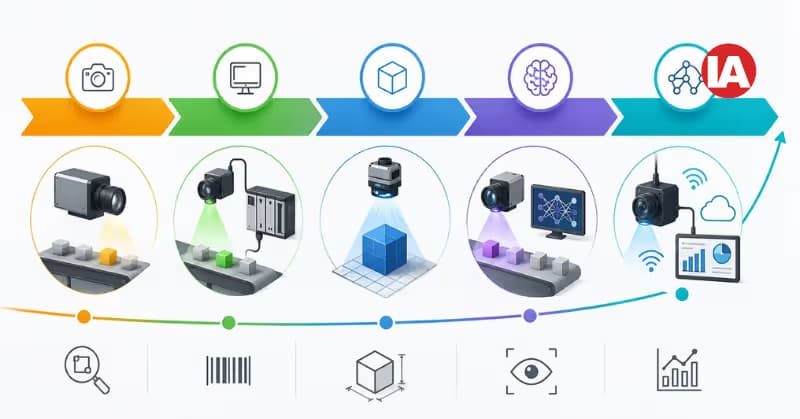
The evolution is therefore from Sense → Record → React to Sense → Correlate → Understand → Predict → Act → Learn.
Advances in CMOS imaging, processing, memory and connectivity have made it economically practical to capture enormous quantities of information. Edge computing allows time-critical processing close to the machine, while industrial networks, historians, MES and cloud platforms provide the wider data infrastructure.
AI/ML can then identify relationships and patterns that are difficult to see in individual data streams. The objective is not to eliminate every variation, but to understand which variations matter, how they interact and when they begin to affect quality or performance.
Data fusion: creating the manufacturing context
Consider an assembly line producing a safety-critical product. A failure may not originate from one obvious parameter. It could result from a marginal incoming component, a small process variation, machine calibration drift, environmental conditions or the interaction of several variables.
Data fusion creates the context required to investigate this.
The product can be connected digitally to its component batch, supplier lot, process sequence, machine, tooling, torque or force values, temperature, vision results, robot trajectory and quality measurements. This creates a digital thread from product → batch → process → machine → measurement → quality outcome.
This is more valuable than simply having more data. It provides traceability and helps distinguish normal process variation from meaningful deviation.
The same principle applies to the customer end. Ideally, a problem observed during product operation should not remain an isolated field complaint. It should trigger a digital connection back into the manufacturing history – allowing engineers to examine the relevant batch, process parameters, machine condition and quality records.
That is where smart manufacturing begins to create value beyond the factory boundary.
Machine vision becomes process intelligence
Machine vision is also moving beyond conventional final inspection.
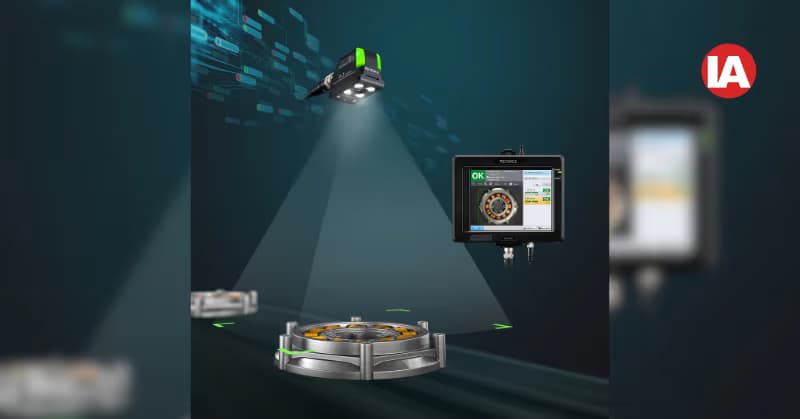
Modern optical systems, supported by increasingly capable CMOS sensors and processors, can inspect products at high speed and resolution. Vision can verify component presence and orientation, connector seating, fasteners, adhesive application, dimensions, surface characteristics and assembly sequence.
But the greater opportunity is to connect vision with PLCs, robots, sensors and process data.
A vision system can identify a deviation while the process is still running. Combined with process information, it can help determine whether the deviation is an isolated defect or an early indication of process drift. The progression is from:
Detect and reject → Detect and understand → Detect, understand and correct.
This creates the possibility of self-correcting processes, but autonomy should not become a technology objective by itself. The appropriate level of automation depends on the value and risk of the application.
From reactive maintenance to informed action
The same journey applies to maintenance.
Reactive maintenance follows a familiar sequence: failure → alarm → maintenance → recovery. Predictive maintenance attempts to identify the movement toward abnormal behaviour before failure occurs.
Here again, raw data is not intelligence. Sensor and vision information becomes useful when combined with machine load, operating conditions, historical failures, maintenance records and product characteristics.
Edge analytics can identify high-frequency deviations locally. Historical data can establish the normal operating envelope. AI/ML can identify subtle changes in vibration, temperature, current, image characteristics or cycle behaviour.
GenAI can add value as an interface and reasoning layer, bringing together machine history, maintenance records, sensor trends and visual observations so that engineers can investigate a problem more quickly.
The ultimate question changes from “What failed?” to “What is changing, what is likely to happen, and what action should we take?”
Digital twins: leverage, not another buzzword
When sufficient physical, process and historical data are available, the next logical layer is the digital twin – a continuously updated digital representation of a machine, process, product or system.
A digital twin can help simulate process changes before implementing them physically, compare actual behaviour with expected behaviour, investigate deviations and optimise parameters. Hardware-in-the-loop (HIL) can further validate control strategies and system behaviour before deployment.
This can reduce commissioning risk, accelerate new-product introduction and improve process stability.
But a digital twin should not be created simply because the technology is available. Its value should be demonstrated against a measurable business or engineering problem.
The economics of the smart factory
This is perhaps the most important consideration in the entire smart-factory journey.
Every technology introduced into a factory has its own lifecycle. Sensors and cameras need installation and commissioning. Systems require calibration, maintenance and cybersecurity. AI models need monitoring and periodic updates. Networks, servers and software require support. Data architectures evolve.
In other words, the digital layer itself becomes a plant operation that has to be managed.
Therefore, RoI must include not only the initial investment but also the cost of operating and evolving the technology.
Economies of scale are equally important. A sophisticated solution may make excellent economic sense when deployed across hundreds of machines, multiple production lines or several plants, while the same solution may not be justified for one low-value operation.
The practical approach is therefore:
Define the outcome → establish the baseline → optimise the process → introduce the minimum enabling technology → measure the result → iterate → scale.
The measures should be tangible: first-pass yield, scrap and rework, OEE, downtime, MTBF and MTTR, process capability, cycle-time variation, energy per unit, warranty cost, commissioning time, customer response time and overall process predictability.
From smart factory to intelligent customer experience
The ultimate measure of a smart factory is not the number of sensors installed, cameras deployed or AI models running.
It is whether the factory can produce a better, more predictable product at a sustainable cost – and respond faster when something goes wrong.
The real opportunity is to connect the physical product, the production process and the customer experience into one learning loop. A customer-end event can be traced back to manufacturing history; manufacturing data can reveal the process cause; the process can be corrected; and the learning can be incorporated into future production.
That is the true promise of sensing, machine vision and data fusion.
The factory of the future will not necessarily be the one with the most technology. It will be the one that knows where technology creates measurable value, deploys it incrementally, learns continuously and scales what works.
Optimise → Instrument → Measure → Learn → Scale.
Glossary
AI — Artificial Intelligence
ML — Machine Learning
CMOS — Complementary Metal-Oxide Semiconductor
IIoT — Industrial Internet of Things
PLC — Programmable Logic Controller
MES — Manufacturing Execution System
OEE — Overall Equipment Effectiveness
MTBF — Mean Time Between Failures
MTTR — Mean Time To Repair
HIL — Hardware-in-the-Loop
RoI — Return on Investment
Cp/Cpk — Process Capability Indices
GenAI — Generative Artificial Intelligence
Dr Mahesh Patil is a global engineering and technology leader with 30+ years across industrial automation, electronics, EVs, embedded systems and sensors, having held with senior Management roles at GE, Hero Electric, Amphenol and Crompton Greaves. A DBA, M.Tech, INSEAD & XLRI alumnus and Certified Independent Director, he co-founded SMEV, scaled several ventures, and now serves as CTO Vipany Engineering Services and Co-Founder, Urjayanam Technologies (EV charging infrastructure).
Author