The evolution of machine vision reflects a broader transformation in manufacturing, says Benedicta Chettiar.
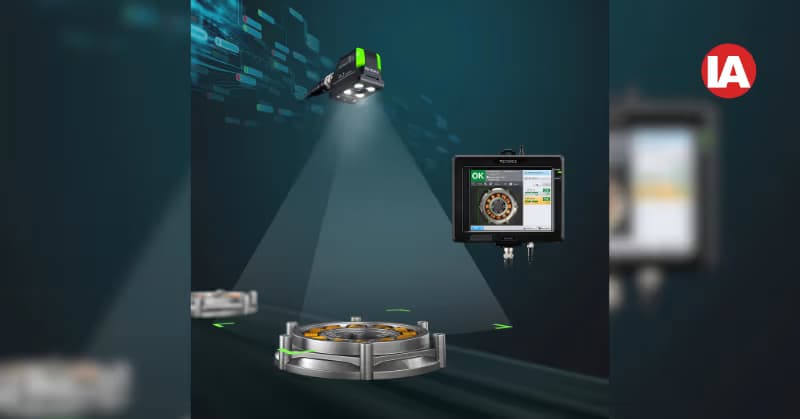
Machine vision has evolved from a relatively simple inspection technology into an intelligent sensing and decision-making capability at the heart of modern automated manufacturing. What began with cameras performing basic pattern recognition has today developed into sophisticated systems capable of interpreting complex visual information, guiding robots, detecting minute defects and supporting real-time production decisions.
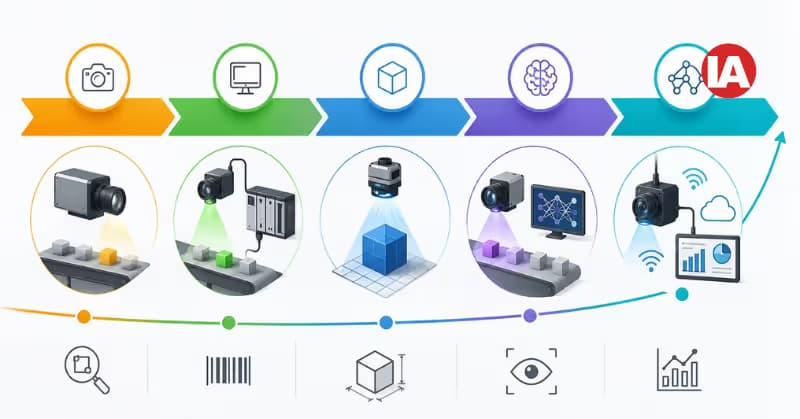
The early applications of machine vision emerged in the 1970s and 1980s, when industrial cameras, image-processing hardware and rudimentary software were deployed for tasks such as presence/absence detection, dimensional measurement and simple quality inspection. These systems were largely rule-based. Engineers had to define parameters such as edges, shapes, brightness and tolerances, and configure the system to recognise deviations. While effective for repetitive, controlled environments, they could struggle when lighting, product orientation or surface characteristics changed.
The arrival of more powerful processors and digital cameras transformed the technology. During the 1990s and 2000s, machine vision became increasingly integrated with PLCs, industrial robots and production-line control systems. Higher-resolution cameras, faster image acquisition and improved optics enabled applications ranging from barcode reading and assembly verification to surface inspection and precision measurement.
A major transformation came with the emergence of 3D machine vision. Instead of analysing only two-dimensional images, systems could now perceive depth and geometry. Technologies such as laser triangulation, structured light and time-of-flight sensing opened new possibilities in bin picking, robotic guidance, dimensional inspection and complex assembly operations. This significantly expanded machine vision beyond conventional quality-control applications.
The next major leap has been driven by artificial intelligence and deep learning. Traditional vision systems depend heavily on precisely defined rules, whereas AI-based vision can learn from examples. This makes it possible to identify defects that are difficult to describe mathematically – such as subtle surface imperfections, variations in texture or irregular assembly conditions. Deep-learning algorithms have therefore made machine vision more adaptable, particularly in industries where product variants are numerous and defect characteristics are difficult to predict.
Today, machine vision is also becoming more distributed and connected. Smart cameras increasingly combine image capture, processing and communication within a single device. Edge computing allows visual data to be analysed close to the machine, reducing latency and avoiding the need to transmit every image to a central server. Integration with Industrial IoT platforms, MES and cloud systems enables visual inspection data to contribute to broader production analytics.
The latest phase is the convergence of machine vision, AI, robotics and generative technologies. Vision systems are no longer simply answering “Is this product good or bad?” They can increasingly help determine why a problem occurred, guide autonomous machines, identify process trends and support corrective action.
The evolution of machine vision therefore reflects a broader transformation in manufacturing – from seeing to understanding, and from inspection to intelligent action. As cameras become smarter and AI models more capable, machine vision is poised to become an increasingly important sensory layer for the autonomous and human-centric factories of the future.
Visit for more insights: https://www.industrialautomationindia.in/
Benedicta Chettiar is Editor & Publisher of Industrial Automation; and Manager, Strategic Developments, at IED Communications. Besides these roles, Beni, as she is known, is also actively managing the affairs of Jyothi Process, a state-of-the-art printing press.
Author