AI and Machine Learning-Based Predictive Maintenance for Autonomous Mobile Robot (AMR) Fleet Operations
Discover how AI-powered predictive maintenance boosts AMR fleet uptime, reliability, and operational efficiency.
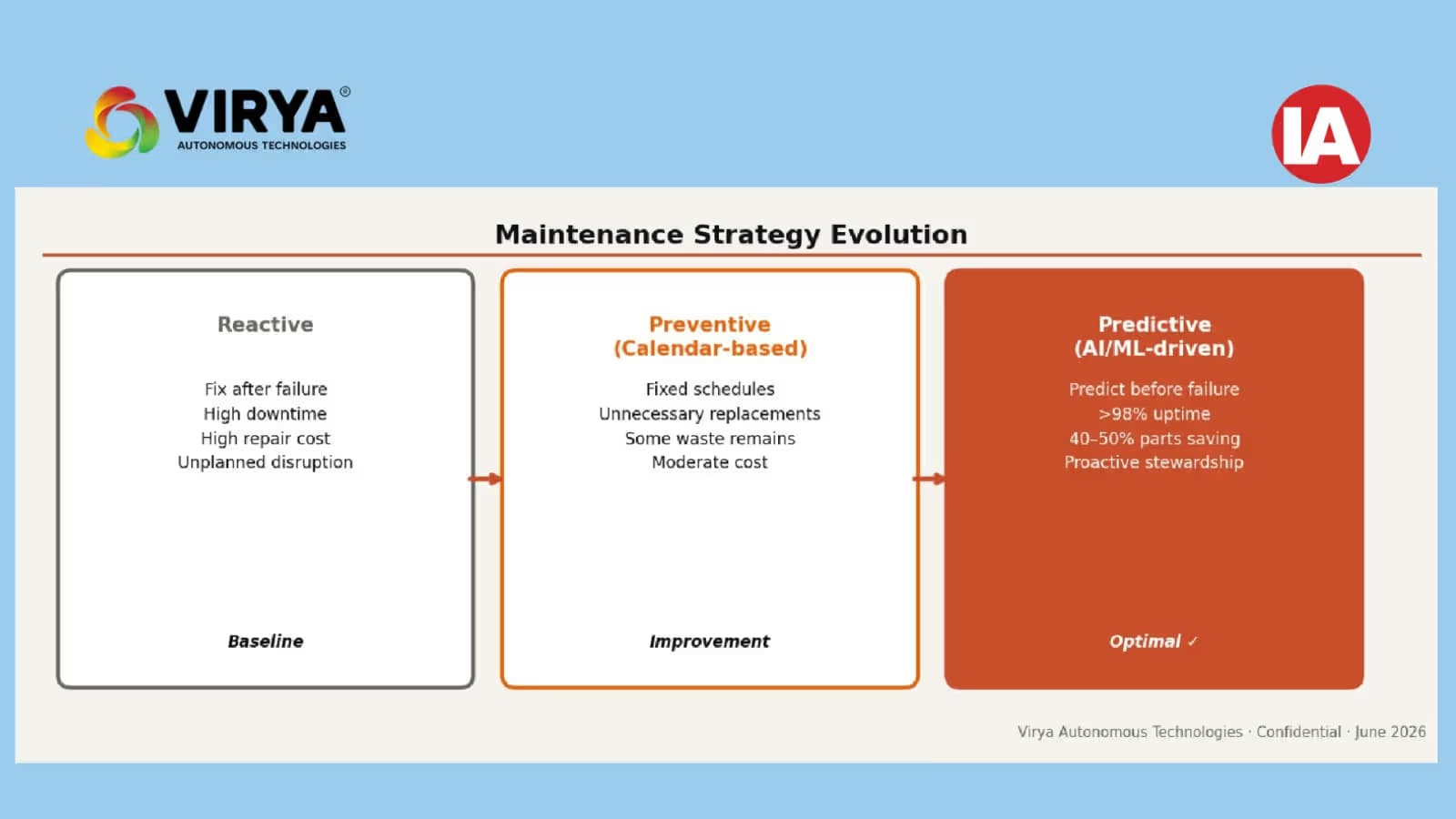
Maintenance Strategy Evolution: Reactive → Preventive → Predictive (AI/ML-Driven)
For facilities operating AMR fleets in 24/7 production environments, Predictive Maintenance provides the foundation for smart manufacturing
As manufacturing facilities continue their journey toward Industry 4.0 and smart factory transformation, Autonomous Mobile Robots (AMRs) have become a critical component of modern material handling and intralogistics operations. AMRs improve productivity, enhance safety, and provide flexible automation across manufacturing, warehousing, and logistics environments. However, ensuring maximum uptime and reliability of AMR fleets remains a significant challenge, particularly in facilities operating around the clock 3-shift.
Traditional maintenance approaches — reactive repairs and fixed calendar-based schedules — frequently result in unexpected failures, increased downtime, elevated maintenance costs, and inefficient use of resources. To overcome these limitations, organizations are increasingly adopting Predictive Maintenance powered by Artificial Intelligence (AI) and Machine Learning (ML).
Predictive Maintenance leverages real-time operational data, advanced analytics, and intelligent algorithms to anticipate equipment failures before they occur. By identifying early warning signs of degradation and abnormal behaviour, maintenance teams can take proactive action — preventing breakdowns, improving asset reliability, and optimizing maintenance scheduling. This approach transforms maintenance from a reactive function into a strategic reliability programme that supports operational excellence.
Context: The need for predictive maintenance in AMR operations

ML Models → Anomaly Detection → Alert & Action
In facilities operating multiple AMRs across 3 shifts, continuous 24/7 operation places significant demands on critical subsystems: batteries, drive motors, controllers, safety scanners, LiDAR sensors, communication modules, and charging systems. Even minor failures can disrupt production flow, increase downtime, and impact delivery commitments.
A Predictive Maintenance system continuously monitors the health of each subsystem and delivers actionable insights to maintenance teams. Rather than waiting for failure, AI and ML algorithms analyse historical and real-time data to predict potential issues — enabling maintenance to be performed at precisely the right time. The system continuously processes parameters including:
- Battery State of Charge (SOC) and State of Health (SOH)
- Drive motor current consumption and temperature
- CPU utilization and controller performance metrics
- Safety scanner and LiDAR diagnostics
- Localization accuracy and route completion performance
- Network connectivity and communication logs
- Emergency stop events and obstacle detection frequency
- Charging cycle data and fault / alarm history
As more operational data is accumulated, models continuously improve their prediction accuracy — enabling maintenance teams to anticipate failures with increasing confidence over time.
AI Applications: Key applications of AI-based predictive maintenance
Battery Health Monitoring. Battery performance directly affects AMR availability and productivity. AI algorithms analyserisksandpatterns, discharge rates, temperature trends, and aging characteristics to forecast remaining battery life, detect abnormal charging behaviour, identify overheating risks, and predict replacement requirements. Long Short-Term Memory (LSTM) neural networks track State-of-Health (SOH) degradation over time, enabling planned battery swaps before unexpected mid-shift failures occur.
Motor and Drive System Monitoring. Machine Learning models monitor motor current, vibration characteristics (via FFT Fast Fourier Transform analysis), operating temperature, and movement efficiency to identify early signs of wear — including bearing degradation, mechanical resistance, wheel wear, and alignment issues. Motor Current Signature Analysis (MCSA) detects bearing defects and winding faults via frequency domain analysis, preventing costly breakdowns before they interrupt production.
Sensor and Safety System Diagnostics. AI continuously monitors LiDAR sensors, safety scanners, and navigation systems to detect calibration drift, sensor contamination, communication failures, localization inaccuracies, and reduced detection capability. Identifying sensor degradation early maintains reliable navigation and ensures workplace safety compliance — two requirements that cannot be compromised in an automated facility.
Communication and Network Monitoring. ML algorithms analyse network quality and communication logs to identify weak signal areas, packet loss trends, network congestion, and controller disconnection patterns — ensuring uninterrupted fleet operations and system stability.
External factors continuously monitor such as road damage, potholes, uneven floors, layout changes, dynamic obstacles, and trolley oscillations that impact AMR performance. By analysing vibration, localization, fault, and travel data, the system can identify infrastructure-related issues, predict operational risks, and recommend corrective actions to improve fleet reliability, safety, and uptime.
Anomaly Detection and Root Cause Analysis. Rather than relying solely on fixed alarm thresholds, ML models learn normal operating behaviour and automatically flag deviations — such as excessive emergency stops, frequent localization loss, unusual route delays, increased charging duration, or repeated controller restarts. Automated root-cause analysis correlates multiple data sources to identify the most probable failure causes, significantly reducing fault investigation time.
Operations: Real-time fleet monitoring and FAE shift support
A centralized AI-powered dashboard provides complete visibility into fleet performance and asset health — displaying fleet availability, AMR utilization, active missions, battery health status, component health scores, fault alerts, predictive maintenance recommendations, charging station utilization, and upcoming maintenance schedules. This enables maintenance teams, operations personnel, and management to make informed, timely decisions based on live data.
Field Application Engineers (FAEs) deployed across all three shifts use a dedicated shift operations dashboard to manage day-to-day fleet health. Incoming alarms are automatically prioritized by severity — from P1 critical events such as E-Stop activations and thermal faults, down to P4 informational notices — ensuring FAEs focus first on what matters most. At shift end, an AI-assisted report generator automatically compiles shift performance data, open maintenance actions, anomaly summaries, and next-shift recommendations into a structured handover report.
With AI handling continuous monitoring and data synthesis, FAEs shift from reactive troubleshooting to proactive reliability management — improving both system performance and customer satisfaction.
Operational benefits
Beyond headline KPIs, AI-driven PdM delivers measurable day-to-day operational improvements across the entire fleet management workflow:
- Unplanned downtime eliminated — faults resolved during pre-scheduled windows, not mid-shift
- FAE productivity improved — alarm queues auto-prioritized by severity (P1–P4), eliminating manual fault-hunting
- Shift handovers automated — AI generates structured reports covering open actions, anomalies, and next-shift recommendations
- Production throughput protected — 24/7 monitoring ensures customer SLA compliance even during peak load
- Maintenance scheduling optimized — parts ordered and technicians assigned ahead of predicted failures
- Battery utilization extended — replacement timed to actual degradation, not conservative fixed cycles
- Root cause identification accelerated — multi-source correlation reduces MTTR by removing diagnostic guesswork.
KPI Impact — Before vs After AI/ML predictive maintenance
Deploying AI-based Predictive Maintenance on a 6 × AMR50 fleet operating 24/7 delivers measurable, compounding improvements across all key performance indicators:
The results are measurable and compounding:
- Improvement in MTBF (Mean Time Between Failures)
- Reduction in MTTR through planned, parts-ready maintenance windows
- Uptime exceeding 98% — versus industry averages of 94–96%
- 40-50% reduction in spare parts costs from planned rather than emergency procurement.
For autonomous mobile robot (AMR) fleets operating 24/7, these gains translate directly into production throughput and customer SLA compliance.
Conclusion
AI and Machine Learning-based Predictive Maintenance represents the next evolution in AMR fleet management. By continuously monitoring asset health, analysing operational data, and predicting failures before they occur, organizations can significantly improve reliability, productivity, and operational efficiency.
For facilities operating AMR fleets in 24/7 production environments, Predictive Maintenance provides the foundation for smart manufacturing — combining real-time monitoring, intelligent analytics, automated reporting, and predictive insights to reduce downtime, optimize costs, enhance safety, and maximize return on investment.
Each resolved fault enriches the training dataset, sharpening future predictions. Over time, the system becomes smarter and the organization less dependent on individual engineering intuition. Embracing AI-driven Predictive Maintenance transforms maintenance from a reactive necessity into a strategic advantage — supporting sustainable growth, operational excellence, and the continuous improvement culture that defines the factories of the future.
Manjunath Srinivasan is the Lead Field Application Engineer at Virya Autonomous Technologies, with over 15 years of experience in industrial automation, autonomous mobile robots (AMRs), after-sales service, and field engineering operations. An Electrical and Electronics Engineer by training, he specializes in customer-focused solutions, service excellence, system deployment, and operational performance improvement across industrial automation environments. Beyond his technical and business expertise, Manjunath is a strong advocate for team building, leadership development, and continuous learning.
Author