Sensing The Future: Sensors, Vision Systems & Data Fusion
Explore how smart factories use sensor fusion, AI vision systems, and edge intelligence to drive accurate perception and navigation in autonomous robotics.
Sensors and vision systems continuously collect information about machines
In Smart Factories, sensors & vision systems collect data about the manufacturing process, while data fusion combines this information for more accurate and reliable insights.
In smart factories, the ability to sense the environment is becoming as important as the ability to automate it. Sensors and vision systems continuously collect information about machines, materials, people, vehicles and processes. But simply collecting more data does not make a factory intelligent. The real challenge is making sense of that data, bringing different sources together and using it to make reliable decisions in real time.
This is where sensor fusion and vision systems are becoming fundamental building blocks of modern industrial automation.
Beyond conventional sensing
Traditional industrial automation has largely been built around predefined workflows, fixed sensors and structured environments. These systems work well when conditions are predictable, but changing layouts, moving objects and unexpected obstacles make conventional approaches harder to manage. Smart factories therefore need systems that can understand what is happening around them and respond as conditions change.
Materials can move between areas, people and autonomous vehicles may share the same workspace, and operating conditions can affect how a system perceives its surroundings.
This makes sensing an important part of autonomous systems. Cameras provide visual information to identify objects, while Light Detection and Ranging (LiDAR) sensors provide spatial information about surrounding objects and obstacles.
Depth cameras add distance information, while Inertial Measurement Units (IMUs) and wheel encoders provide information about vehicle motion and orientation.
Each sensor sees the environment from a different perspective.
However, no single sensor provides a complete picture. Cameras can be affected by lighting, shadows and occlusions, while LiDAR provides strong geometric information but limited information about an object's identity or appearance.
Odometry provides useful motion estimates but can become less reliable under conditions such as wheel slip.
The focus is therefore shifting from simply adding more sensors to making better use of their complementary information. This allows autonomous systems to build a more reliable understanding of their surroundings and make better-informed decisions.

Why vision is becoming central to industrial autonomy
Vision systems have traditionally been used to turn raw image data into useful information for robotic systems. With advances in AI-based vision, their role is expanding from tasks such as product inspection to helping machines understand what is happening around them.
Modern vision systems can detect and track objects, identify features, and estimate their position and orientation. For autonomous material handling, a robot needs to know more than whether an obstacle is present. It may need to identify the object, determine whether it is moving, locate a pallet or trolley, and understand its orientation relative to the vehicle. The camera therefore becomes more than an imaging device; it becomes a perception sensor.
At Virya Autonomous Technologies, cameras work alongside LiDAR and inertial sensing to provide complementary information for navigation, object detection and material handling. The goal is to combine different sources rather than depend on a single sensor.
However, deploying vision in industrial environments introduces its own challenges. Differences in scene appearance, changing viewpoints, object variability and limited visibility can affect perception. Building reliable vision therefore requires more than a capable AI model. It also depends on representative data, proper camera calibration and validation under actual operating conditions.
The case for sensor fusion
Although individual sensors provide valuable information, relying on a single source can limit perception reliability. Data fusion addresses this by combining complementary information from multiple sensors to create a more comprehensive representation of the environment.
Sensor fusion: Combining complementary information
Camera-LiDAR fusion is particularly relevant to autonomous robotics. Cameras provide rich visual information for identifying and classifying objects, while LiDAR supplies spatial measurements for distance estimation and three-dimensional localisation. Combining these perspectives allows robotic systems to associate detected objects with their corresponding spatial information.
But fusion is not simply about putting sensor outputs together. For fusion to work reliably, measurements need to be aligned in both space and time:
Extrinsic calibration determines the relative position and orientation of sensors, so measurements from different viewpoints can be aligned in a common coordinate system.
Temporal synchronisation ensures that measurements from a moving robot represent the same moment in the scene.
In industrial environments, sensor placement, calibration accuracy, changing conditions and occlusions can affect the quality of fused information. Reliable autonomy therefore depends not only on the sensors and algorithms, but also on how well the sensing system is calibrated, integrated and validated.
From perception to autonomous operations
The purpose of perception in an autonomous system is not just to detect objects. Perception needs to provide information that supports decisions. An AMR needs to know where it is, what is around it and how those objects relate to its movement. Perception quality therefore directly affects how reliably the vehicle can navigate and interact with its surroundings.
Different perception inputs become useful together here. Vision can identify the trolley and estimate its key features and pose, while LiDAR provides additional spatial information about the surrounding area. The vehicle can use these inputs to determine how to approach the trolley and achieve the required alignment for docking.
The vehicle does not have to treat every frame as a completely newo bservation. A trolley may be briefly occluded, lighting may change as the vehicle moves, or a single frame may contain an imperfect detection. Previous frames can provide context and help maintain a stable estimate instead of reacting to every variation.
This becomes particularly important as operating conditions change. At Virya, perception is evaluated not only by detection accuracy, but also by how consistently position and pose can be estimated across different operating conditions and levels of occlusion. The goal is to turn perception outputs into information the vehicle can use for navigation, docking and material handling.
Edge intelligence: Making decisions where data is created
As the number of sensors on an autonomous vehicle increases, so does the amount of data that needs to be processed. Cameras generate continuous image streams, LiDAR produces spatial data, and other sensors provide information about vehicle motion and status. Sending all this data to a central server is not always practical when the vehicle needs to respond quickly.
This is where edge computing becomes important. Processing sensor data on the vehicle, or close to the machine, allows perception and decision-making without depending on a remote system for every operation. It also reduces data transfer and helps the vehicle respond quickly to changes around it.
For autonomous systems, the benefit is not only lower latency. Local processing also reduces dependence on network connectivity, allowing an AMR to continue detecting obstacles, maintaining perception and making essential navigation decisions even if communication with a central system is temporarily unavailable.
As autonomous machines become more capable, processing data closer to where it is generated will become increasingly important for building responsive and dependable industrial systems.
Conclusion: Building reliable autonomy
The next stage of smart manufacturing will not be defined simply by how many sensors a factory deploys, but by how well they work together.
A reliable perception architecture needs calibrated sensors, accurate time synchronisation, robust algorithms, confidence handling and ways to identify when a sensor is degraded or uncertain. It also needs to connect perception with the wider automation system.
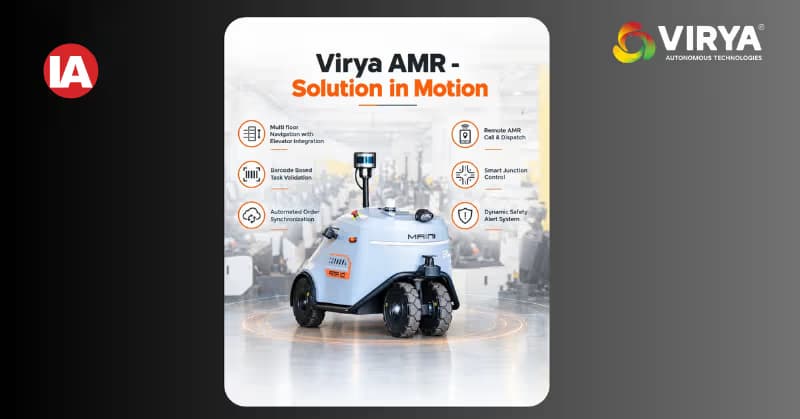
For Virya, this philosophy extends across autonomous material-handling platforms operating in real industrial environments. Its AMRs are designed for indoor and outdoor operation, while platforms such as the APT20 combine multiple sensing technologies for navigation, obstacle detection and safe material handling.
Autonomy is not created by a camera, LiDAR, AI model or navigation algorithm on its own. It comes from making these technologies work together as one perception and decision-making system.
The smart factory of the future will do more than collect data. It will understand what is happening around it, recognise uncertainty, combine information from different sources and turn that understanding into action.
Sensing is the beginning. Fusion is what creates understanding. And reliable understanding is what makes autonomy possible.
About the Author: Sanjana Bhat is a Robotics Perception Engineer at Virya Autonomous Technologies, where she focuses on developing perception solutions for autonomous robotic systems. She holds a B.Tech in Computer Science and Engineering, with a specialisation in Artificial Intelligence and Machine Learning. Passionate about emerging technologies in AI, robotics, machine learning and autonomous systems, she has also authored articles sharing her insights into AI and robotics.
Virya Autonomous Technologies
Adaptive Autonomy. Delivering Outcomes.
Phone:+91-8197816601 Email: saba.g@virya.ai
Author