When Material Movement Stops Following Takt and Starts Following Orders
Discover how WES, autonomous robots and physical AI enable smarter, order-driven warehouse material movement.
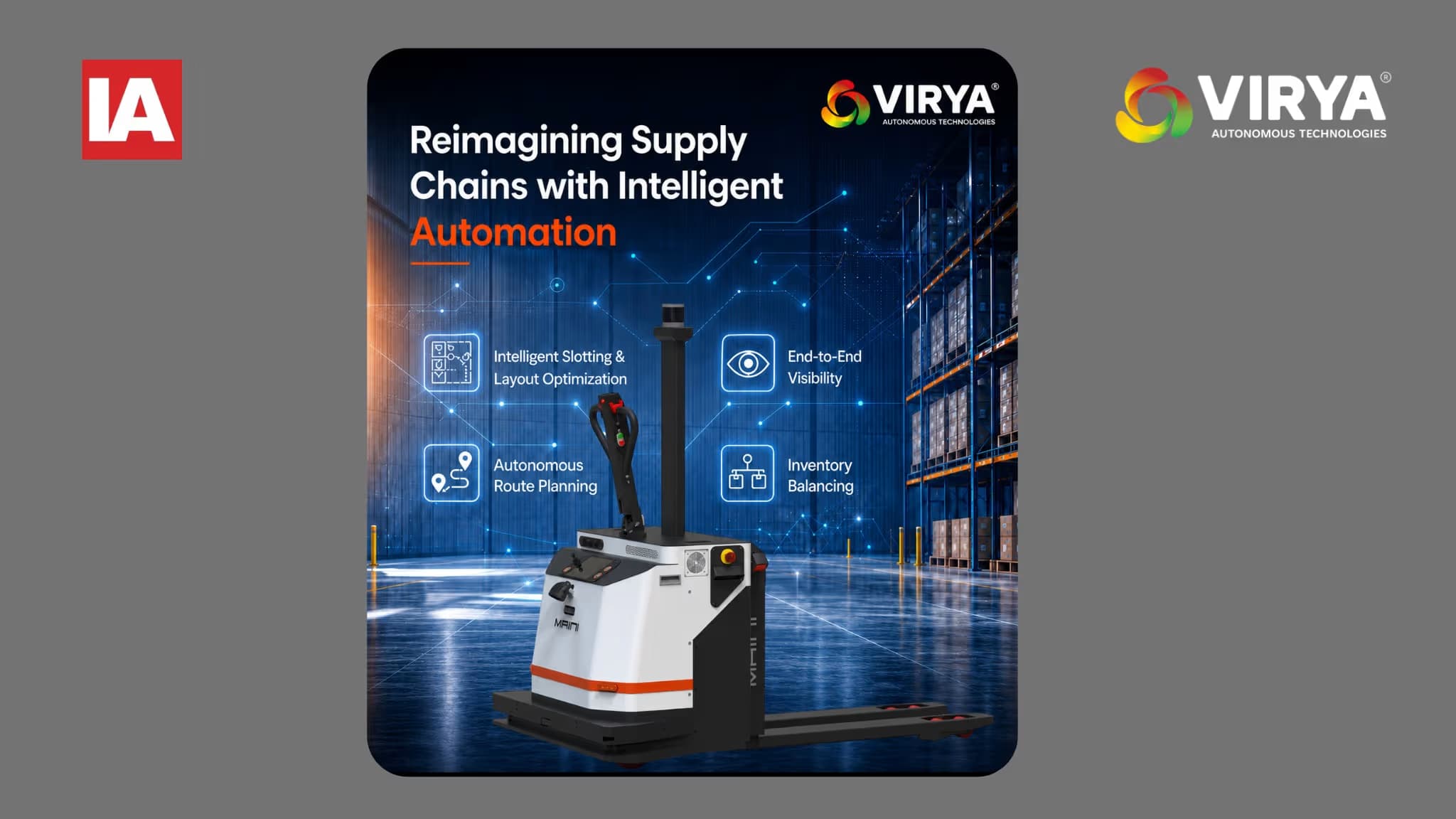
Reimagining supply chains
What changes when the same robots move from the production floor into the warehouse
Most writing about AI in supply chains describes software. Demand forecasting, inventory optimization, slotting algorithms and order sequencing all improve when a model sees more data than a planner can. That work is real and it has already been delivered.
It also stops at the point where something has to physically move. A forecast that says a pallet should be at dock 4 by 11:00 is a prediction until a machine takes it there. In most facilities the layer that does the moving is the least connected part of the operation, which means the intelligence upstream arrives at a manual handover and waits.
Closing that gap is less about better algorithms than about what the moving equipment is told, and how quickly it acts on it.
A production floor and a warehouse are not the same problem
Autonomous mobile robots grew on the production floor, and the two environments look similar enough that the difference gets missed.
Production material flow is governed by takt. A cure line, an assembly station or a press bay consumes material at a known rate, in a known sequence, along a route that rarely changes. A fleet serving that floor is solving a repetition problem. Once the route is mapped and the cadence is understood, the same trips happen shift after shift, and the hardest questions are physical: aisle width, trolley geometry, pedestrian traffic at changeover.
The warehouse movement is governed by orders. What moves next depends on what was sold, what arrived, what is short, and what a customer changed an hour ago. The route is not fixed because the destination is not fixed. Two shifts running identical equipment produce entirely different movement patterns.
Production gives fleet a cadence. A warehouse gives it a queue, and a queue has to be managed. That difference is what makes warehouse automation a software problem in a way production automation is not.
The integration question is which system is doing the telling
Three system classes get discussed as though they were interchangeable, and for this purpose they are not.
MES runs production. It knows the work order, the operation and the station, and it is the right source when material movement follows a build sequence.
A WMS runs the warehouse as a record. It knows what stock exists, where it is, and which order needs it. It is authoritative about inventory, and it is not, by design, a real-time dispatcher.
A WES is the layer between that record and the equipment on the floor. Its job is release and sequencing: deciding which task goes out now, to which resource, in what order, given what is happening at this minute.
For an autonomous fleet, that third layer is the one that matters. A fleet manager taking work from a WES receives tasks shaped by order priority and inventory position rather than by a person pressing a call button. The fleet stops being equipment that gets used and becomes a resource that gets scheduled.
Virya has built this integration into its fleet management system, and it is a capability rather than a running deployment: the software exists, and no customer site is operating it yet. That distinction is worth stating plainly, because a warehouse evaluating automation should know which parts of a proposal are proven on a floor and which are ready to be proven on theirs.
Why the deciding happens on the vehicle
Order-driven work changes the timing requirement as well as the source.
A robot serving a fixed production route can afford to ask a server what to do next, because the answer is nearly always the same. A robot working on an order-driven floor is negotiating congestion, changing priorities and people, and it needs to resolve most of that where it happens.
This is what physical AI describes: perception, planning and control running on compute carried by the vehicle, so that seeing, deciding and acting close in a fraction of a second without a round trip to a server room. Virya's platforms process fused 3D LiDAR, 2D LiDAR, inertial and camera data onboard, which is what keeps a fleet working when the network is degraded and predictable when the floor is busy.
The division of labour is a useful part. The vehicle decides how to move. The fleet manager decides which vehicle moves and in what order. The WES decides what needs to move at all. Each layer works on the timescale it can actually meet.
Getting there from a floor that already runs
Adoption looks different depending on what exists.
In a brownfield facility, production does not stop so the automation project can get comfortable. The workable path is one zone at a time: automate a route that is well understood, connect it at the shallowest useful depth, and let the software integration deepen once the physical operation is stable. Nothing about that sequence is slow. On one four-plant manufacturing site, the first robots were handed over five weeks after the first vehicle arrived and the initial phase was live within sixteen weeks, with production running throughout.
A greenfield facility has fewer excuses. Pickup and drop points, aisle geometry, charging positions and the integration architecture can be designed together rather than retrofitted around each other.
Either way, the sequence that works is physical first, software second. A fleet that cannot reliably move a pallet across a busy aisle will not be rescued by a better task allocator, and a facility that integrates deeply before it trusts the hardware inherits both risks at once.
What to settle before automating a warehouse
The questions are practical rather than technical.
Which system will decide what moves, and does it operate in real time or in batches. What happens to the fleet when that system is unavailable. Whether the automation is being asked to follow a sequence or to respond to one. And whether the first deployment is a route, the operation already understands, which is the difference between proving a system and discovering it.
AI in the supply chain will keep improving what a facility knows. It pays when the floor acts on that at the speed the software decides, and that is a question about the machines, the network, and the integration underneath them.
About the Author: Vatsal Kumar Singh is the GTM Engineer at Virya Autonomous Technologies, where he develops full- stack AI automation for marketing and business strategy, as well as enablement for the sales team. With a background in computer science and AI/ML, he is well versed in the modern automation tech stack. Standing at the crossroads of product, sales and marketing, he has a keen eye for using the right words to get the point across.
Virya Autonomous Technologies
Adaptive Autonomy. Delivering Outcomes.
Phone:+91-8197816601 Email: saba.g@virya.ai