Sensing the Future: Sensors and Data Fusion
Endress+Hauser connects smart sensors with data fusion and Heartbeat Technology to enable predictive maintenance and actionable plant intelligence.
Trusted field measurements
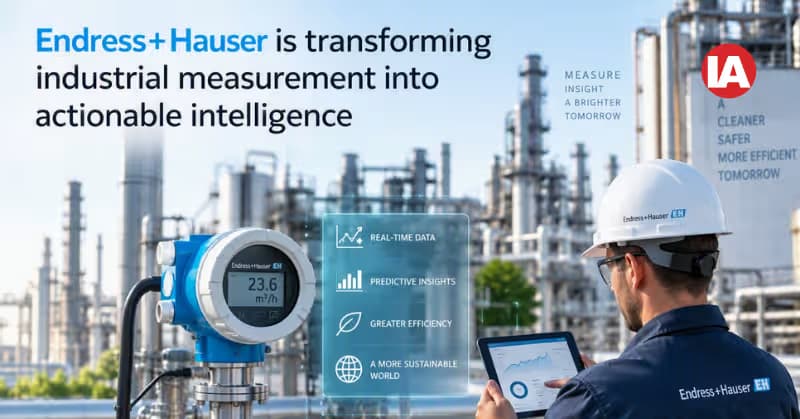
How Endress+Hauser is transforming industrial measurement into actionable intelligence.
Industrial operations are generating more data than ever before. Every flowmeter, level instrument, pressure transmitter, temperature sensor and analytical measuring point can contribute valuable information about the process, the measuring device and the surrounding plant assets.
The next transformation in process automation will therefore not be driven by measurement alone. It will be driven by the ability to combine trusted measurements with device diagnostics, process indicators and historical information.
This is the promise of sensors and data fusion.
Endress+Hauser instruments provide measured values as well as signals that help operators draw conclusions about sensor health and process conditions. Heartbeat Technology uses instrument data for sensor self-monitoring, device verification and the monitoring of process changes, while the NetilionIIoT ecosystem supports the capture, transmission, management and analysis of data.
From individual measurements to a complete process picture
A single sensor provides an important piece of information. Data fusion connects these individual pieces to create a more complete and reliable understanding of the process.
Consider an industrial vessel:
A Micropilot radar monitors material level.
A Cerabar pressure transmitter measures process or hydrostatic pressure.
A Proline flowmeter measures the material entering or leaving the vessel.
An iTHERM temperature sensor monitors thermal conditions.
Memosens sensors with a Liquiline transmitter measure pH, conductivity, dissolved oxygen or other quality parameters.
Individually, each instrument answers a specific process question. When their data is combined, operators can determine whether changes arise from production demand, product characteristics, equipment condition or an emerging process anomaly.
Data fusion therefore creates context. It helps transform isolated measurements into process knowledge.

The Endress+Hauser sensor portfolio
1. Proline Flow Measurement
The Proline portfolio includes electromagnetic, Coriolis, ultrasonic, vortex and thermal flow measurement technologies for liquids, gases and steam.
Proline Promag electromagnetic flowmeters equipped with Heartbeat Technology can provide insights into buildup in the measuring tube through a buildup index. The HBSI, or Heartbeat Technology Sensor Integrity parameter, can also identify potential changes in the device’s magnetic system. These insights support improved maintenance planning, optimised cleaning cycles and lower unplanned downtime.
Relevant products and applications
Promag W: Water abstraction, water distribution and wastewater applications
Promag H: Hygienic flow measurement in food, beverage and life-science processes
Promass: Coriolis measurement of mass flow, density, concentration and temperature
Prowirl: Steam, gas and liquid flow measurement, and
Prosonic Flow: Clamp-on and inline ultrasonic flow measurement.
In a groundwater application, a Promag W 400 with the Heartbeat Technology buildup index was used to monitor iron-hydroxide buildup continuously without interrupting the process.
The information helped the operator establish a more accurate maintenance plan and optimise cleaning.
2. Micropilot Radar Level Measurement
Micropilot free-space radar instruments provide non-contact level measurement in tanks, silos, reactors and vessels. The portfolio addresses demanding chemical, oil and gas, food, beverage, water and life-science applications.
Selected Micropilot instruments provide intelligent information beyond the level value. Heartbeat Technology functions can support device verification and the detection of process conditions such as foam or buildup.
In an industrial wastewater treatment application, a Micropilot radar measured the liquid level and used Heartbeat Technology to detect foam formation. A Cerabar pressure transmitter provided hydrostatic level measurement, allowing the application to determine foam height and initiate targeted dosing of antifoam agent.
This is a practical example of sensor fusion. Radar and hydrostatic-pressure measurements provide complementary information that a single measuring principle cannot deliver independently.
3. Levelflex SensorFusion
Levelflex FMP55 combines capacitance and guided-radar measuring principles in one instrument. It provides level and interface-layer signals simultaneously and is designed for interface applications in the oil and gas, chemical and petrochemical industries.
This built-in SensorFusion approach supports reliable measurement even in the presence of emulsion layers and changing process conditions. The product also incorporates Heartbeat Technology for lifecycle-oriented plant operation.
4. Cerabar and Deltabar Pressure Measurement
Cerabar transmitters measure gauge and absolute pressure, while Deltabar transmitters measure differential pressure. Their applications include process pressure, hydrostatic level, flow measurement, filter monitoring and the measurement of pressure differences across plant equipment.
Cerabar and Deltabar instruments equipped with Heartbeat Technology can detect information such as deviations in loop resistance, blocked impulse lines and pressure peaks. IIoT applications can use this additional information to derive load profiles for surrounding equipment and enable predictive-maintenance strategies.
Relevant products and applications
Cerabar PMP71B: Process-pressure measurement in demanding industrial applications
Cerabar PMC71B: Pressure and hydrostatic-level measurement
Deltabar PMD75B: Differential pressure, filter condition and flow applications, and
Deltabar FMD71/FMD72: Electronic differential-pressure measurement.
5. Memosens and Liquiline Liquid Analysis
Memosens digital sensor technology converts the measured value into a digital signal inside the sensor and transfers it inductively to the transmitter. Memosens 2.0 stores calibration, sensor and process data, providing a basis for trend identification, process management and predictive-maintenance services.
The Liquiline platform supports parameters including:
pH and ORP
Conductivity
Dissolved oxygen
Chlorine
Turbidity
Sludge level
Nitrate, and
SAC and other analytical parameters.
The Liquiline CM442 can connect up to two Memosens sensors and supports multiple industrial communication interfaces. Heartbeat Technology supports status-oriented maintenance and verification of the analytical measuring point.
For larger installations, Liquiline CM448 can connect up to eight Memosens sensors and can also control cleaning systems or dosing pumps.

6. iTHERM Temperature Measurement
The Endress+Hauser iTHERM portfolio provides temperature measurement for process, hygienic and safety-critical applications.
Temperature data can be combined with flow, pressure and analytical measurements to monitor:
Heat exchangers
Sterilisation and cleaning cycles
Steam systems
Reactor efficiency
Cooling circuits, and
Product-quality conditions.
In heat-exchanger applications, for example, integrating inlet and outlet temperatures with flow data gives a more meaningful view of heat-transfer performance than temperature measurement alone.
Heartbeat technology: The foundation for predictive maintenance
Predictive maintenance depends on recognising changes before they develop into equipment or process failures. For this reason, reliable instrument and process diagnostics are essential.
Heartbeat Technology brings together three complementary functions across Endress+Hauser’s smart instrumentation portfolio. It is available for flow, level, pressure, analytical and temperature measuring instruments.
Heartbeat Diagnostics
Heartbeat Diagnostics continuously monitors the measuring device and process conditions.
It provides clear, standardised diagnostic messages and recommended actions, helping plant personnel identify whether an issue relates to the instrument, installation or process.
Examples include:
Detection of buildup in a flowmeter
Identification of foam or buildup in a level application
Detection of blocked impulse lines
Sensor-health information in an analytical measuring point, and
Identification of corrosion, abrasion, thermal stress or mechanical stress.
Internal Endress+Hauser application material identifies process and asset conditions such as abrasion, buildup, mechanical stress, thermal stress, foam, sensor ageing and corrosion as potential monitoring use cases.
Heartbeat Verification
Heartbeat Verification provides documented evidence that a measuring instrument is functioning correctly.
Verification can be carried out in situ without removing the instrument and without interrupting the process. The system generates a report with a clear result, supporting documentation and compliance requirements.
This allows companies to reduce manual verification effort and make better-informed decisions about calibration and proof-test intervals.
Heartbeat Monitoring
Heartbeat Monitoring transforms additional instrument variables into information for process optimisation and predictive maintenance.
Rather than waiting for a fixed service interval or an unexpected failure, maintenance teams can monitor condition indicators and act when a developing trend requires attention.
Examples include:
Monitoring buildup in Promag flowmeters
Detecting abrasion or corrosion in demanding flow applications
Detecting foam or buildup with Micropilot radar.
Monitoring loop resistance, pressure peaks or blocked impulse lines with Cerabar and Deltabar
Using sensor-health data to improve analytical-sensor maintenance intervals, and
Monitoring installation and process conditions that could affect measurement reliability.
Heartbeat Monitoring is specifically positioned to provide information for process optimisation and predictive maintenance.
From reactive to predictive maintenance
The predictive-maintenance journey can be understood in four stages:
1. Measure: Flow, level, pressure, temperature and analytical instruments collect reliable process information.
2. Diagnose: Heartbeat Diagnostics continuously evaluates instrument and process health and communicates abnormalities.
3. Combine and contextualise: Data from multiple sensors is combined with historical trends, asset information and operating conditions.
4. Predict and act: Maintenance teams identify developing problems, prioritise interventions and plan service activities before performance deteriorates or an unexpected shutdown occurs.
Connecting field intelligence with Netilion
Sensor intelligence creates its greatest value when information can be made available beyond the individual measuring point.
The Endress+Hauser portfolio includes gateways and connectivity components for Bluetooth, WirelessHART, Ethernet, HART-IP, EtherNet/IP, PROFINET and other industrial communication methods. Internal portfolio material positions Netilion for cloud or on-premises asset lifecycle management and process monitoring.
By connecting Heartbeat-enabled devices to plant systems or the cloud, organisations can:
Access diagnostics remotely
Centralise device-health information
Manage asset documentation
Analyse measurement and condition trends
Perform verification activities more efficiently
Support plant-wide maintenance planning, and
Relate process information to other operational data.
Endress+Hauser describes this connected approach as turning data into knowledge through smart devices, field tooling, asset-management systems and cloud connectivity.
Practical applications of sensor and data fusion
Water and Wastewater
Combine Promag flow measurement, Micropilot or Waterpilot level measurement, Cerabar pressure and Memosens analysis for:
Pump-performance monitoring
Groundwater buildup detection
Aeration optimisation
Chemical-dosing control
Water-quality monitoring, and
Early detection of process abnormalities.
Food and Beverage
Combine Promass flow and density, Micropilot hygienic radar, iTHERM temperature and Memosens analytical measurements for:
Product-quality monitoring
Cleaning-in-place optimisation
Mixing and blending control
Filling-process consistency, and
Energy and utility monitoring.
Chemical and Petrochemical
Combine radar level, differential pressure, Coriolis flow, temperature and liquid-analysis data for:
Reactor monitoring
Interface measurement
Foam detection
Heat-exchanger performance
Chemical consumption optimisation, and
Safety and asset-health monitoring.
Mining, Minerals and Metals
Combine flow, radar level, pressure and analytical measurements for:
Slurry monitoring
Thickener optimisation
Pipeline condition monitoring
Buildup and abrasion detection, and
Water-management optimisation.
Power and Energy
Combine steam flow, pressure, temperature, conductivity and water-quality information for:
Boiler efficiency
Steam-system performance
Condensate monitoring
Cooling-water management, and
Heat-rate and energy optimisation.

The future: Self-aware and connected measuring points
The future industrial sensor will not simply report a process value.
It will understand its own condition, identify changes in the surrounding process, verify its functionality and make its information available to control systems, maintenance platforms and cloud-based applications.
Combined with artificial intelligence and machine learning, trusted sensor data can support:
Earlier anomaly detection
More precise maintenance forecasting
Automated process recommendations
Plant-wide energy optimisation
Improved production quality, and
More autonomous industrial operations.
However, every advanced analytics model depends on the quality of its source data. Reliable measurement remains the foundation.
This is where Endress+Hauser brings together comprehensive measurement technologies, intelligent diagnostics, Heartbeat Technology, industrial connectivity and digital services.
Conclusion
Sensors are becoming more intelligent, more connected and more valuable to the entire organisation.
Through data fusion, individual measurements become a comprehensive view of process and asset performance. Through Heartbeat Technology, instruments continuously provide diagnostics, verification and monitoring information that supports predictive maintenance. Through digital connectivity and Netilion, these insights can be made available wherever operational decisions are taken.
The future of process automation is therefore not only about sensing what is happening today.
It is about using trusted data to sense what may happen next.
Main improvements made
Added application-relevant Endress+Hauser product families and model examples.
Positioned Heartbeat Technology clearly within the predictive-maintenance workflow.
Included real application examples for buildup, foam, interface and pressure monitoring.
Added nine image-placement directions with ready-to-use captions.
Preserved the thought-leadership style while strengthening the technical and product content.
References
1. https://www.endress.com/en/endress-hauser-group/Case-studies-application-notes/Build-up-Promag-W
2. https://www.endress.com/en/endress-hauser-group/Case-studies-application-notes/micropilot-heartbeat-technology
3. https://www.apsc.endress.com/en/field-instruments-overview/level-measurement/Guided-Radar-Levelflex-FMP55
4. https://www.endress.com/en/field-instruments-overview/pressure/Pressure-measurement-process-automation