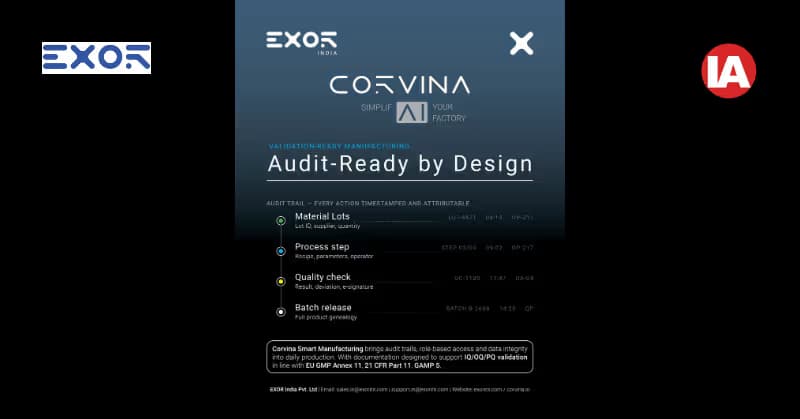
Audit-Ready by Design
Explore why data integrity in pharma manufacturing is now an architectural choice. Learn how CORVINA automates GMP compliance and audit readiness.
Corvina MES Pharmaceutical (Audit-Ready)
Why data integrity in pharmaceutical manufacturing is becoming an architecture decision, not a documentation exercise.
For years, pharmaceutical quality assurance lived largely in the document room. Batch records were compiled after the fact, reviewed on paper, and filed against the day an inspector asked for them. That model is closing. With the revised Schedule M now in force, and with export markets applying EU GMP and USFDA expectations to every consignment, the questions being asked of Indian manufacturers have changed. Not do you have the record, but can you show who did what, when, on which machine, and prove the record has not changed since. The compliance burden has moved to the shop floor now.
That is not a documentation problem. It is a question about how production data is captured, structured and governed, which makes it a question about the systems sitting on the line.
From paper records to attributable data
Data integrity principles are straightforward to state and difficult to retrofit. Every entry needs to be attributable to a person, legible, recorded at the time it happened, original, and accurate. A spreadsheet compiled at end of shift satisfies none of those conditions convincingly.
CORVINA approaches this by treating the record as a by-product of execution rather than a separate task. Production data is collected directly from machines, sensors and legacy equipment; each action carries the operator, the timestamp and the process context in which it occurred. Access is governed by role, through single sign-on and role-based permissions, so authority to act and the evidence of having acted are the same event. Material lots, process parameters, quality results and release decisions remain linked as product genealogy, which means a query about a finished pack can be traced back to the raw material lot behind it, and forward from a suspect lot to everything it touched.
Built for validation, not retrofitted for it
Regulated manufacturers know the real cost of a computerised system is rarely the licence. It is the validation effort, and the effort of revalidating after every change.
The CORVINA Lean Digital Platform is designed to support validation activities in GMP-regulated environments. Its architecture and documentation are structured to help customers perform IQ/OQ/PQ validation in line with EU GMP Annex 11, FDA 21 CFR Part 11 and GAMP 5 guidelines, and the platform supports validated operations through audit trails, role-based access control, data integrity principles and controlled change management. A standard validation documentation package is provided rather than assembled from scratch on each project.
The distinction matters. A system that produces good data but arrives without a validation trail transfers the entire regulatory workload to the customer's quality team. One built with that workload in mind shortens the path from installation to qualified use.
Connect what you already have
Very few pharmaceutical plants get to start from a clean sheet. Granulation, coating, filling and packaging equipment arrives across decades from different suppliers, running different protocols, with different levels of openness.
CORVINA's edge data layer, XLayer, addresses heterogeneity directly: over 200 industrial protocols, including OPC UA, Modbus and MQTT, are supported through its Edge Data Collector Agent, with historical data held in integrated time-series and SQL storage. Machine status, alarms and process values from new and existing assets are unified into one consistent model, with IT/OT network segmentation and OAuth2 access control. The practical effect is that traceability can be extended across a mixed installed base without replacing equipment that is otherwise performing well.
Structured once, deployed across sites
For manufacturers running several plants, or the same dosage form in several locations, consistency is its own compliance asset. CORVINA Factory Modeler describes plant topology, machine structures, protocols and data mappings against the ISA-95 standard, using reusable machine types that can be deployed across identical assets and sites.
The result is that the second plant does not repeat the first plant's integration work, and the data structures reaching ERP, MES and quality systems are the same wherever the batch was made. The Smart Manufacturing portfolio supports the main ISA-95 MES functions in both standard and regulated environments: production data collection and traceability, scheduling and dispatching, quality and maintenance workflows, machine status monitoring, KPI analysis, and bidirectional ERP/MES integration for orders, materials and production confirmations.
What this means for Indian pharmaceutical manufacturing
India supplies a substantial share of the world's medicines, and increasingly does so into jurisdictions where the audit is unannounced and the evidence is expected to be electronic. Meeting that standard is not a matter of tightening procedures around existing systems. It is a matter of whether the data layer underneath production was designed to be inspected.
CORVINA – part of the X Platform ecosystem, and ISO 27001:2022 certified, builds that assumption in from the start.
EXOR India Pvt Ltd. sales.in@exorint.com | support.in@exorint.com exorint.com | corvina.io
Article source: Exor India