From Low-Code to No-Code: Who Gets to Change a Route?
Discover how low-code configuration tools and operational discipline enable factory teams to own autonomous mobile robot routes and democratise Industry 4.0.
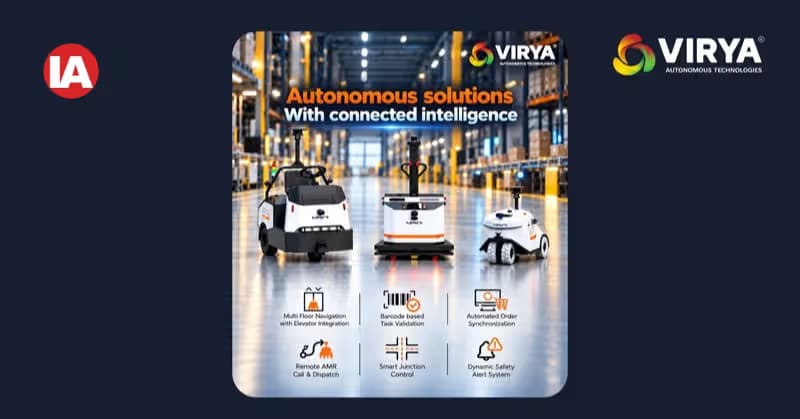
Virya's robots navigate from a 3D map built at installation, with no lines, tapes or magnetic strips laid on the floor
Democratizing Industry 4.0 on a plant floor is a question about people, not software.
India's digital payments shift is an instructive parallel. UPI did not succeed because its interface was simple. It succeeded because banks, merchants and payment providers agreed on a common set of standards, and the simplicity followed. Factory automation has reached the same point, and the progress is already visible on a working floor: at one Indian machinery plant, twelve operators were trained to run an autonomous fleet in a single three-hour session, none of them a robotics specialist.
Democratisation on a plant floor looks like that, and not like a simpler interface. What grows is the list of people allowed to change something.
Who the barrier actually stops
The barrier is documented, and not by vendors. The Telecommunication Engineering Centre, under the Department of Telecommunications, published TEC 31238:2025 in June 2025. Its list of challenges facing Indian manufacturing MSMEs puts two squarely on people: a lack of knowledge of how to implement engineering solutions, and the unavailability of skilled workers and partners to implement and maintain such digital systems.
The global robotics body agrees from the other direction. The International Federation of Robotics, in World Robotics 2025, puts global robot density at 177 robots per 10,000 manufacturing employees and Asia's at 204, then names a shortage of the engineering capability needed in peripherals as what prevents SMEs from adopting robots, calling a developed ecosystem of system integrators the bottleneck.
Two bodies, independently, naming capability rather than hardware. TEC argues that standardisation is what gets a smaller manufacturer past those barriers. That framing matters. Most writing about low-code in manufacturing comes from low-code software companies, and concerns dashboards, application builders and ERP connectors. The harder question is what happens on the floor after the integrator leaves.
What deployment costs today
Putting an autonomous mobile robot to work has usually meant weeks of integration, specialist programming and a standing dependency on the supplier for every later change. A route moves, a station is added, a layout shifts. The plant raises a ticket.
For a large manufacturer that is an annoyance. For a mid-sized one it is the reason the project never starts. Capital cost is visible and quotable; the dependency is neither, and it is the thing that decides whether automation spreads past the first plant.
Low-code: configuration in place of programming
The tools are visual and configuration-based, so a route is set rather than written. Plant engineers can map routes, set pick-up and drop-off points and define mission rules without writing any software. Changing a route can then be an operational task instead of an engineering request, while supplier engineers stay available for the work that genuinely needs custom logic.
Settings are made zone by zone, because a route is rarely uniform. On one outdoor route between buildings the path is divided into 69 zones, each carrying its own speed and obstacle clearance, and the customer signed off every one of them on their own checksheet. A single speed setting may be too slow on the open stretches or too fast at the turns. Setting them zone by zone is configuration work, and it is work a plant engineer can own.
Training is then measured in hours. Twelve operators were trained on that site, and at a pharmaceutical warehouse thirteen were trained to operate and troubleshoot. After an afternoon the fleet is theirs to run.
Integration depth is chosen too, and typically it is chosen shallow. On a four-plant tyre site the fleet management system takes a one-way feed from the site's manufacturing execution system (MES), and nothing inside the MES itself had to change. That is what let the fleet go in without an IT project running alongside it. Deeper tiers exist and belong to a later phase. The shallow tier is what runs today.
No-code, stated as an objective
The longer-term aim is no-code: a deployment requiring no technical expertise at all, taking a robot from commissioning to productive work in hours instead of weeks. That is an objective and not a description of today. Saying so matters in a field where roadmap and product are routinely published in the same tense.
The distance left is visible in the current numbers, and it is already short. Commissioning to signed handover took seventeen days on the outdoor route. On the tyre site the first vehicle was handed over five weeks after it arrived. Both are weeks, not months. Both still involve engineers doing work that no-code intends to remove.
What the facility has to bring
Tools alone democratise nothing. Simplified deployment depends on discipline inside the building: standardised pallets and bins, pathways kept clear and consistently maintained, material flow processes that are genuinely defined, and reliable data out of plant systems.
One clarification matters, because it is easy to misread. The floor markings that still help are generally the ones organising people and forklift traffic. Virya's robots navigate from a 3D map built at installation, with no lines, tapes or magnetic strips laid on the floor, indoors or out. When a layout changes, the map is redrawn and the floor is left alone. The discipline being asked for is operational, not civil work.
Where those fundamentals hold, configuration tools can deliver their full value. Where they are missing, the best platform on the market still struggles, and no interface design compensates for a pathway nobody keeps clear.
What this changes for a mid-sized manufacturer
TEC frames MSME adoption as a standardisation problem, and that is the useful framing. A manufacturer who cannot hire a robotics engineer is not short of automation technology. They are short of a way to own it once it arrives, which is what configuration tools allow.
Just as common standards let digital payments reach the whole country, a shared commitment to operational discipline is what will carry automation to manufacturers of every size, and not only to those large enough to keep a specialist on the payroll.
About the Author
Vatsal Kumar Singh is the GTM Engineer at Virya Autonomous Technologies, where he develops full-stack AI automation for marketing and business strategy, as well as enablement for the sales team. With a background in computer science and AI/ML, he is well versed in the modern automation tech stack. Standing at the crossroads of product, sales and marketing, he has a keen eye for using the right words to get the point across.
Virya Autonomous Technologies
Adaptive Autonomy. Delivering Outcomes.
Phone:+91-8197816601 Email: saba.g@virya.ai
Author