Cummins achieves the balance between lower emissions, fuel efficiency, and reliability through an integrated technology approach
Cummins India's Jameson Mendonca explains how integrated technology balances fuel efficiency, CPCB IV+ emission compliance, and standby power reliability.
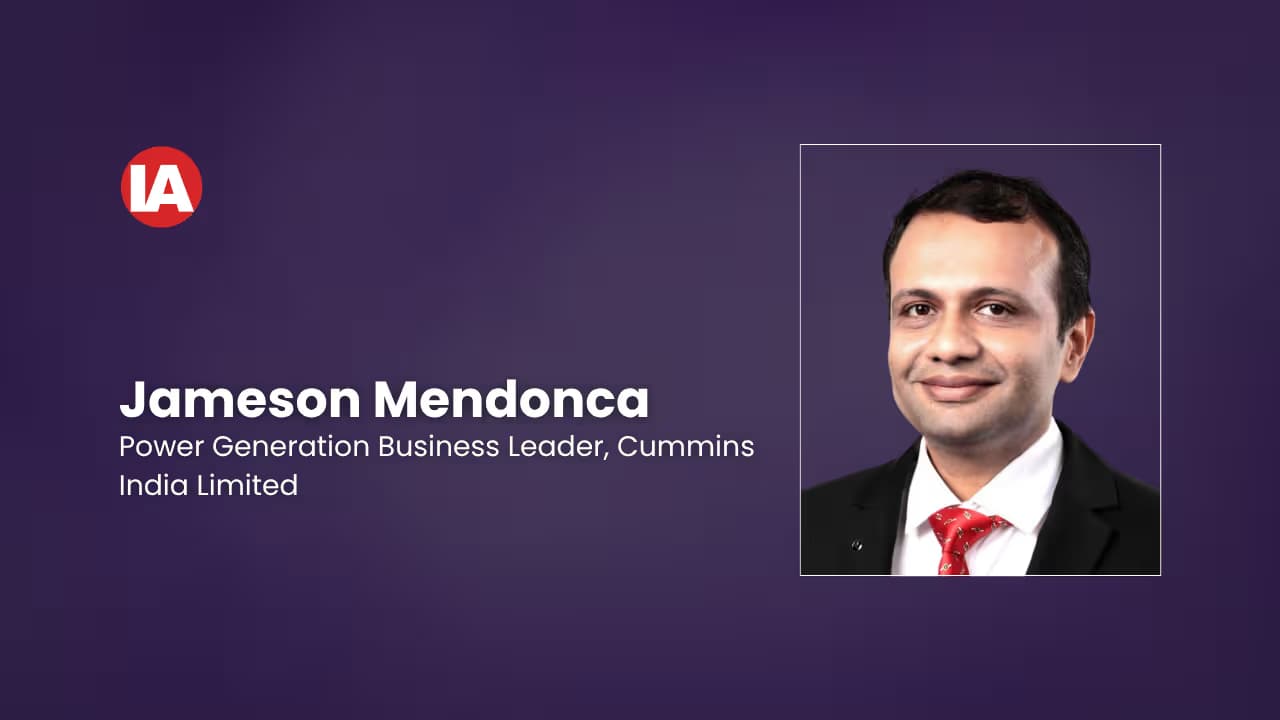
Jameson Mendonca, Power Generation Business Leader, Cummins India Limited.
How is Cummins India evolving its power-generation portfolio to meet the changing requirements of sectors such as construction, infrastructure, manufacturing and commercial facilities?
India's growth sectors increasingly require power solutions that are cleaner, smarter and more connected, while maintaining the reliability that critical operations demand.
The requirements of sectors such as construction, infrastructure, manufacturing, and commercial facilities are becoming increasingly complex, with a growing emphasis on reliability, efficiency, compliance, and sustainability. At Cummins India, we are continuously evolving our power-generation portfolio to address these needs through a broad range of power solutions, across 7.5kVA – 3750kVA, designed for diverse operating environments.
In addition to product innovation, we are leveraging connected technologies and our aftermarket service network to help customers improve uptime and optimise lifecycle performance. We are also advancing alternative fuel and lower-emission technologies to support the industry's evolving energy needs. Our focus remains on delivering dependable, future-ready power solutions that enable customer success across critical growth sectors.
What have been the key engineering and technology challenges in achieving CPCB IV+ compliance, and how is Cummins leveraging its global expertise while developing and localising solutions specifically for the Indian market?
We have leveraged decades of global experience in developing emissions-compliant power solutions across multiple regulatory environments, while ensuring the products are engineered for India's unique operating conditions. Achieving CPCB IV+ compliance was not simply an emissions challenge; it required balancing stringent environmental requirements with the performance, reliability, and total cost of ownership expectations of customers operating in demanding Indian conditions. Our teams combined proven global technologies with extensive local validation to address factors such as high ambient temperatures, varying fuel and power conditions, diverse application requirements, and customer expectations for uptime.
Beyond regulatory compliance, customers increasingly expect lower emissions, better fuel efficiency and higher operational reliability. What advanced engine, combustion, aftertreatment and control technologies are helping Cummins achieve this balance?
Cummins achieves the balance between lower emissions, fuel efficiency, and reliability through an integrated technology approach that combines advanced combustion systems, electronically controlled fuel injection, optimised air handling, intelligent engine controls, and sophisticated after-treatment solutions. Together, these technologies improve combustion efficiency, reduce emissions, optimise fuel consumption, and deliver dependable performance across demanding applications. Complementing these technologies are connected digital capabilities, such as telematics, remote monitoring, and predictive diagnostics, helping customers maximise uptime and operational efficiency. The result is a power solution that meets evolving sustainability requirements, without compromising the reliability that critical operations depend on.

The reliability expectations of standby power are particularly high in mission-critical applications, such as data centres, healthcare and telecommunications. How are customer requirements evolving in these segments, and what does a modern back-up power solution need to deliver beyond simply starting when the grid fails?
The expectation in mission-critical sectors has evolved from simply having backup power to ensuring complete business resilience. Customers today require rapid load acceptance, high power quality, remote monitoring, predictive diagnostics, sustainability, and dependable lifecycle support in addition to reliable startup performance.
We address these needs through an integrated power-system approach that combines advanced power-generation technologies, digital intelligence, and comprehensive support across the entire customer journey, from product innovation and application engineering to commissioning, operation, and aftermarket service. Backed by a strong pan-India service network, this enables customers to maximise uptime, operational efficiency, and peace of mind in environments where downtime is simply not an option.
Digital technologies are changing how generator sets are monitored and maintained. How is Cummins using connectivity, remote monitoring, diagnostics and data analytics to improve uptime and enable more predictive approaches to maintenance?
Digital technologies are enabling a shift from reactive maintenance to proactive asset management. Through connected controls, remote monitoring, diagnostics, and analytics, customers gain real-time visibility into generator performance, faster fault identification, and actionable insights that help maximise uptime and optimise maintenance planning.
We combine these digital capabilities with comprehensive lifecycle support, spanning product design, commissioning, operation, remote diagnostics, and aftermarket service. Backed by a strong pan-India service network, this integrated approach helps customers improve reliability, reduce unplanned downtime, and achieve greater value from their power-generation assets throughout their lifecycle, enabling predictive maintenance and proactive service interventions.
How is Cummins strengthening its lifecycle proposition through service networks, genuine parts, aftermarket support, maintenance contracts and other solutions that improve total cost of ownership?
Customers today are looking beyond product performance and evaluating the total lifecycle
value of their power systems. Reliability, parts availability, service responsiveness, digital
insights, and maintenance optimisation are all critical contributors to total cost of ownership.
Cummins addresses this through a comprehensive lifecycle approach that spans application
engineering, commissioning, connected monitoring, maintenance contracts, genuine parts, and
aftermarket support. Backed by a strong pan-India service network and advanced diagnostic
capabilities, we help customers maximise uptime, extend asset life, and achieve greater
operational efficiency throughout the life of their equipment.

India is simultaneously pursuing rapid infrastructure development and a transition towards more sustainable energy systems. How does Cummins see the role of engine-based power generation evolving alongside renewables, energy storage, gas-based systems and other emerging power technologies?
India's growing power demand and sustainability ambitions will require a balanced energy mix, rather than a single technology solution. We see engine-based power generation continuing to play a critical role alongside renewables, energy storage, and other emerging technologies, by providing the reliability, flexibility, and resilience needed to support critical operations and grid stability. At Cummins, we believe the future lies in integrated energy solutions that combine conventional power generation, renewables, battery storage, intelligent controls, and digital technologies. Leveraging our broad portfolio and lifecycle support capabilities, we are helping customers achieve both their sustainability goals, and their need for dependable power in an increasingly dynamic energy landscape.
Looking ahead, what is Cummins India’s broader vision for sustainable growth in the construction, infrastructure and power-generation ecosystem? Where do you see the biggest opportunities for innovation and how will Cummins balance reliability, affordability, emissions reduction and the changing energy needs of India?
India's energy transition is reshaping the role of power generation. As the country targets 500 GW of non-fossil fuel capacity by 2030, gensets are evolving from traditional standby assets into integral components of distributed energy ecosystems, helping support grid stability, renewable integration and operational resilience. We believe India's energy future will not be defined by a single technology, but by multiple technologies working together. The opportunity lies in integrating reliable power generation, renewables, storage, digital intelligence and service expertise to deliver solutions that are sustainable, resilient and economically viable.
Our vision is to help customers navigate this, evolving energy landscape by combining advanced power-generation technologies, digital connectivity, and comprehensive lifecycle support. We continue to invest in innovation, localisation, cleaner technologies, intelligent controls, and integrated energy solutions that balance four critical priorities for India: reliability, affordability, sustainability, and resilience.