The true purpose of technology is not just progress — it’s compassion in action
Genrobotics Innovations, founded in Kerala in 2017, is redefining hazardous task automation with compassion-driven robotics. Sparked by tragedies in manual scavenging, the company launched Bandicoot—the world’s first robotic manhole cleaner—restoring dignity to workers and revolutionizing sanitation safety. Today, Bandicoot operates in 100+ cities and actively improves public health and inclusion.
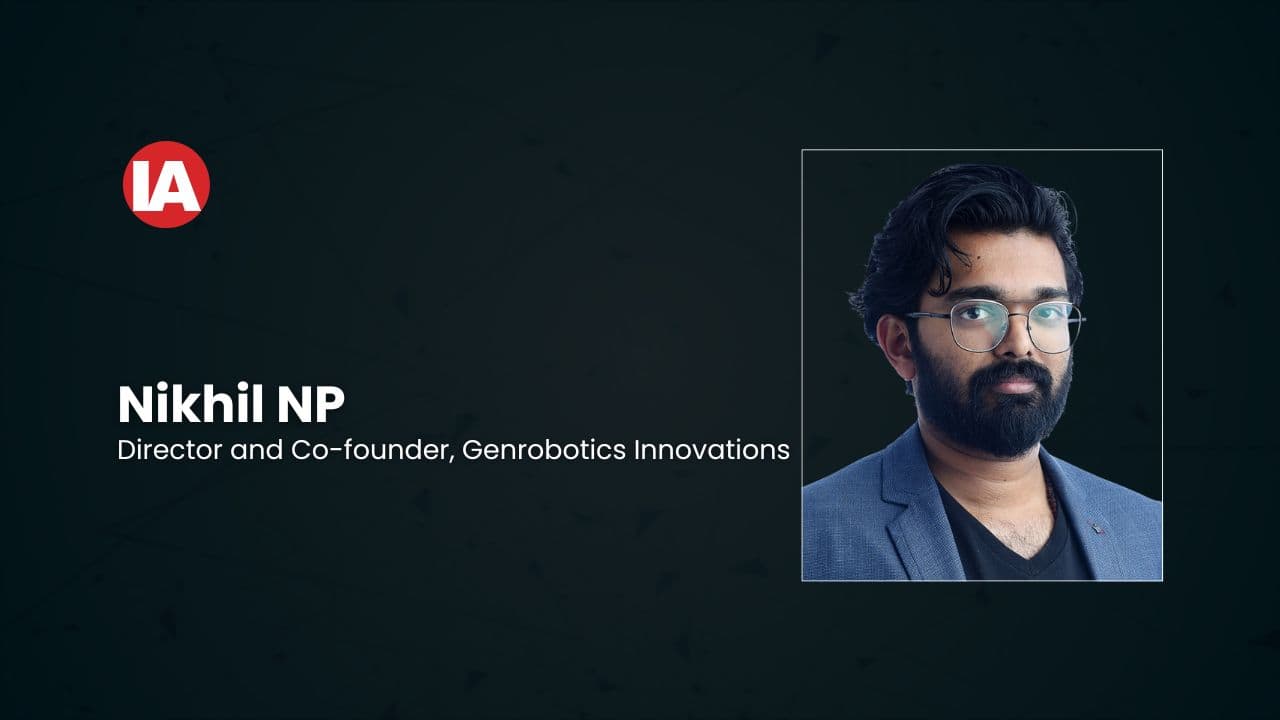
Nikhil NP, Director and Co-founder, Genrobotics Innovations.
Genrobotics has emerged as a pioneering name in robotic solutions for hazardous tasks. Could you share how the company’s journey began and the core problem you set out to solve?
Genrobotics was born in 2017 out of a simple yet profound belief — that technology, at its best, should protect and uplift human life. For us, robotics was never just about circuits and code; it was about curiosity, compassion, and the conviction that innovation must serve humanity.

Our journey took a defining turn after a tragic incident in Kozhikode, Kerala, where two sanitation workers and a brave civilian named Naushad lost their lives inside a manhole. That moment was more than a news story — it was a mirror held up to society, questioning why, in a world racing ahead with AI and automation, humans still had to descend into danger to earn a living.
It was then that Genrobotics took shape — not merely as a company, but as a movement to restore dignity and safety to those who had long been forgotten. Our mission became clear: to end manual scavenging and make sanitation completely human-safe. That purpose led us to create Bandicoot — the world’s first robotic manhole cleaner — a symbol of how technology can stand for empathy and equality.
Today, our journey continues across new frontiers — from sanitation to industrial maintenance and healthcare — but our vision remains unchanged. Every innovation we build carries the same message: no human should ever risk their life for a task that a robot can do safely.
What was the initial response from municipalities and industries when you introduced robotic sewage cleaning solutions, given the strong legacy of manual scavenging in India?
When we first introduced Bandicoot, we weren’t just launching a robot — we were challenging a century-old system built on manual labour, inequality, and silence. The resistance we faced in the beginning wasn’t only about technology; it was about mindset. Many questioned whether a robot could really replace something that had, for generations, been done by human hands — often at the cost of dignity and life itself.
But change begins where courage meets purpose. When municipalities and industries witnessed Bandicoot at work — cleaning manholes faster, safer, and without exposing anyone to toxic gases — the perception began to shift. The most powerful moment wasn’t the robot’s efficiency; it was the sight of former sanitation workers operating it with pride. That’s when we realised this wasn’t just innovation — it was inclusion.
Today, Bandicoot operates in over 100 cities across India, transforming sanitation practices and restoring human dignity. Supported by national programs like Swachh Bharat Mission, AMRUT, NAMASTE, NSKFDC, and Make in India, it stands as living proof that when technology is driven by empathy, even the oldest, most rigid systems can evolve — and a society can rise with it.
Your flagship product Bandicoot has gained widespread attention. How has the technology evolved since its first deployment?
I’ve always believed that the true purpose of technology is not just progress — it’s compassion in action.
When we built the first Bandicoot, our goal was simple yet profound: to end human entry into manholes forever. That moment wasn’t just a technical milestone; it was a social revolution powered by robotics. Bandicoot became the world’s first robotic solution to replace manual manhole cleaning with a fully automated process, making sanitation work completely human-safe.
But innovation, for us, has never been a destination — it’s a continuous journey. Each generation of Bandicoot reflects that spirit, evolving in performance, adaptability, and intelligence.
Today, Bandicoot has transformed into a two-part system: the Robotic Unit and the Stand Unit. The Robotic Unit enters the manhole, equipped with high-torque robotic arms that replicate human dexterity to desilt and remove solid or semi-solid waste. Its AI-assisted vision system, IP68-rated cameras, and powerful illumination ensure perfect visibility even in dark or submerged conditions. Advanced gas sensors continuously monitor the atmosphere, alerting operators to any hazardous gases — because safety is the foundation of every design decision we make.
Above ground, the Stand Unit serves as the operator’s command hub — a place where control and safety merge seamlessly. Through an intuitive joystick interface, the operator manages the entire process remotely, never stepping into danger. The system’s modular, mobile design allows easy transport and deployment across urban and rural terrains alike.
We re-engineered the latest Bandicoot with a lightweight carbon fibre composite body, built to withstand the extremes of India’s climates — from the freezing chill of Leh to the heat of Rajasthan. Its modular architecture simplifies maintenance and future upgrades, ensuring long-term reliability and adaptability.
As our mission expanded, so did our ecosystem. We built solutions that address every layer of sanitation challenges: Wilboar for stormwater drain and STP well cleaning, G Mammoth for suction and jetting operations, and G Mamba for underground inspection. All are seamlessly connected through G Crow, a digital platform enabling real-time monitoring, performance analytics, and predictive maintenance across every deployed robot.
Together, these innovations form an intelligent and connected sanitation ecosystem — one that replaces human entry with robotics, safeguards lives, and supports cities in building cleaner and more sustainable sanitation infrastructure.
Together, these innovations form a connected and intelligent sanitation ecosystem — one that replaces human entry with robotics, ensures safety in hazardous environments, and supports cities in achieving cleaner and more sustainable sanitation infrastructure.
What are some of the biggest engineering challenges your team faced in designing robots to operate in India’s diverse and unpredictable sewer systems?

Designing a robot to work inside India’s sewer systems has been one of the most complex and meaningful engineering journeys we’ve ever taken. Unlike controlled industrial environments, India’s underground sanitation network is an unpredictable maze. No two manholes are the same — they vary in depth, diameter, structure, and material. Each locality tells a different story of design and decay. This unpredictability demanded not just engineering excellence but empathy — a system that could adapt like a human would, in real time.
We built adaptive robotic legs that can adjust to the manhole’s structure — changing height, angle, and stance to stay balanced and effective even in the most uneven or narrow chambers. This adaptability was our way of teaching the machine to “understand” its environment.
One of our biggest challenges was recreating human dexterity — the natural precision of a worker’s hands inside a manhole. Manual cleaners rely on instinct and flexibility that no ordinary machine could replicate. To bridge that gap, our engineers developed a high-torque robotic arm capable of gripping, rotating, and scooping just like human hands — only with greater strength and consistency. The custom-designed gear and joint mechanism gave it both fine control and raw power, enabling Bandicoot to handle everything from semi-solid sludge to heavy debris — all without human entry.
Then came the challenge of endurance. The manhole isn’t just a workspace; it’s a harsh ecosystem filled with corrosive gases, sludge, and water ingress. Every component of Bandicoot had to survive what humans should never be exposed to. So, we used waterproof, anti-corrosive materials and sealed every electronic element to achieve IP68 protection. Bandicoot doesn’t just operate in these environments — it thrives in them.
Safety was at the heart of our mission. Toxic gases like methane and hydrogen sulfide are silent killers inside manholes. We equipped Bandicoot with real-time gas sensors that continuously monitor the environment and alert operators before danger strikes. For us, technology isn’t successful until it can safeguard human life.
But innovation doesn’t end with machinery — it extends to the human experience. The Bandicoot’s interface was designed for sanitation workers transitioning into tech operators. Developed in collaboration with Google, the control system features an intuitive graphical UI, joystick-based control, and real-time visuals. It ensures that anyone — even without prior technical knowledge — can confidently operate a robot.
We engineered adaptability, strength, safety, and simplicity into one system — crafted not for perfect environments, but for the unpredictable realities of India’s sanitation network.
How does Genrobotics leverage automation and AI to make its robots adaptive, reliable, and safe in real-world scenarios?
Artificial Intelligence and automation are not just technological tools — they’re catalysts for transformation. At Genrobotics, we’ve always believed that innovation should carry a social purpose. For us, AI isn’t about building smarter machines alone; it’s about creating intelligent systems that understand their surroundings, adapt to challenges, and ultimately make human lives safer.
In Bandicoot, our flagship robot, AI plays a pivotal role in enhancing both vision and control. Its AI-assisted vision system empowers operators to see and navigate complex, confined spaces with remarkable precision. Real-time feedback and intelligent motion control make every movement smoother and every operation more reliable, even in the most unpredictable environments.
What makes Bandicoot truly future-ready is its evolving design. While it operates in a semi-automatic mode today, its architecture is built to embrace higher levels of automation. With continuous software upgrades and the integration of advanced AI modules, Bandicoot is designed to grow — to become more efficient, intuitive, and autonomous with time, without the need for reinvention.
To extend this intelligence beyond the robot, we built G Crow, our smart monitoring and management platform. It connects every deployed Bandicoot into one digital ecosystem — allowing operators and municipalities to monitor performance, analyse data, and plan predictive maintenance. This seamless integration ensures not just operational excellence but also long-term reliability and insight-driven decision-making.
When robotics, AI, and digital ecosystems converge, we move closer to a world where technology doesn’t just perform tasks — it protects lives, enhances safety, and sustains progress. Our vision has never been about replacing people with machines; it’s about reimagining work itself — making it human-safe, dignified, and efficient for the cities of tomorrow.
Robotic sewage cleaners have clear benefits for worker safety. Could you share some measurable impacts Genrobotics has made in improving public health or eliminating manual scavenging?

The impact of Bandicoot and our sanitation technologies extend far beyond the realm of automation. What we’re witnessing is not just technological progress, but a profound social transformation — one that connects innovation with human dignity, safety, and public health. What began as a mission to end the inhuman practice of manual scavenging has evolved into a national movement for safer and more sustainable sanitation.
Today, our solutions are driving change across more than 100 cities in India, enabling municipalities to completely reimagine how underground sanitation is managed. Through these initiatives, over 3,000 former manual scavengers have been rehabilitated and trained as robotic operators — a shift that represents far more than employment. It’s a change in identity. These individuals, once exposed to life-threatening conditions, now work with advanced technology and serve as symbols of transformation in their communities, inspiring others to pursue dignity through innovation.
The introduction of Bandicoot has also had measurable effects on public health and safety. By eliminating human entry into manholes, we have drastically reduced exposure to toxic gases, pathogens, and contaminated waste. Cities that have adopted Bandicoot are witnessing fewer sanitation-related accidents, improved hygiene outcomes, and greater efficiency in maintenance operations. Precision cleaning, consistency, and real-time monitoring have redefined what urban sanitation can achieve.
At the core of this mission lies a simple yet powerful belief — technology must serve humanity. Every time a person steps out of a manhole and takes the controls of a robot, we see a victory for safety, respect, and opportunity. That is the real impact of Genrobotics — proving that when innovation is guided by empathy and purpose, it doesn’t just solve problems; it transforms lives and builds a more inclusive future.
When it comes to our business model, we’ve structured it around three pillars: accessibility, scalability, and sustainability — principles that make robotic sanitation both practical and impactful for governments and industries alike.
We operate primarily through a Business-to-Government (B2G) model, partnering with municipalities, urban local bodies, and state sanitation departments to modernise their systems. To make adoption effortless, we offer flexible engagement models that include direct product sales and comprehensive Operations & Maintenance (O&M) support. This ensures that municipalities not only gain access to the technology but also receive 24×7 technical support through our nationwide O&M network — maximising uptime, optimising performance, and ensuring reliability under real-world conditions.
We’ve also embedded continuous learning into our ecosystem. Local operators are trained and upskilled through our dedicated programs, while feedback from the field directly shapes ongoing product improvements. This creates a dynamic cycle of progress — where both human capability and technological performance evolve together.
By making advanced sanitation affordable and dependable, we’ve helped cities transition smoothly from manual methods to robotic systems. The success of this approach has naturally extended to sectors like industrial cleaning and wastewater management, where safety and operational continuity are equally vital.
Ultimately, our goal is to build a self-sustaining ecosystem of safety, efficiency, and dignity — ensuring that every robot deployed doesn’t just clean a manhole but contributes to a cleaner, safer, and more equitable society.