For large utility-scale projects, hybridisation is rapidly becoming the preferred development model
Hero Future Energies' Ashutosh Vyas discusses renewable energy hybridisation, battery storage, and India's shift towards reliable clean power.
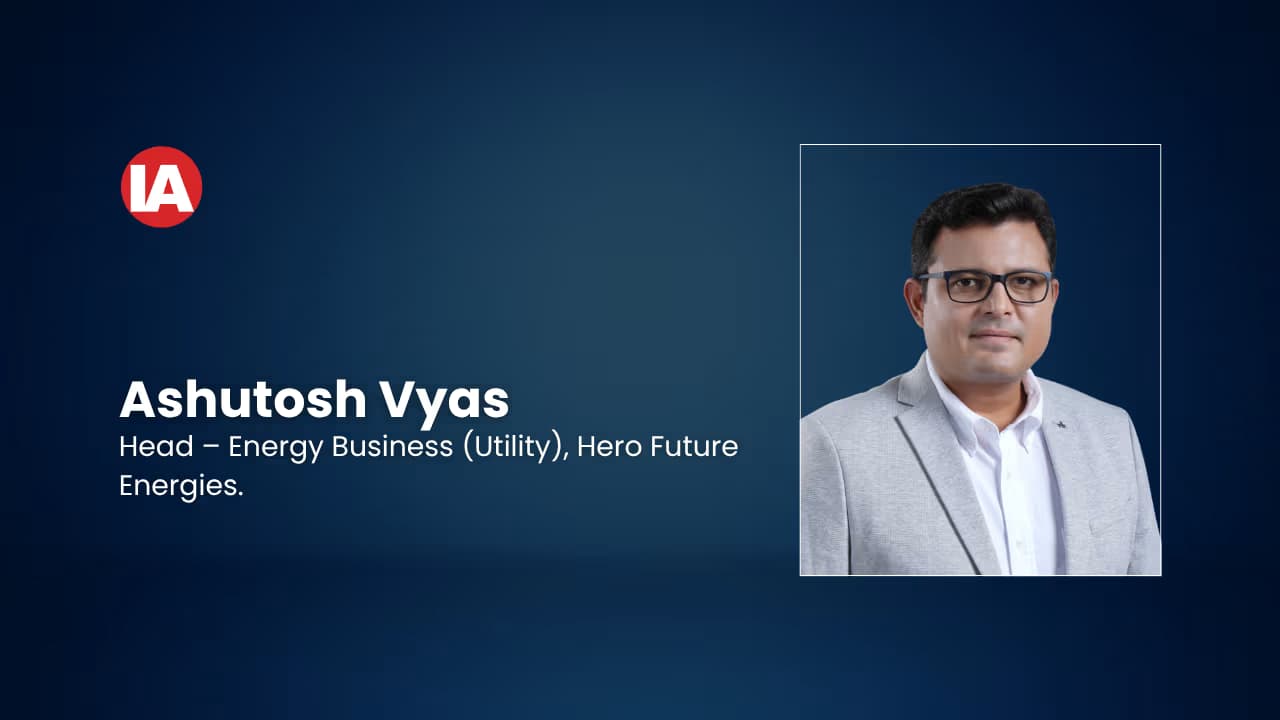
Ashutosh Vyas, Head – Energy Business (Utility), Hero Future Energies.
India’s renewable capacity is growing rapidly, but generation capacity does not automatically translate into reliable power. What do you see as the biggest bottleneck in the next phase – intermittency, transmission, curtailment, storage or market design – and what needs to change most urgently?
India has proven it can add renewable capacity at scale and at record-low tariffs. The next phase is about delivering firm, reliable power when the grid needs it. Among the constraints listed, transmission remains the most significant bottleneck today.
Solar and wind projects can typically be developed within 18-24 months, while transmission infrastructure often takes four to five years. The result is stranded or curtailed capacity in resource-rich states such as Rajasthan and Gujarat, which undermines investor confidence at a time when accelerated deployment is critical. A significant portion of renewable curtailment today is effectively a transmission and scheduling challenge.
Over time, intermittency has become more manageable, and storage costs have declined. The larger gap lies in market design. The power market still tends to reward the lowest-cost energy rather than the attributes a high-renewable grid requires, namely firmness, flexibility and peak-time availability.
The most urgent priorities are:
Planning transmission ahead of generation, with faster clearances and accountability for delays
Creating bankable revenue streams for storage and flexibility through ancillary services, peak-availability payments and stronger time-of-day pricing, and
Reducing offtake risk through faster PPA signing and stronger payment security from discoms.
Transmission is the immediate constraint, but market design is the enabler that can unlock long-term system reliability. With the right price signals and commercial frameworks in place, capital deployment will accelerate, allowing India to convert its renewable capacity leadership into reliability leadership.
Wind and solar have complementary generation profiles, yet hybrid projects can be more complex to develop and finance. At what point does the improved utilisation and grid profile of a wind-solar hybrid project outweigh its additional complexity and cost? Is hybridisation now becoming the default model for large-scale renewable development?
The decision to hybridise comes down to one practical question: does the combination deliver a superior energy product at a competitive cost or not. Simply combining wind and solar under a single contract does not create value on its own. The additional development and financing complexity must be justified by tangible benefits such as better utilisation of transmission infrastructure, a broader generation window, lower variability, reduced curtailment, or a smaller storage requirement.
The strongest case for hybridisation lies in transmission, because connectivity, rather than modules or turbines, has become the scarcest resource in the Indian renewable energy sector. A standalone solar project typically utilises its grid connection for only 20-25% of the year. A well-designed wind-solar hybrid can increase that utilisation to 35-45%, and even higher (80-90%) when complemented by storage. When connectivity is constrained and the grid requires supply beyond daylight hours, these advantages generally outweigh the additional complexity.
However, the complexity is real. Hybrid projects require strong wind resources in proximity to suitable solar sites, management of two technology supply chains, aligned construction schedules, more rigorous resource assessment, and lenders comfortable with combined generation risk. The economics favour hybridisation mainly when three major conditions hold:
Transmission is costly or scarce, so moving more energy through the same connection carries high value
The offtaker pays for the generation profile, as in FDRE, round-the-clock (RTC) and peak-supply tenders, or C&I buyers facing time-of-day (ToD) tariffs.
The site offers genuine resource complementarity, with strong evening, night and monsoon wind balancing the solar profile.
For large utility-scale projects, hybridisation is rapidly becoming the preferred development model, and gradually the market is moving towards hybrid-plus-storage solutions. Standalone solar has so far played an important role in meeting daytime demand. However, a steeper duck curve has pushed buyers to shift from procuring the lowest-cost energy to securing reliable and dispatchable supply; and hence, hybrid projects have become the logical choice rather than the complex alternative.
If wind-solar generation is combined with BESS, the proposition moves from simply producing renewable electricity to delivering power when it is actually needed. How close is India to making firm and dispatchable renewable (FDRE) power commercially competitive with conventional sources?
From a cost perspective, FDRE and RTC (round-the-clock) projects are already approaching commercial parity with conventional power sources in India. Recent FDRE and RTC tenders have discovered tariffs broadly in the Rs 4.5-5.3 per kWh range, while power from new coal capacity is widely estimated to cost more once fuel, financing and the long-term risk of stranded assets are factored in. Battery prices have also declined sharply over the past two years, and recent storage tenders reflect that trend. For evening peak supply in particular, renewable-plus-storage solutions are already competitive with, and in many cases cheaper than, new conventional alternatives.
The picture becomes more nuanced when the objective is truly firm 24x7 supply. Meeting high availability commitments across every season still requires oversizing both generation and storage, because the challenge is not just the daily solar cycle but longer periods of weak renewable generation, such as weak winter wind or cloudy monsoon weeks. Four or six-hour batteries are well suited for daily energy shifting, but multi-day and seasonal firming still relies on pumped hydro, longer-duration storage technologies or some form of conventional backup.
As a result, the remaining gap is no longer primarily one of technology or tariff, but of risk allocation and commercial frameworks. Three developments would accelerate the transition:
Bankable contracts: Faster PPA and PSA execution following auctions, stronger payment security mechanisms, and penalty structures that realistically reflect the cost of delivering firm power
Supply chain resilience: Reduced dependence on imported battery cells, along with greater clarity around battery degradation, augmentation requirements and end-of-life management
Market recognition of firmness: Pricing mechanisms that appropriately value capacity, reliability and peak-time availability, rather than focusing solely on energy volumes.

Representative image
BESS is increasingly being discussed not merely as a renewable-enabling technology but as core power infrastructure. Where do you see its greatest near-term value in India – peak shaving, energy shifting, ancillary services, grid balancing or Round-the-Clock power – and what is currently preventing much faster deployment?
BESS is moving from being a renewable-enabling technology to becoming core power infrastructure. In the near term, value is likely to be driven by energy shifting, peak demand management, and ancillary services, as India’s solar generation creates a growing mismatch between when power is produced and when it is needed.
BESS can store surplus renewable energy during the day and discharge during evening peaks, while also reducing curtailment and providing grid-balancing and ancillary services. As renewable penetration increases, this flexibility will be critical to delivering RTC renewable power more reliably and cost-effectively at scale.
The constraint today is not the technology; it is the commercial framework required to monetise its multiple system benefits. Revenue visibility, appropriate capacity and ancillary-service markets, transmission integration, financing and long-term contracting mechanisms need to evolve faster.
The industry therefore needs to move beyond viewing BESS simply as an energy asset. Its true value lies in providing flexibility, capacity and reliability to the power system. Creating predictable and bankable revenue streams for these services will be the key to accelerating deployment across India.
Storage economics ultimately depend on how frequently and effectively the asset can be used. Does India need a fundamental change in power-market mechanisms, tariffs and ancillary-service markets to unlock the full commercial potential of BESS? What policy or regulatory intervention would make the biggest difference?
For BESS to scale economically in India, the industry needs to move beyond treating storage primarily as an energy asset and recognise it as a flexibility and capacity asset as well. The economics improve significantly when a battery can participate across multiple applications, including energy shifting, peak-demand management, grid balancing and ancillary services, rather than relying on a single revenue stream.
The most important intervention would be to create predictable, bankable and technology-neutral revenue mechanisms for these different services. This includes stronger time-of-day price signals, well-defined capacity and ancillary-service markets, and clear rules allowing BESS to participate across multiple markets without regulatory or contractual barriers.
Long-term contracts, particularly for capacity and grid-support services, would also improve financing visibility and accelerate investment.
Ultimately, India does not necessarily need a completely new market architectureThe priority is to evolve the existing framework to properly value flexibility, reliability and availability alongside energy supplied. Once these attributes are adequately compensated, BESS economics become far more compelling and deployment can scale much faster.
Green hydrogen has moved rapidly from concept to pilot projects, but industrial-scale adoption requires a compelling commercial case. What is the single biggest missing ingredient today – low-cost renewable power, electrolyser economics, infrastructure, carbon pricing or long-term offtake commitments? And what would make large industrial customers willing to sign bankable long-term offtake agreements?
Scaling green hydrogen will ultimately depend on bankable long-term offtake frameworks that create sufficient demand visibility and support project economics.
India has made progress on renewable power, electrolyser manufacturing and project development. However, industrial-scale adoption will require customers to commit to long-term offtake agreements of 10-15 years with confidence in pricing, supply reliability and the long-term competitiveness of green hydrogen.
Large industrial customers will commit to long-term offtake agreements when three conditions are met: competitive and predictable delivered pricing, reliable supply, and credible long-term demand-side policy support. Contracts should also provide appropriate mechanisms to manage changes in renewable power costs, carbon economics and technology efficiency over time.
This is where policy can play a catalytic role, not through permanent subsidies, but by reducing early-stage market risk through demand aggregation, production/offtake incentives, clear carbon-accounting standards and long-term procurement mechanisms.
Ultimately, green hydrogen will scale when it becomes not just technically feasible, but commercially bankable for both the producer and the industrial consumer. Creating that bankability is the key step from pilots to large-scale deployment.
We are seeing renewable generation, hybrid plants, BESS, digital controls and green hydrogen increasingly being planned together. Is the traditional model of developing standalone solar or wind projects becoming obsolete? What might an integrated Hero Future Energies project look like five to ten years from now?
Standalone wind projects are unlikely to become obsolete; however, the same may not be said about solar. Market evolution is clearly pivoting towards integrated energy systems that can deliver greater flexibility, reliability and dispatchability. As renewable penetration increases, the greater value will come from combining generation with flexibility, storage, digital controls and, where appropriate, green hydrogen.
Over the last few years, Hero Future Energies has been evolving from developing individual renewable assets towards integrated clean-energy platforms that combine solar, wind and BESS with advanced energy-management systems and grid-responsive controls. Green hydrogen or other forms of flexible demand can also become part of this ecosystem where the economics and customer requirements support it.
The objective is to optimise the entire energy portfolio, rather than maximise the output of an individual asset. Digital platforms will enable better forecasting, real-time optimisation, intelligent storage dispatch and participation across evolving power markets.
HFE is already developing complex energy solutions some of which deliver more than 85% CUF. In the next 5 to 10 years, renewable projects are likely to deliver even more flexible and reliable clean power.
The transition is therefore not from standalone renewables to a single new model, but from “generation assets” to intelligently integrated clean-energy platforms.
Looking ahead, could the real competitive advantage in clean energy shift from owning renewable capacity to intelligently orchestrating generation, storage, transmission, markets and industrial demand? What capabilities – technological, digital and organisational – will distinguish the leaders of India's next-generation energy industry?
The competitive advantage is progressively shifting from simply owning renewable capacity to orchestrating an integrated energy ecosystem. As renewable penetration grows, the ability to optimise generation, storage, transmission, markets and customer demand in real time will become even more crucial.
The next generation of energy companies will need three core capabilities. First, technology and engineering depth to integrate solar, wind, BESS, green hydrogen and grid infrastructure into reliable energy systems. Second, digital intelligence enables advanced forecasting, AI-enabled optimisation, energy-management platforms and real-time asset control, to optimise portfolios across different market and operating conditions. Third, organisational agility, with teams that can bring together power markets, technology, project development, financing and evolving customer requirements.
The leaders are unlikely to be defined solely by installed capacity, but by their ability to deliver the right energy product at the right time and at the right cost, while maximising value across generation, storage and market opportunities.
For India, this means moving from a capacity-led renewable model towards an integrated, data-driven and customer-centric energy platform, where flexibility, reliability and intelligent optimisation become as important as generation capacity itself.