I see the future warehouse as an integrated ecosystem rather than a collection of individual machines
AI is reshaping warehouse automation through predictive analytics, robotics, digital twins and smarter inventory management.
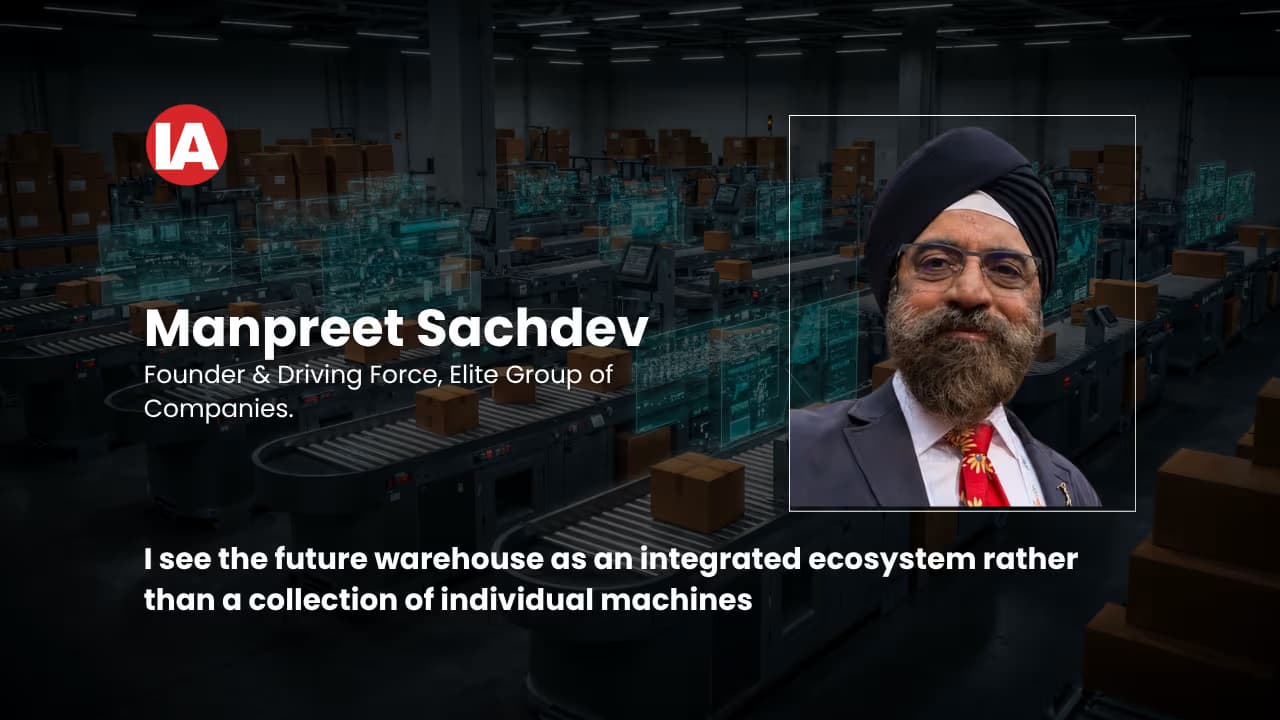
Manpreet Sachdev, Founder & Driving Force, Elite Group of Companies.
Artificial Intelligence is rapidly reshaping supply chain operations. Which areas – from demand forecasting and inventory optimisation to procurement and logistics planning – are witnessing the most significant impact, and why?
The strongest impact is currently visible in demand forecasting, inventory optimisation, warehouse planning, procurement and logistics.
Traditionally, many supply-chain decisions have depended heavily on historical averages and individual experience. AI changes this by combining historical information with real-time data. Demand forecasting can incorporate seasonality, customer behaviour, market conditions, promotions, weather and other external signals.
Inventory is another major area. The objective should no longer simply be to hold ‘more stock to be safe’. AI can help determine where stock should be positioned, how much safety stock is actually required and which SKUs require priority.
Procurement is also becoming more intelligent. AI can analyse supplier lead times, historical quality, pricing, delivery reliability and external risk indicators to identify potential supply problems before they become operational problems. McKinsey's recent work highlights the growing use of AI for supplier-risk intelligence and procurement decision support.
In logistics, AI can optimise routes, transportation capacity and delivery schedules while considering changing conditions. The important shift is from reactive management to predictive management.
For a warehouse operator, the question changes from ‘What is happening?’ to ‘What is likely to happen next, and what should I do now?’
AI-powered machine learning models can analyse vast volumes of historical and real-time data. How are these capabilities improving inventory accuracy, reducing stockouts, and enabling more responsive warehouse operations?
Inventory accuracy is fundamentally a data problem.
If the system says there are 100 units but the warehouse physically has 83, no amount of sophisticated planning will solve the problem. Therefore, AI must be built on reliable data captured from RFID, barcode systems, sensors, cameras, WMS and ERP platforms.
Machine-learning models can identify patterns in inventory movements and detect anomalies. For example, if a particular SKU normally moves 50 units per week but suddenly shows an unusual movement pattern, the system can flag it for investigation.
AI can also continuously calculate inventory health:
• Fast-moving versus slow-moving SKUs
• Dead stock
• Safety-stock requirements
• Reorder points
• Stockout probability
• Supplier lead-time risk
• Warehouse capacity
• Demand variability
This creates a much more dynamic inventory model.
The economic opportunity can be significant. McKinsey estimates that AI-enabled approaches can potentially reduce inventory by 20–30 percent in some distribution environments while improving logistics and procurement performance.
But I would emphasise one point: AI does not compensate for poor master data. If SKU descriptions, dimensions, locations, stock quantities or transaction records are inaccurate, the AI will simply make incorrect decisions faster.
That is why data discipline must come before sophisticated AI.
Modern warehouses are increasingly deploying AI alongside robotics, autonomous mobile robots (AMRs), computer vision, and automated storage and retrieval systems (AS/RS). How do these technologies work together to accelerate order fulfilment while maintaining accuracy and flexibility?
I see the future warehouse as an integrated ecosystem rather than a collection of individual machines.
An AS/RS can provide high-density automated storage and retrieval. AMRs can move materials between workstations. Computer vision can identify products, verify quantities, inspect packaging and monitor safety. Sensors can continuously monitor equipment and environmental conditions.
AI becomes the intelligence layer connecting these technologies.
For example, an order enters the WMS. AI determines the optimal fulfilment sequence. The AS/RS retrieves the required inventory. An AMR transports it to the appropriate picking or packing station. Computer vision verifies the SKU and quantity. The system then dynamically assigns the next task based on workload, location and priority.
This is where automation becomes much more powerful than simply installing robots.
The objective should be to optimise the entire material flow, not individual pieces of equipment.
At Elite Material Handling, we have always looked at material handling from this broader perspective. A dockleveller, scissor lift, dock system or other equipment is not an isolated product; it is part of the customer's overall movement of goods. AI will make this systems approach even more important.
Digital twins are particularly interesting because they allow companies to simulate warehouse layouts, material flows and automation strategies before making major capital investments. Current industry research shows that digital twins can combine predictive models with operational simulations to optimise inventory positioning, warehouse capacity and fulfilment decisions.
Supply chains today face frequent disruptions caused by geopolitical events, extreme weather, and fluctuating customer demand. How can AI-driven predictive analytics help organisations anticipate risks, improve resilience, and make faster operational decisions?
The greatest value of predictive AI may ultimately be in risk management.
Supply chains today operate in an environment of geopolitical uncertainty, changing trade policies, extreme weather, transportation disruption, labour shortages and unpredictable demand.
A traditional supply chain often reacts after the disruption occurs. An AI-enabled supply chain can continuously monitor risk indicators and identify potential consequences.
For example, if a critical supplier has increasing lead times, the system could identify the risk several weeks before the actual stockout. It could then model alternatives:
Should we increase safety stock?
Should we accelerate another shipment?
Should we qualify an alternate supplier?
Should we move inventory to another warehouse?
This is where AI combined with a digital twin becomes particularly powerful. Instead of merely predicting a problem, the system can evaluate multiple scenarios and recommend the best response.
McKinsey describes this transition as moving toward predictive and prescriptive supply chains, where digital twins can model different demand, lead-time and supplier scenarios and help determine optimal operational responses.
The ultimate goal should be a supply chain that is not simply efficient but resilient and self-correcting.
Despite the growing adoption of AI, many organisations still struggle with fragmented data, legacy systems, and workforce readiness. What are the biggest challenges in implementing AI-enabled supply chain and warehouse solutions, and how can companies overcome them?
The biggest barriers are not necessarily the AI algorithms.
They are data fragmentation, legacy systems, integration, cybersecurity, investment and people. Many companies have ERP data in one system, warehouse data in another, maintenance information somewhere else and critical operational knowledge inside the heads of experienced employees.
Connecting these systems is difficult.
There is also a common mistake of trying to automate everything simultaneously. I believe companies should start with clearly measurable business problems.
For example:
• Reduce stockouts by 20%.
• Improve inventory accuracy.
• Reduce forklift travel.
• Increase warehouse utilisation.
• Reduce loading/unloading time.
• Improve preventive maintenance.
• Reduce order-processing time.
Once the business case is established, technology should be selected around the problem. Workforce adoption is equally important. Automation should not be presented simply as a replacement for people. Operators need to be trained to work with the technology and, increasingly, to supervise automated systems.
The successful warehouse of the future will therefore require a combination of machine intelligence and human judgement.
McKinsey's recent supply-chain work similarly emphasises that adoption, capability building and technology implementation must progress together; automation alone does not guarantee transformation.
Looking ahead, how do you envision AI transforming supply chains over the next five years? Which emerging technologies – such as generative AI, digital twins, agentic AI, or autonomous decision-making – will have the greatest impact on warehouse automation and end-to-end supply chain performance?
Over the next five years, I expect the biggest transformation to come from the convergence of AI, generative AI, digital twins, robotics, computer vision, IoT and agentic AI.
Generative AI will become the interface through which managers interact with supply-chain systems.
Instead of opening multiple dashboards, a warehouse manager could ask:
"Why did our fulfilment performance fall yesterday?"
The system could analyse orders, inventory, labour availability, equipment downtime and dispatch data and provide an explanation.
The next step will be agentic AI.
An AI agent will not simply report that inventory is low. Subject to defined controls, it could recommend or initiate the next action – such as creating a replenishment proposal, requesting supplier confirmation or reallocating stock.
Digital twins will provide the simulation environment in which these decisions can be tested before they are implemented physically.
Robotics will increasingly become more autonomous, while computer vision will make machines more aware of their physical surroundings. The emerging concept of ‘physical AI’ – combining AI, digital twins, computer vision, edge computing and robotics – is already receiving significant industrial attention in 2026.
However, I do not believe the warehouse of 2031 will be completely human-free. Instead, I see a human-led, AI-augmented warehouse.
People will increasingly move away from repetitive physical tasks and spend more time on supervision, exception management, maintenance, customer service, process improvement and decision-making.
The real competitive advantage will therefore not come from having the most robots. It will come from having the best-connected system of people, machines, data and intelligence.
For Indian industry in particular, this is important. We need automation that delivers a measurable return on investment and can operate reliably in our real-world conditions. The answer is not always maximum automation. It is appropriate automation.
At Elite Material Handling, our philosophy has always been to understand the customer's material-flow problem first and then engineer the right equipment and solution around it. AI will strengthen this philosophy by allowing us to design systems that are more predictive, connected and responsive.
The warehouse of the future will therefore not simply be ‘smart’. It will be aware, predictive, adaptive and increasingly autonomous. And the companies that start building the underlying data and operational discipline today will be the ones best positioned to benefit from that future.
(The views expressed in interviews are personal, not necessarily of the organisations represented.)
Manpreet Sachdev is the Founder and Driving Force behind the Elite Group of Companies, with extensive experience across material handling, industrial equipment, manufacturing, business development and golf retail.
Through Elite Material Handling Co., Bengaluru, he has been involved in the supply and development of material-handling solutions including docklevellers, scissor lifts, dock systems and other industrial handling equipment, working with industrial and corporate customers across India.
His experience extends beyond equipment supply into engineering, installation, service, customer support and industrial project execution, giving him a practical perspective on the relationship between machinery, people and operational efficiency.
Manpreet has also been involved in industrial manufacturing and technology-led projects, including powder-compaction press systems and associated tooling and service activities. His approach to automation is therefore grounded in practical industrial experience: technology must ultimately improve productivity, safety, reliability, utilisation and return on investment. He is particularly interested in the convergence of material handling, warehouse automation, artificial intelligence, predictive maintenance, digitalisation and intelligent industrial systems. He is also a certified golf club fitter from USA and the founder of Elite Golf Inc., reflecting his wider entrepreneurial experience across industrial and consumer businesses.