AI-Powered Supply Chains Are Moving from Forecasting to Autonomous Execution
AI is connecting supply-chain decisions with physical automation, enabling predictive planning, intelligent orchestration and faster warehouse execution.
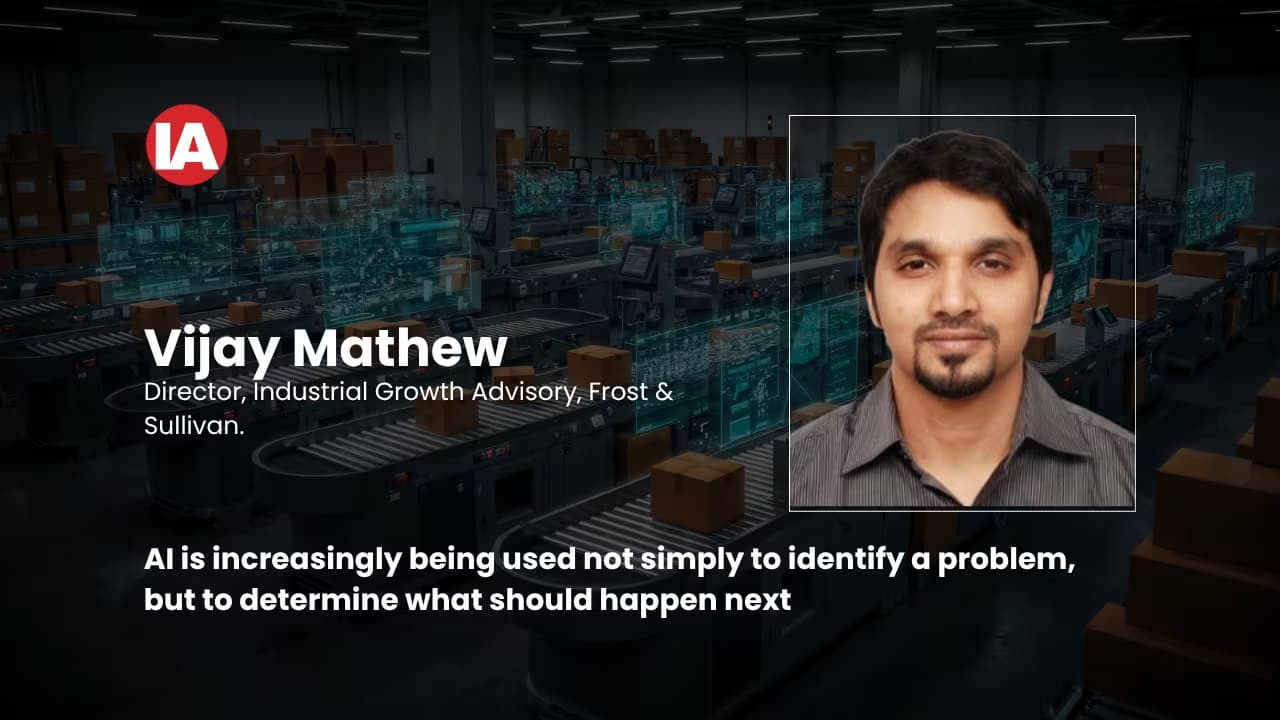
Supply-chain technology is entering a period in which the distinction between digital decisions and physical operations is getting blurred, says Vijay Mathew.
For much of the past decade, supply-chain digitalisation focused on visibility. Companies invested in dashboards, control towers, warehouse management systems and track-and-trace platforms to understand where inventory was, where an order had been delayed, or where capacity was constrained.

Image source: Daifuku
The next phase will be different. Artificial intelligence is increasingly being used not simply to identify a problem, but to determine what should happen next. A demand change can trigger an inventory decision, a supplier delay can initiate a revised production plan, and changing order priorities can alter how people, robots and inventory are deployed inside a warehouse.
Supply chains have traditionally been managed through a series of planning and execution layers that operate at different speeds. Demand planning may happen weekly or monthly, production scheduling more frequently, while warehouses and transport networks make thousands of decisions every hour. AI has the potential to connect these layers more closely and reduce the time between identifying a change and responding to it.
Warehouse automation is evolving in parallel. The market is moving beyond conveyors, fixed automated storage systems and standalone robots toward flexible fleets, robotic picking, machine vision and software platforms capable of continuously coordinating equipment, workers and inventory. The longer-term opportunity lies in bringing these two developments together: an intelligent supply chain that can sense changes, make decisions and translate them into physical action.
The market is scaling across both software and physical automation
The investment opportunity extends across several related markets. Frost & Sullivan analysis places the global warehouse automation market, including automated storage and retrieval systems (AS/RS), conveyors and sortation, mobile robots, robotic picking, warehouse execution software and associated integration, at approximately USD 30 billion in 2025. The market could reach approximately USD 60 billion by 2030, supported by e-commerce, labor constraints, SKU proliferation and increasing pressure for faster fulfillment.
Within this market, flexible automation is growing particularly quickly. Frost & Sullivan analysis estimates that autonomous mobile robots (AMRs), automated guided vehicles (AGVs) and robotic picking collectively represented an approximately USD 10 billion opportunity in 2025, potentially increasing to USD 22 billion by 2030.
A parallel opportunity is developing in the software layer. Supply-chain planning, visibility, orchestration and AI-enabled execution software represented an estimated USD 25 billion global market in 2025. Boundaries between these categories are increasingly fluid as planning providers move into execution and warehouse automation companies build more sophisticated orchestration software.
What an AI-powered supply chain really means

Image source: AutoStore
The most useful way to understand AI in supply chains is not as a single application, but as a decision layer spanning multiple functions.
At the planning level, machine-learning models can improve demand sensing by incorporating a wider range of signals than conventional forecasting methods. Inventory models can evaluate the impact of changing demand, lead times and service levels across multiple locations. Production-planning applications can continuously assess capacity and material constraints, while transportation systems can dynamically adjust routing and shipment priorities.
Generative and agentic AI add another layer. Instead of requiring a planner to navigate multiple applications and manually investigate an exception, an AI agent can potentially identify the problem, evaluate alternatives, explain the trade-offs and initiate a workflow. The important change is therefore not the conversational interface. It is the movement from analytics that describe a supply chain toward systems that participate in decision-making.
In 2025, Kinaxis launched Maestro Agents, embedding context-aware AI agents within its Maestro supply-chain orchestration platform. The company has subsequently been working with NVIDIA on the concept of longer-running agents capable of repeatedly evaluating scenarios and optimisation models as conditions change rather than producing a single recommendation.
Manhattan Associates is moving in a similar direction. The company introduced agentic AI capabilities across Manhattan Active in 2025 and launched Agent Foundry to allow customers and partners to build specialised agents. In May 2026, it extended this approach through Manhattan Marketplace, where customers will be able to deploy agents and extensions developed across its ecosystem.
The competitive question for supply-chain software providers is shifting from who provides the best dashboard to who can most reliably connect prediction, optimisation and execution.
A software problem as much as a hardware problem
Traditional warehouse automation was largely deterministic. Conveyors followed predefined routes, AS/RS systems operated within fixed structures, and equipment was designed around relatively stable volumes and product flows.
That model remains highly effective for predictable, high-throughput environments. However, modern warehouses increasingly need to handle changing SKU mixes, volatile order profiles, shorter delivery windows and multiple fulfillment channels from the same facility. This is increasing demand for automation that can be reconfigured through software rather than through major physical modifications.
AMRs are an important part of this shift because routes and fleet sizes can be modified more easily than fixed conveyor infrastructure. But simply adding robots does not create an intelligent warehouse. As facilities deploy different forms of automation, the challenge becomes deciding which task should be executed by which resource at any given moment.
This is why warehouse execution and orchestration software is becoming increasingly important. These platforms sit between higher-level warehouse management systems and physical automation, dynamically allocating tasks across robots, conveyors, workstations and people.
AutoStore's recent product direction illustrates the transition. In March 2025, the company introduced CarouselAI, an AI-powered robotic piece-picking system, alongside VersaPort and an expanded software suite. In 2026, it went further with CubeVerse, a cloud platform that brings together system design, operational data, analytics and AI. AutoStore Intelligence uses more than 20 proprietary models for applications including robot-flow optimisation, congestion reduction and predictive analytics.
The architecture of the automated warehouse is consequently changing. The value is gradually shifting from individual machines toward the intelligence that coordinates the entire system.
Physical AI is expanding the tasks that warehouses can automate
One of the persistent limitations of warehouse robotics has been the physical variability of the environment. Moving a pallet along a predictable route is relatively straightforward. Picking thousands of products with different shapes, surfaces, weights and packaging characteristics is considerably harder.
Advances in computer vision, sensing, foundation models and robotic control are beginning to address this gap.
In 2025, Amazon introduced Vulcan, its first robot capable of using force and touch sensing when manipulating items inside storage pods. Amazon also passed the milestone of deploying its one-millionth robot across more than 300 facilities and introduced DeepFleet,
a generative AI foundation model designed to coordinate robot movements across fulfilment centres. Amazon says DeepFleet can improve robot travel efficiency by approximately 10%.
These developments demonstrate where physical AI is likely to create value first. The immediate opportunity is less about replacing an entire warehouse workforce with humanoid robots and more about automating individual tasks that conventional robotics could not reliably perform.
Technical improvements to the robots themselves also matter. Symbotic announced in 2025 that it would introduce Nyobolt battery technology into its SymBot mobile robots. The new power system provides six times the energy capacity of the ultracapacitors previously used while being 40% lighter, allowing robots to operate for longer between charges.
These advances may appear incremental individually, but collectively they change warehouse economics by increasing utilisation, reducing idle time and expanding the number of processes that can be automated.
An automation market and a technology development base
India presents a different automation environment from mature markets. Labor economics remain less favorable to full automation in many conventional warehouses, while facilities can be highly heterogeneous and capital budgets constrained. This makes the business case for large, fixed automation systems more selective.
At the same time, several parts of the Indian economy are creating unusually demanding logistics requirements. Quick commerce requires very high order-processing speeds from relatively compact fulfillment locations. E-commerce and organised retail is increasing SKU complexity. Automotive, electronics, pharmaceuticals and other manufacturing industries require increasingly sophisticated intralogistics, traceability and inventory control.
This is favoring modular automation and locally engineered solutions. Noida-headquartered Addverb is one example of India's developing robotics ecosystem. The company introduced Trakr 2.0, the Brisk picking robot and HOCA, a system specifically designed for fast fulfillment in space-constrained quick-commerce environments. In 2026, Addverb also highlighted the development of Elixis-W, its made-in-India wheeled humanoid platform, as part of a broader move into physical AI.
India's public logistics infrastructure is also becoming more digital. Under the National Logistics Policy, the Unified Logistics Interface Platform has connected logistics data across government systems to enable greater shipment visibility and information exchange. By August 2025, ULIP had facilitated more than 160 crore digital transactions.
More importantly for warehouse automation, the Central Warehousing Corporation introduced a Smart EXIM Warehouse System in 2025 incorporating AI, IoT, FASTag, OCR/ANPR and GNSS. Applications include automated gate processing, digital-twin-based yard management and real-time inventory management integrated with ERP and WMS systems.
Research capabilities are developing alongside deployment. FedEx and IIT Madras established the SMART Centre in 2025 with a five-year USD 5 million grant to research areas including predictive analytics, autonomous delivery, warehouse automation and sustainable logistics.
The opportunity for India therefore extends beyond importing warehouse automation. There is potential to develop robotics, control software, AI models, system integration and engineering services that can eventually address other cost-sensitive and brownfield-heavy markets globally.
Conclusion
Supply-chain technology is entering a period in which the distinction between digital decisions and physical operations will become increasingly difficult to maintain.
Over the next five years, the most valuable platforms are likely to be those capable of operating across this boundary. AI agents will move beyond answering planner questions toward continuously evaluating supply, demand and inventory trade-offs. Warehouse software will increasingly coordinate mixed fleets of robots and conventional automation. Robotics will expand into tasks that require greater perception and dexterity, while simulation and digital twins will allow companies to test changes before deploying them physically.
This will also change the economics of automation. Historically, warehouse automation favoured very large facilities with stable volumes because projects required significant upfront engineering and fixed infrastructure. Modular robotics, cloud software and AI-driven orchestration can progressively extend automation to smaller facilities and brownfield operations where flexibility matters more than maximum throughput.
The ultimate objective is not an autonomous warehouse or an AI-generated forecast. It is a supply chain that can detect change earlier, understand the consequences across the network and execute the right response faster. The companies that close that loop between signal, decision and physical action will define the next generation of supply-chain automation.
Vijay Mathew is Director, Industrial Growth Advisory, at Frost & Sullivan. With over 18 years of experience, Vijay is a seasoned advisor known for providing strategic, unbiased, and objective advisory services across a variety of industries. His areas of expertise include automation, process control, industrial sensors and instrumentation, and electronic test and measurement. Always on the forefront of technological evolution, Vijay is committed to tracking and understanding the latest trends in Industry 4.0, data analytics, predictive maintenance, smart factories, and blockchain technologies.