The smart warehouse is not a collection of individual technologies, but as an orchestrated intelligent system
AI is transforming smart warehouses with predictive inventory management, robotics, digital twins and intelligent supply-chain execution.
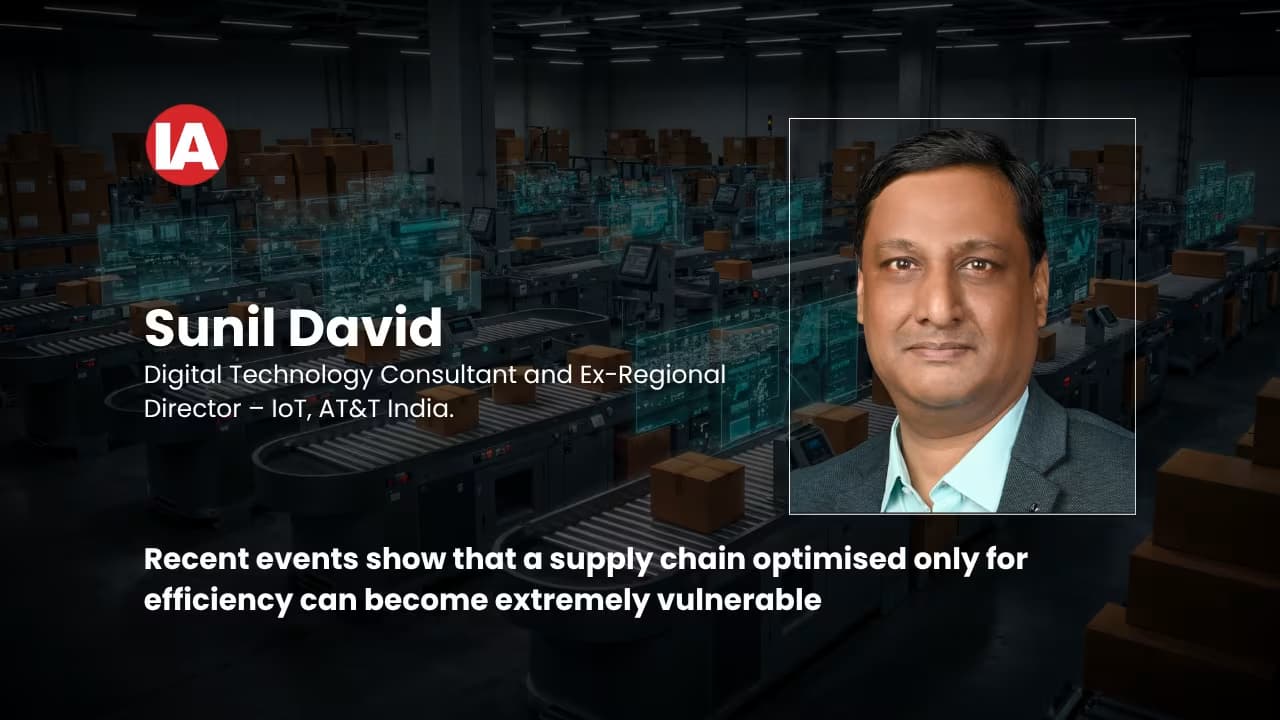
Sunil David, Digital Technology Consultant and Ex-Regional Director – IoT, AT&T India.
Artificial Intelligence is rapidly reshaping supply chain operations. Which areas – from demand forecasting and inventory optimisation to procurement and logistics planning – are witnessing the most significant impact, and why?
AI is having its most significant impact across demand forecasting, inventory optimisation, procurement, transport planning and warehouse execution, because these are all areas where decisions depend on large volumes of constantly changing data.
Traditional demand forecasting relied heavily on historical sales and periodic planning cycles. AI and ML models can now combine historical demand with promotions, weather patterns, economic indicators, market signals, supplier performance and real-time customer behaviour. This enables organisations to forecast demand at a much more granular level and respond much faster to changing conditions.
In procurement, AI can identify supplier risks, analyse pricing trends, detect contract anomalies and evaluate alternative sourcing scenarios. In logistics, it can dynamically optimise transportation routes, loads, delivery schedules and distribution decisions instead of relying on static planning.
This capability has become particularly important because supply chains today are exposed to geopolitical and economic risks that can change very quickly. Disruptions in the Red Sea, concerns around the Strait of Hormuz, tariff uncertainty, commodity-price fluctuations and the concentration of critical minerals in a few countries are forcing companies to rethink their sourcing and logistics strategies.
For example, China continues to dominate several areas of critical-mineral refining and rare-earth processing. Organisations therefore need visibility not only into Tier-1 suppliers but increasingly into their extended supplier ecosystems. AI is consequently moving beyond simple cost optimisation. It is becoming an important tool for scenario planning, supplier diversification, risk management and supply-chain resilience.
AI-powered machine learning models can analyse vast volumes of historical and real-time data. How are these capabilities improving inventory accuracy, reducing stockouts, and enabling more responsive warehouse operations?
The fundamental shift is from inventory visibility to predictive inventory management.
RFID tags, Blue-tooth beacons, IoT sensors, Warehouse Management Systems, ERP systems, Computer vision and order data can provide organisations with a near-real-time picture of inventory – what is available, where it is located, how quickly it is moving and what is likely to be required next.
ML models can then analyse demand volatility, supplier lead times, product criticality, seasonality, margins and historical consumption patterns to recommend more intelligent stocking policies.
Rather than maintaining the same safety-stock philosophy across all SKUs, companies can dynamically decide where additional buffer inventory is necessary and where inventory can safely be reduced.
AI can also identify inventory discrepancies, slow-moving items and unusual consumption patterns much earlier, reducing the chances of both stockouts and overstocking.
A good Indian example is Delhivery, which has invested extensively in automated sortation, Machine vision and algorithm-driven logistics operations. By March 2025, the company reported operating 45 fully or semi-automated sortation centres, with rated automated sorting capacity of 8.2 million shipments per day. Such platforms demonstrate how data, automation and algorithms can work together to improve throughput and operational responsiveness at very large scale.
For Indian manufacturers and logistics organisations, this is particularly relevant because better inventory intelligence reduces not only warehousing costs but also working-capital requirements.
Modern warehouses are increasingly deploying AI alongside robotics, autonomous mobile robots (AMRs), computer vision, and automated storage and retrieval systems (AS/RS). How do these technologies work together to accelerate order fulfilment while maintaining accuracy and flexibility?
The smart warehouse should be viewed not as a collection of individual technologies, but as an orchestrated intelligent system. AS/RS solutions enable high-speed and high-density storage and retrieval. AMRs dynamically move products, pallets or totes across warehouses without requiring fixed tracks. Robotic arms can pick, sort and palletise products, while computer vision verifies items, reads labels, detects defects and improves quality control. AI becomes the intelligence or orchestration layer connecting these technologies. It can determine which task should be performed, which robot or system should execute it, and in what sequence. This dramatically improves throughput while preserving flexibility.
Traditional warehouse automation was often highly fixed. Modern AMRs can be redeployed as warehouse layouts, volumes or fulfilment requirements change, making automation more adaptable during peak demand periods. A compelling global example is Amazon, which announced the deployment of its one-millionth warehouse robot in 2025. Amazon has also introduced DeepFleet, a Generative-AI foundation model intended to improve coordination across its robotic fleet and reduce robot travel time.
Another interesting development is Amazon’s Vulcan robot, which combines vision with force and touch sensing. This represents the emerging world of Physical AI, where robots increasingly sense and learn from their environment, understand physical interaction and adjust their behaviour rather than simply repeating pre-programmed movements. This convergence of Robotics and AI will be extremely important for future warehouses.
Supply chains today face frequent disruptions caused by geopolitical events, extreme weather, and fluctuating customer demand. How can AI-driven predictive analytics help organisations anticipate risks, improve resilience, and make faster operational decisions?
This is perhaps where AI is becoming strategically most valuable. For many years, supply-chain strategies were built around efficiency, lean operations, lowest-cost sourcing and just-in-time inventory. Recent disruptions have demonstrated that a supply chain optimised only for efficiency can become extremely vulnerable. Organisations now have to balance efficiency with resilience.
AI-powered predictive analytics can continuously analyse supplier performance, shipment movements, port congestion, extreme-weather alerts, commodity prices, freight rates, political developments and changing customer demand. The objective is to detect signals of disruption before they become major operational problems. For example, if an important shipping corridor becomes disrupted, AI can assess which shipments and customer orders could be affected, identify alternate routes, estimate additional transportation cost and lead time, and recommend inventory repositioning.
Similarly, if a supplier located in a particular geography is exposed to geopolitical or commodity risk, AI can help organisations assess alternate suppliers and model the impact of switching. Digital twins can further strengthen resilience. By creating a Digital representation of the end-to-end supply chain, organisations can simulate events such as a port closure, supplier failure, sudden tariff change or major demand spike before making changes in the physical supply chain. In this sense, the traditional supply-chain control tower is evolving. It is moving from being a dashboard that explains what has happened to an intelligent decision platform that recommends what should happen next.
Despite the growing adoption of AI, many organisations still struggle with fragmented data, legacy systems, and workforce readiness. What are the biggest challenges in implementing AI-enabled supply chain and warehouse solutions, and how can companies overcome them?
The biggest challenge is often not AI itself. It is Data readiness and integration with complex legacy systems. Many organisations have fragmented ERP, WMS, transportation, supplier and shop-floor systems. Poor master data, inconsistent SKU definitions and disconnected legacy systems make it difficult for AI models to generate reliable insights.
Companies therefore need to start by creating a trusted data foundation and improving integration between operational technology and enterprise IT systems. A second challenge is adopting AI without a clearly defined business problem. Organisations should begin with use cases tied to measurable outcomes such as:
- forecast accuracy
- reduction in stockouts
- inventory turns
- picking accuracy
- order-cycle time
- truck turnaround time
- warehouse throughput, and
- cost per shipment.
AI adoption should be driven by business outcomes rather than technology experimentation alone. Legacy equipment is another important issue, particularly in India where many warehouses and factories operate with equipment from different generations. APIs, middleware, IoT gateways and modular automation can allow organisations to modernise progressively without completely replacing existing infrastructure. Cybersecurity and AI governance also need to be embedded from the beginning because greater connectivity inevitably increases the attack surface.
Finally, workforce readiness is critical. AI and robotics will change jobs, but they will also create new requirements around robot supervision, analytics, maintenance, exception handling and intelligent decision-making. The most successful organisations will therefore combine automation with human-in-the-loop operating models and continuous workforce upskilling.
Looking ahead, how do you envision AI transforming supply chains over the next five years? Which emerging technologies – such as generative AI, digital twins, agentic AI, or autonomous decision-making – will have the greatest impact on warehouse automation and end-to-end supply chain performance?
Over the next five years, I believe we will see a fundamental transition from AI that informs decisions to AI that increasingly participates in and executes decisions.Generative AI will make supply-chain intelligence much easier to access. Managers will increasingly interact with complex enterprise systems using natural language.
For example, a supply-chain leader may simply ask: “Which suppliers are most exposed to the current disruption, which customer orders could be affected, and what alternatives do we have?”
AI will bring together information from procurement, logistics, inventory and supplier systems and provide an integrated response.
Digital Twins will become increasingly important for continuous scenario modelling and optimisation. Physical AI will make warehouse robots more intelligent and adaptive, enabling them to sense, learn and adjust to changing environments. However, I believe Agentic AI could ultimately have one of the biggest impacts.
AI agents will increasingly be capable of executing multi-step supply-chain workflows. An agent could monitor inventory levels, identify an emerging shortage, assess alternative suppliers, compare lead times and costs, determine potential business impact and initiate procurement or logistics workflows within predefined organisational guardrails. This is the beginning of what could become increasingly autonomous supply chains. For India, this transformation presents an enormous opportunity.
India is rapidly expanding its manufacturing base and positioning itself as an important alternative and complementary global manufacturing destination. Initiatives such as PM GatiShakti, the National Logistics Policy and the Unified Logistics Interface Platform (ULIP) are creating a stronger digital and multimodal logistics foundation.
The latest DPIIT–NCAER assessment puts India’s logistics cost at approximately 7.97% of GDP, lower than the older 13-14% figure that is still frequently cited. However, logistics efficiency remains a major competitiveness issue, particularly for smaller companies that continue to face disproportionately high costs. AI, automation and digital logistics therefore have an important role to play in improving India's manufacturing competitiveness.
Ultimately, however, the objective should not be automation for automation’s sake. The competitive advantage will come from creating supply chains that are visible, connected, predictive, adaptive and resilient. In a world where the next disruption may originate from a shipping corridor, tariff decision, weather event, commodity shock or critical-mineral restriction, the smartest supply chain will not necessarily be the one that predicts every disruption. It will be the one that senses change early, understands its implications and responds faster than the competition.
(The views expressed in interviews are personal, not necessarily of the organisations represented.)
Sunil David is an Independent Digital Technology Consultant with 30 years of experience in the IT and Telecom Industry. He is currently empanelled as an Independent Consultant in the Manufacturing and Process Control Practice Area with Frost and Sullivan India, one of the top Global 10 Research, Consulting and Strategy firms. He also consults an IoT and AI based Technology solutions firm, Flamenco Technologies in their Go to Market strategy, Branding initiatives and building of their partner ecosystem. Flamenco solutions address use cases around Connected Manufacturing, Digital Supply Chain and Technology Enabled Sustainability solutions. Sunil is also a Mentor to T-Hub (Telangana Hub), one of the largest startup Incubators in India supporting some of the most innovative startups.
Sunil, an alumnus of Symbiosis Institute of Management Studies, Pune (Post Graduate Diploma in Business Administration with specialisation in Marketing) spent almost 20 years with AT&T India. In his last stint with AT&T, Sunil was the Regional Director – IoT (India and ASEAN). Sunil has had extensive experience in Business Strategy, Sales, Business Development and Alliance & Partnership building during his AT&T stints.
He is a very frequent speaker having spoken at more than 300 Industry forums both in India and abroad (organised CII, NASSCOM, ASSOCHAM, IET, PHD Chamber of Commerce, The Economic Times, etc), and leading Educational Institutions (IIT Madras, IIT Delhi, IIM Shillong, IIT Jammu, Symbiosis Institute of Telecom Management, ISB Hyderabad, etc., to name a few) on topics related to IoT, AI, 5G, Digital Transformation, Industry 4.0, Gen AI, Metaverse, Future of
Work, Cybersecurity, etc. Sunil also has been invited by leading business TV channels ET NOW and CNBC TV 18 to comment on topics related to India’s 5G rollout and adoption, the Telecom Act 2023, etc. He has been a recipient of a number of Awards and Recognitions (17 in total) from various Industry bodies and Media conglomerates in recognition for his work in Digital Technology Advocacy, Digital Skilling initiatives for Women and Startup Corporate connect (notable among them being – AsiaOne, one of Asia’s largest media conglomerates – India’s Fastest Growing Leader given in Bangkok in 2020, India’s Fastest Growing Digital Evangelist in 2021 and India's Fastest Growing Technology for Change Champion Award in 2023. Some of the other notable awards won being Top 50 Most Influential Digital Marketing Leaders in 2017 and India’s Most Influential Digital Marketing Leaders in 2022 conferred by World Marketing Congress and India’s Most Dynamic Leader given by Global Triumph Foundation in 2023.
NASSCOM Foundation and IBM India have planted trees in Sunil’s name for his contribution towards Digital skilling of women and efforts to advocate AI importance in India. He has also written a number of articles on topics related to Cybersecurity, Digital Transformation, Metaverse, IoT, 5G, etc., for leading business publications and technology focused websites.
Sunil is also affiliated with a number of Industry bodies and is a key member of the CII CTO Forum, CII National AI Forum, CII Northern Region Digital Transformation Committee, CII Southern Region Taskforce for Technology and Digital Transformation, CII Inst of Logistics, NASSCOM Foundation, IET Digital Communications Working group, Indo American Chamber of Commerce, etc., working on a number of National initiatives around Digital Skilling, Digital Technology awareness and advocacy, MSME Digital Transformation, Sustainability and ESG, Startup – Corporate Connect, etc.