AI will not replace human expertise on the factory floor; it will increasingly augment it
AVEVA highlights how AI and trusted industrial data can augment human expertise and drive smarter, more resilient operations.
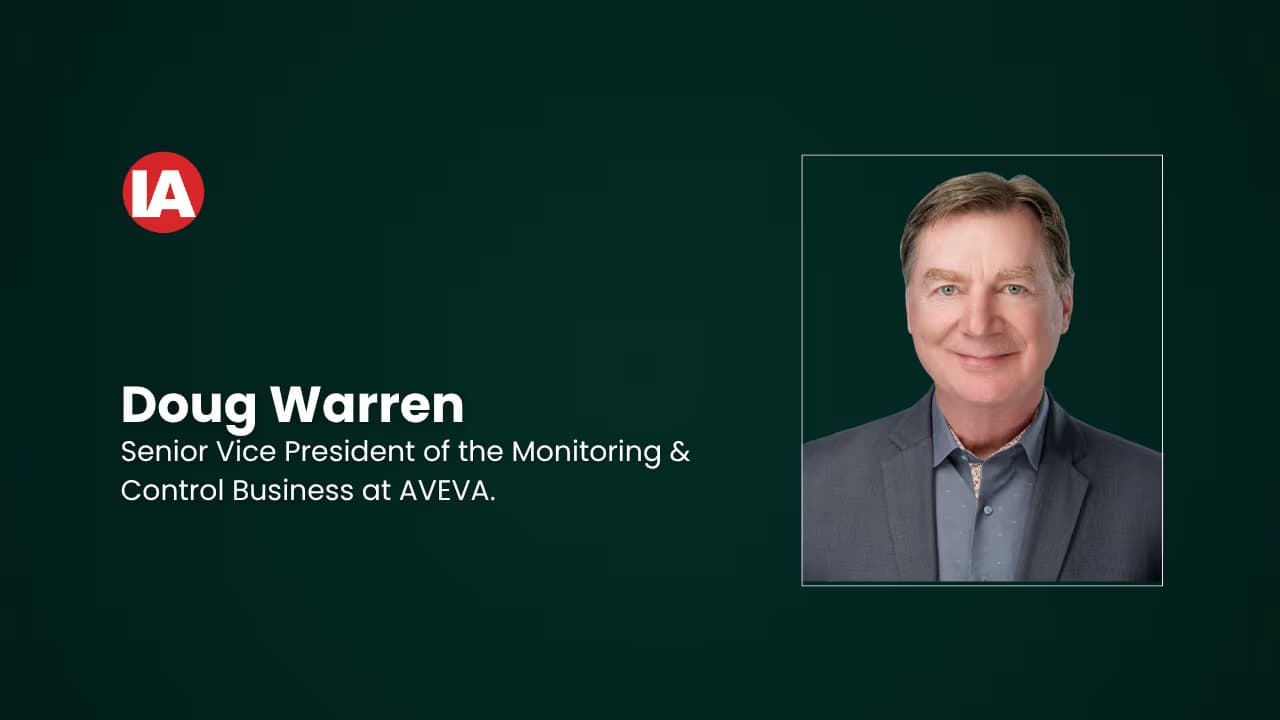
Doug Warren, Senior Vice President of the Monitoring & Control Business at AVEVA.
Industrial organisations have spent years collecting data from machines, processes and enterprise systems. What, in your view, is preventing many companies from turning this vast data resource into actionable intelligence, and how is AVEVA helping customers move from dashboards and analytics to AI-driven decisions and measurable operational action?

The primary barrier organisations face is that industrial data is typically fragmented and siloed across IT, OT, and ET systems. Without unifying this information, the raw data lacks the semantic context required for AI to truly understand the logic and relationships behind it. Because industrial environments are highly complex and often regulated , companies cannot rely on raw data alone, they require trusted data deeply integrated with operational context and technical domain expertise. At AVEVA, we overcome this hurdle through our "Pragmatic AI" approach, focusing on delivering tangible, real-world business outcomes safely and securely. We help customers move from basic analytics to measurable action primarily through CONNECT, our industrial intelligence platform that bridges data silos to transform raw information into trusted action. We combine this unified data with living digital twins, where AI agents automatically model and contextualise assets. Additionally, our AI-enriched HMI and SCADA solutions provide operators with the situational awareness needed to detect anomalies and respond faster. Ultimately, this closed-loop activation allows organisations to progress from mere assisted insight to accountable, AI-driven action governed by strict physical constraints. We measure success not by the sophistication of the AI, but by outcomes such as improved efficiency, reliability, safety, resilience and sustainability.
There is growing interest in industrial AI, but experimentation and production deployment are two very different things. What needs to change for organisations to move AI out of the sandbox and into day-to-day operations, and where are you seeing the most successful real-world applications today?
The transition from experimentation to production requires organisations to treat AI as an operational capability rather than a standalone technology project. That starts with a trusted data foundation, clear business outcomes and the right operational context. AI also needs to be embedded into existing workflows, with security, governance, validation and human oversight essential in high-stakes environments.
At AVEVA, our approach is deliberately outcome-led. Through CONNECT and our broader portfolio, we help organisations contextualise industrial data and apply AI across engineering, operations and maintenance, moving from insight to operational action.
We are seeing this across different industries. In India, Kohima Smart City used AVEVA’s Unified Operations Center to bring disparate municipal services and data together, delivering approximately 20% energy savings and 40% higher operational efficiency, with KPIs and notifications enabling corrective action. In chemicals, ISU Chemicals combined machine learning with physics-based simulation to predict reactor yield with 99.7% accuracy, enabling faster operational decisions. And in power, Duke Energy uses predictive analytics to centrally monitor generating assets, one early warning event alone avoided more than $34 million in costs.
These examples show that successful industrial AI is ultimately about measurable operational outcomes and not simply deploying AI technology.
How do you see AI changing the human-machine relationship on the factory floor, and what role will contextualised information and AI copilots play in helping employees make faster and smarter decisions?
AI will not replace human expertise on the factory floor; it will increasingly augment it. The opportunity is to give employees the right information, in the right context, at the right time, enabling faster and more informed decisions.
Today, operators and engineers can be overwhelmed by data from multiple systems, dashboards and alerts. Contextualised information connects operational data with engineering knowledge, asset information and process conditions, helping AI move beyond identifying what is happening to explain why it is happening, what could happen next and what action should be considered.
AI copilots will play an important role in this evolution. At AVEVA, we see domain-fluent AI working alongside employees as an interactive thought partner, providing recommendations, guided troubleshooting and insights while keeping experts in control.
The human-machine relationship will become more collaborative, with AI handling more analysis while people provide judgement, experience and accountability. The goal is not to remove humans from the loop, but to make their expertise more powerful and actionable. This becomes increasingly critical as the average employee tenure naturally reduces.
How can organisations pursue smart modernisation without a costly ‘rip and replace’ approach, and what role do open architectures and software-defined capabilities play in extending the life and value of existing assets?
Smart modernisation does not have to mean starting again. For most industrial organisations, the better approach is to build on existing investments and modernise progressively, adding new digital capabilities where they can deliver the greatest value while keeping proven operational systems in place. AVEVA’s own guidance emphasises that digital change should be graduated rather than a “rip-and-replace” exercise.
Open and vendor-neutral architectures are central to this approach. They allow organisations to connect legacy and modern equipment, third-party systems and new applications, creating a common digital layer without having to replace functioning assets. CONNECT, for example, is designed to integrate information, real-time data, processes and people across heterogeneous industrial environments, while supporting hybrid architectures.
Software-defined capabilities take this a step further by separating new functionality from the underlying hardware. Organisations can introduce capabilities such as advanced analytics, AI, visualisation and monitoring through software while allowing existing control infrastructure to continue operating. This protects previous investments while creating a pathway to modernisation.
We are already seeing this model work in practice. AVEVA has helped organisations modernise brownfield facilities through digital twins and connected data, with the objective of extending asset life and improving efficiency without the cost and disruption of rebuilding the plant.
The goal is not to replace what works, but to make existing assets more intelligent, connected and valuable over time.
What does digital resilience mean for an industrial organisation today – from operational continuity and cybersecurity to data availability and workforce capability – and where do you see the biggest gaps that Indian companies need to address?
Digital resilience today means much more than protecting systems from cyber threats. It is about an organisation’s ability to keep operations safe and productive through disruption, while continuously adapting and improving. That requires resilient infrastructure, secure IT/OT environments, reliable access to industrial data and a workforce equipped with the information and tools needed to make decisions quickly.
For industrial organisations, one of the biggest gaps is still the disconnect between systems, data and people. Many companies have accumulated significant amounts of operational data but struggle to make it consistently available, contextualised and actionable across the enterprise. AVEVA’s approach is to create a trusted data foundation that connects engineering, operations and enterprise information, while maintaining the security and governance required for critical environments.
For Indian companies, I see data fragmentation, IT/OT integration, cybersecurity and workforce capability as important areas of focus as industrial digitalisation accelerates. AVEVA’s recent expansion of CONNECT in India, including partnerships with Deccan Fine Chemicals, Reliance Power and VJTI, reflects the importance of building secure industrial data ecosystems while developing a future-ready talent pool.
The resilience comes from connecting trusted data, industrial context, technology and human expertise. When employees can access validated, real-time information and AI-assisted insights securely, organisations can respond faster to disruption and build more adaptable, sustainable operations.
How should industrial organisations measure the true RoI of AI and digital transformation, and what KPIs do you believe should determine whether a project moves from pilot to enterprise-wide deployment?
The true RoI of AI and digital transformation should be measured by the operational and business outcomes they create, rather than simply by the technology deployed or the number of AI use cases implemented. Organisations should establish a clear baseline before starting and then track whether the solution delivers sustained improvements against those metrics.
The KPIs will vary by use case, but I would look at measures such as uptime, asset reliability, production throughput, first-pass yield, quality, energy consumption, operating costs and sustainability performance. For example, AVEVA Advanced Analytics deployments have delivered up to a 12% increase in equipment uptime, an average 4% reduction in energy consumption and, in some cases, a tenfold RoI within the first year.
However, RoI is only one part of the equation. Before moving from pilot to enterprise deployment, organisations should also ask whether the underlying data is trusted and contextualised, whether the AI can integrate with existing systems and workflows, and whether employees are actually using its insights to make better decisions. AVEVA’s approach is built around connecting industrial data with context and applying AI to actionable use cases.
Lastly, I would move an AI project beyond the pilot stage when it demonstrates repeatable business value, measurable operational impact, user adoption and the ability to scale securely across sites. The strongest projects are those where AI becomes part of everyday operations and continuously improves performance and not simply a technology demonstration.
AVEVA has developed a highly capable network of IT and OT partners collaborating through the AVEVA CONNECT platform to co-create localised Industry 4.0 solutions and contextualise AVEVA software on real factory floors. How important is this ecosystem approach to scaling digital transformation, and what capabilities do you expect partners to bring to the next phase of industrial AI?
The ecosystem approach is fundamental to scaling industrial digital transformation because no single technology provider can address the complexity of every plant, process and market. Partners bring the local industry knowledge, implementation expertise and complementary technologies needed to translate a common digital platform into solutions that work in real-world operating environments. AVEVA’s CONNECT ecosystem brings together technology partners, developers and integrators to build applications and services around data management, analytics and AI.
In India, we have seen the value of this model through partnerships such as the Tech Mahindra Center of Excellence in Pune, which combines AVEVA’s industrial software expertise with Tech Mahindra’s Industry 4.0 and process-manufacturing capabilities to develop sector-specific solutions.
As industrial AI matures, we expect partners to bring three things; deep domain and operational expertise, strong IT/OT integration capabilities, and the ability to develop secure, scalable AI applications and agents. Just as importantly, they need to understand how to use our tools to contextualise industrial data and embed AI into existing workflows. The next phase will be less about isolated AI tools and more about collaborative ecosystems that turn trusted data and intelligence into measurable operational outcomes.
AVEVA's partner-centric strategy goes beyond technology implementation to combine global software capabilities with local industry knowledge and application expertise. How do you see this helping address the diverse requirements of Indian industries while accelerating the transition from digital experimentation to sustained operational value?
AVEVA’s partner-centric approach is critical to helping Indian industries move from digital experimentation to sustained operational value. India’s industrial landscape is highly diverse, with different sectors, operating environments and levels of digital maturity. Combining AVEVA’s global software capabilities with partners’ local industry knowledge, integration expertise and understanding of customer requirements allows solutions to be adapted to these specific realities. AVEVA’s Partner Ecosystem brings together thousands of organisations with technology, industry and geographic expertise to address customers’ unique needs.
We are seeing this model through our collaboration with HPCL-Mittal Energy Limited (HMEL) in India. AVEVA and HMEL are exploring a Centre of Excellence and next-generation Refinery Command Centre, combining AVEVA’s digital technologies with HMEL’s deep refining and petrochemical expertise. The collaboration covers real-time operational intelligence, process optimisation, predictive maintenance and supply-chain enhancement.
As AI adoption accelerates, partners will be increasingly important in contextualising industrial data, integrating AI into existing workflows and developing secure, scalable applications for specific operational challenges. This combination of global technology and local expertise can help organisations move from pilots to repeatable, measurable outcomes.